In the middle of the last Saturday of January, hundreds of people congregated on the frozen Dnipro River for a rave. Under the high noon sun, the world was white: the tall apartment blocks lining the riverbank, the unplowed boardwalk and the flat, snow-covered expanse of ice.
With a citywide curfew in effect, parties in Kyiv have long moved to daytime hours, and with much of the city lacking light and heat, it makes sense to gather outdoors. So adults of different ages, dressed in puffy coats of every color, baggy designer sweatpants and chunky Uggs, had gathered, though there wasn’t much dancing, perhaps because the battery-powered speakers weren’t quite strong enough to blast music through the open air. There was, however, much mingling, some barbecuing, a lot of mulled wine and at least one book burning, of a Russian-language young-adult novel. Kids in snow pants slid down the steep, iced-over bank of the river; when they skidded across the ice, they knocked over a few adults.
After the music ended, as scheduled, at 3 p.m., many of the revelers poured into a cafe overlooking the river. It was a quintessential Kyiv scene: exaggeratedly large wineglasses on sturdy wooden tables, a seafood bar, a display of bottles — impeccable style and a commitment to enjoyment as resistance to the Russian onslaught. But a few minutes after the influx of customers, a waitress announced: “We have no water. I won’t be taking orders.” Seconds later, the electricity went off, taking the music and the lights with it and turning the oyster display cases into dark gray boxes. Most of the customers left. The waiters vanished, too, leaving dirty dishes on many tables. The cafe looked like a movie set after the director shouts “Cut!” and the actors and crew disperse, exhausted.
Kyiv is tired. For most of the four years since Russia began its full-scale invasion of Ukraine, the capital city has insisted on maintaining or restoring its usual vibrant urban life. Theaters have been operating, as have art galleries and museums (although permanent collections have been stowed away in safe locations); universities and secondary schools have continued in-person instruction; electric bikes and scooters have been well maintained; the metro has kept running; and the railroad has served the city like clockwork. The railroad in particular has become a symbol of Ukrainian nezlamnist — invincibility or, literally, unbreakability.
But with Russia’s attacks on Ukrainian energy infrastructure leaving people without light and heat for weeks on end, living a normal life has become untenable. It is probably fair to say that there isn’t a place or a person left in Ukraine who can forget about the war for even a few minutes.
People still try — not to forget, but to continue living the best possible life every minute. After a short while, the waiters at the riverbank cafe returned and cleared the tables. New customers came in. Someone restarted the generator, bringing the lights and the music back. Without running water, the place couldn’t serve food, but there could still be — and there was — drinking. Soon, the sun went down and the giant apartment blocks dissolved into the dark sky. Only a few windows flickered dimly, perhaps with the light of candles, oil lamps or a few battery-powered fixtures.
Feb. 24 marks the fourth anniversary of the full-scale invasion. Four years is a particularly significant milestone for people who, like me, grew up in the Soviet Union, in the eternal shadow of World War II, because four years was the duration of the fight against the Nazis. The number was seared into our minds. Four years in which the Soviets fought what they called the Great Patriotic War. Four years that created the country we lived in — its superpower status, its claim to world moral superiority. Four years of death, displacement, of tens of millions of people being called upon to sacrifice for their country’s war effort. The slogan of those years was “Everything for victory.”
Mila Teshaieva, the photographer I worked with on this article, and I were both raised (she in Kyiv, I in Moscow) by parents who were born during that war. For us and so many people of our generation, the war explained why our grandfathers were absent, our grandmothers hoarded odd objects, our parents had fraught relationships to food, and all of our family members seemed at all times to be in a state of hypervigilance. Most of all, the war explained why none of the plans our grandparents had made for their future ever came true. In our generation, the future, as a category, continued to be suspect.
Growing up, I never questioned the heroism and special status of Soviet society. It was only as an adult that I came to understand that the war, which ended 22 years before I was born, had recast public morality, valorizing single-minded commitment and self-sacrifice above all else — above happiness, human connection, creativity, freedom.
Many Ukrainians — even those born after the country gained independence from Moscow’s rule in 1991 — grew up with much of the same mythology of the Great Patriotic War. Ukraine, which was under German occupation for most of that war, lost some 10 million people. Mila’s surviving grandparents, like mine, celebrated every anniversary of that war’s end but almost never talked about what they had experienced. After the war, the Soviet authorities sent thousands of Ukrainians to the gulag for suspected collaboration with the Germans — in many cases, as what amounted to punishment for surviving the occupation. Ukrainians never forgot that injury. Both of those World War II stories — of the heroism of Ukrainians and of the cruelty of Moscow — inform the way Ukrainians think about the war they are fighting now.
Newer works of history reframe the period as two sides of a coin: German and Soviet occupations of Ukraine, two empires that aimed to enslave Ukrainians — Germany during World War II, the Soviet Union before and after. And yet, the number four has continued to loom large in collective memory. Now Ukraine’s patriotic war, against Russia, has crossed that threshold, with no end in sight. Russia’s offensive appeared to speed up in December. In February, Ukraine recaptured ground, in its most successful counteroffensive in more than two years. But on the whole, the front line has remained largely static for more than three years. Russia’s apparently overwhelming superiority in manpower and military resources didn’t bring about a swift victory, but neither have the resolve of the Ukrainian people and the Western aid they have received proved enough to stop Russia’s aggression.
Whatever lies ahead feels as if it will last forever. Ukrainians have organized their lives accordingly. They are living this war in their work, their social lives, their waking and sleeping hours. It is a fundamental orientation of time, values and social relations that will define many future generations of Ukrainian life.
By any measure, Ukraine is a profoundly different country now than it was four years ago. At the start of the full-scale invasion, excluding regions that were already occupied by Russia, it had a population of perhaps 36 million people, according to Tymofii Brik, a sociologist and the rector of the Kyiv School of Economics. (Other estimates tend to be higher.) Since then, Brik says, six million have been displaced inside the country and some four million — mostly women and children — have left Ukraine. More than 100,000 Ukrainians, troops and civilians, are estimated to have been killed. Millions of people live under occupation in areas Russia controls.
When people were fleeing the Russian offensive in the winter of 2022, squeezing onto overcrowded train cars headed west, few imagined that the war would go on for a long time. Either Russia’s tremendous military might or the West’s firm resolve would dictate a fast resolution, it seemed. But four years after that — and 13 months into the presidency of Donald Trump, who promised to bring the war to an end within 24 hours of his inauguration — there is no safe home for Ukrainian war refugees to return to. And there is less and less reason even to think about it: The people who stayed in Western Europe have adapted to their new homes, and to the separation from those they left behind.
“What kind of relationship can we have, with them over there and me back here?” Taras Viazovchenko said when I asked him about the state of his marriage. He got his wife and two children out of Irpin, one of the Kyiv suburbs then under Russian occupation, on March 3, 2022. The wife and kids live in Switzerland now. He has visited once. “She’s built a life there,” he said. “The kids speak French to each other, and I don’t understand.”
Like many Ukrainians who remained in the country, Viazovchenko has lived several different lives in the past four years — lives that he has shared with his parents and some of his friends, but not with his wife and kids. Before the full-scale invasion, Viazovchenko was a yoga instructor and a member of the Irpin City Council, a position he still holds. During the weeks in 2022 when part of Irpin was occupied, he spent every day helping people escape the town. When Russian troops retreated from the Kyiv region, Viazovchenko joined the effort to identify the bodies of people killed in Irpin and neighboring Bucha, which has become synonymous with Russian war crimes.
People killed during the occupation had been buried in private yards, in group graves, in town parks, often after their bodies were left for days wherever the killing had occurred. Viazovchenko and others exhumed the bodies, interviewed loved ones and witnesses and tried to match remains to descriptions. After several months of this work, Viazovchenko became obsessed. He and his colleagues had been able to identify more than 400 bodies, but several dozen remained. Viazovchenko couldn’t sleep. He couldn’t think of anything else. He kept unzipping the black bags in which the bodies were kept — or what remained of them after several months in morgues that didn’t consistently have electricity.
It took the intervention of visiting mental health professionals for Viazovchenko to get help. He worked on setting up therapy centers for survivors of Russian aggression in different parts of Ukraine. And then last year, at the age of 46, he enlisted. He thinks that everyone should.
To be clear, not everyone agrees. After an initial wave of volunteers immediately after the full-scale invasion, the Ukrainian armed forces have struggled to conscript enough people. People who enlisted four years ago and who are still physically able to serve have been unable to leave the service. Meanwhile, enlistment officers stage daily raids in Ukrainian cities, apprehending potential conscripts and delivering them to military bases. Some escape. At the same time, on this visit in particular, I heard many stories of people who either chose to enlist or submitted to a conscription raid and found peace in the service — and in no longer trying to evade it. Viazovchenko thinks this is as it should be, and that those who cannot serve at the front should join the war effort in the rear. He complained that, after several years of pooling money for the war effort, parents’ groups have resumed collections for gifts and flowers for teachers. That strikes him as frivolous, as does any pretense of peacetime life. As an example of proper, realistic adjustment, he cited the schools of Kharkiv, many of which have permanently moved to underground bunkers.
Underground schools have become symbols of Ukrainian unbreakability, along with warming tents set up in the shadow of unheated high rises. I visited the Kyiv School of Economics, a small, ambitious private university that has managed to draw some outstanding academic talent from both Ukraine and the West. Brik, the rector, excitedly led me to the basement, where the university has created several classrooms, complete with whiteboards. The school schedules only as many classes as can simultaneously convene in the bunker, so that whenever the air-raid alarm sounds, as it does on most days, classes can move down below. Then Brik showed me something else he was proud of: a classroom equipped for a vocational training program, this one in soldering — a skill newly in demand in the growing drone industry.
Most recently, Brik told me, the university had moved dozens of students out of apartment buildings that had lost power and heat and into hotel rooms. I wondered what, with his ingenuity and energy, he would be capable of in peacetime. Russia’s war — a war for the return to an imperial past — has always been a war against Ukraine’s future.
“I imagine that if there were no war, I’d get another Ph.D., in neurobiology,” another acquaintance, Lena Samoilenko, told me. Her first Ph.D. is in mathematics (multidimensional spaces, to be exact). She got it before Russia annexed Crimea and Russian-backed forces occupied the small town in the east where she’d grown up. When that phase of the war began, in 2014, Samoilenko was 28 and living in Kyiv. She started volunteering, helping some people to escape the Russians and others to survive under occupation. She spent many years organizing aid and reporting about the war — and then it came to Kyiv.
“It’s Groundhog Day every day,” she said. “You had your ear to the ground every day, listening for tanks.”
It was only later that night that I realized that it was, in fact, Groundhog Day, Feb. 2. It was also four years to the day since I first wrote about Samoilenko. Back then, I had come to Kyiv — a city I had often visited — to cover its preparations for the Russian invasion. I had sought out Samoilenko because she had written a Facebook post decrying the idea that anyone can adequately prepare for war. While most people she knew were packing go bags and laying in supplies to survive a short-term crisis, Samoilenko was girding herself and her family for a more fundamental change.
In 2022, Samoilenko started to help out in Kherson, a port city in southern Ukraine that spent more than six months under occupation. After Russian troops retreated, remaining residents — a disproportionate number of them poor, older, disabled — needed basic supplies, medicine and care. Samoilenko raised money, recruited volunteers, bought a car and set up shop in a working-class neighborhood of the city. In June 2023, Russian forces apparently blew up the nearby Kakhovka dam, unleashing a deadly flood, which created even more need for Samoilenko’s work. Meanwhile, her marriage ended, and her ex-husband, a poet and musician, joined the military. “Even if he hadn’t joined up, he might have met a younger woman,” Samoilenko said. It’s just that the war has been going on for a long time — long enough for people to fall in and out of love, among other things.
It’s been going on so long that the war itself has changed in profound ways. It started with bomber planes and tanks, but it is continuing primarily with drones — and the drone technology keeps changing. Military personnel have had to train and retrain. So have journalists. On a Sunday afternoon, Mila and I attended a training session for journalists at a former Soviet Young Pioneer camp outside Kyiv. A group of people who became war correspondents four years ago — before that, many of them wrote about politics or social issues, or produced movies — were learning how to detect and avoid drones. They looked for cover, pursued by the devices’ beehive-like hum, but how can you dodge weapons that are capable of turning corners, hovering in wait, and going into open doors and windows? At one point, a journalist dropped to her knees in the snow and yelled: “That’s it! I’m fucked.” The drones made it harder for Samoilenko to continue working in Kherson. She could no longer use the car, because drones would follow the few vehicles traveling the city’s largely deserted back roads, and the distances she needed to cover were too great to travel by foot regularly. So she, too, joined the military. The day we met up, she had been promoted to staff sergeant. “Let’s drink to that,” she said, in a way that made it clear this wasn’t a milestone she’d ever hoped to celebrate.
In her past life, Samoilenko was a prominent figure in Kyiv’s cultural scene. She organized a poetry festival, and she loved to dress up for events. “And I’m spending the last years of my youth in a dimly lit office space with people I wouldn’t ordinarily choose to socialize with.” Like other service members, Samoilenko can’t tell me exactly what she does, but she is based in Kyiv, a couple of hundred miles from the active fighting, which means that she doesn’t get supplemental frontline pay. From her old life, she still has her remote jobs as a consultant, which allow her to rent an apartment near her base, and some floor-length velvet dresses that she keeps in a closet there as something like a talisman. Someday she hopes to wear them again, to travel and to walk by the sea — these are the things she needs to feel happy.
While we talked, Ukrainian, American and Russian representatives continued their endless negotiations — negotiations about negotiations that, Trump kept promising, would bring an end to the war. Meanwhile, 2025 had been the deadliest year for civilians since the war started. The Americans said that Russia had agreed to stop hitting Ukrainian energy infrastructure, for a week. The agreement didn’t hold. “It’s been so cold for the last month that you keep feeling that it must warm up soon,” Samoilenko said. “But there is still February, and March in Kyiv is cold too. There is no reason to think that it will get warmer. And nothing gets easier, even though we’ve been through so much.” Even the catastrophic early days of the full-scale invasion felt more hopeful, she said.
The way we think about the future is also, usually, the way we think about the past. The inescapable sense that this war is forever has compelled Ukrainians to reframe their history — including the history of World War II — as one of eternal war against Russia. I saw and heard this narrative seemingly everywhere on this visit, including in Independence Square in the center of Kyiv, long a site of memorials both permanent and makeshift. For years, these were memorials to revolutions, particularly those of the Orange Revolution of 2004 and the Revolution of Dignity in 2014, for which the square served as the main stage. But the memorials currently on display in the square tell a different story: There is an exhibit devoted to the 1991 protests against the Soviet regime, now reframed as a revolt against Russian imperialism; a permanent memorial to the people who died in 2014, both during the revolution and in the war in the east; and a growing memorial to Ukrainian fighters who have died since 2022, each of them marked with a small Ukrainian flag.
What struck me most about this current memorial is its scale: There is a multitude of flags, but most are tiny, guaranteeing that the memorial can keep expanding for a long time.
Paradoxically, thinking of the war as eternal gives Ukraine some room for negotiating with Russia, and gives Ukrainians a modicum of hope. No one expects the current negotiations to bring permanent peace, but a truce that gives Russia domain over parts of eastern Ukraine may be acceptable when one compares it with the outcome of World War II — the Russian occupation of all of contemporary Ukraine, including lands that had belonged to Poland before that war.
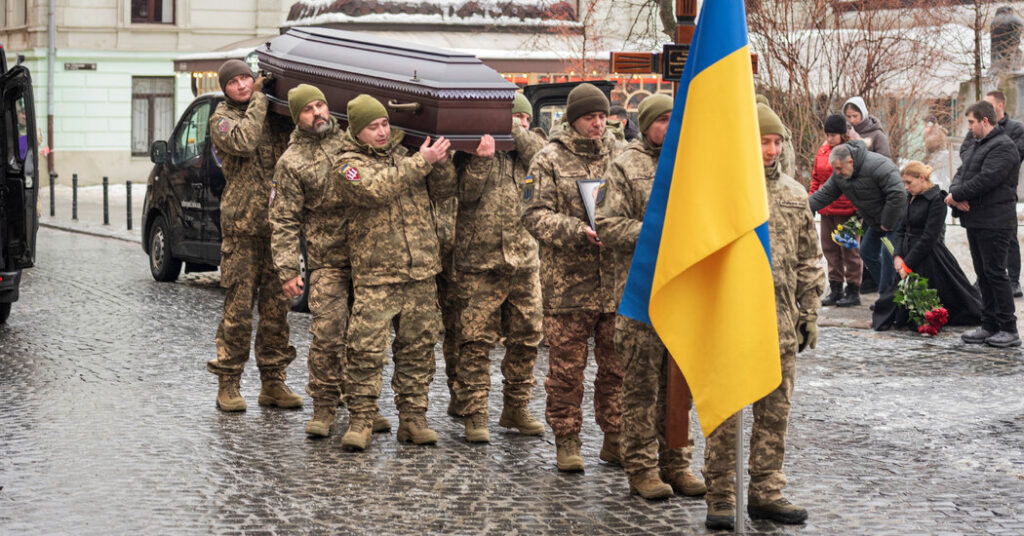
If the war is eternal, it must also be all-encompassing, just as Taras Viazovchenko told me. All of Ukraine is the front. The country’s westernmost major city, Lviv, which has been subjected to only intermittent assault, has transformed itself into a city that visibly lives and breathes the war. A large stand in Market Square, updated every morning at 9, displays the photos and biographies of soldiers who will be buried that day. Typically at 11, cars carrying flag-draped coffins pull up to the Peter and Paul church, one of the largest in the city. A military band assembles in front to play while coffins are loaded back into the vehicles. They are then driven to Market Square, where the mayor of Lviv pays his respects as a trumpeter, dressed in red, plays “Il Silenzio” by Nini Rosso. Every day.
But perhaps the biggest change the war has brought to Lviv is that the city has become a world capital of amputations and prosthetics. Together, centers with names like Unbroken and Superhumans serve thousands of people at a time. In all, some 100,000 Ukrainians are estimated to have lost limbs in this war, so far. At Unbroken, I walked down a hallway filled with photographs and architectural renderings of rehab centers, vocational training schools, new surgical clinics and on and on — that the organization either has recently built or plans to build. At Superhumans, I heard about centers the organization is opening in other cities — including one in Odesa that’s being built partly underground.
These centers are, of course, proud of their work: their technological expertise, their range of rehabilitation services, the speed with which they get people standing and walking and being self-sufficient again. At Superhumans, I interviewed two men who seemed preternaturally cheerful, full of hope for the future; both were fairly newly in love. Each of them was missing both legs above the knee — one because a rocket hit the trench where he was operating a machine gun, the other because an attack caused the loaded drone he was carrying to explode in his hands. This man is also missing one hand.
This war, like the great war before it, has extracted and normalized extraordinary sacrifice. It demands that everyone serve and everyone be a hero. I talked with a lawyer who said he was defending more than 50 of the thousands of people accused of collaborating with the Russians — some, he said, because they didn’t resist occupiers who entered their houses, others because they continued to run businesses under occupation and paid taxes to the occupying authorities.
War poses impossible choices, Samoilenko said — “like, when you are fleeing the advancing Russian troops, whether to force your grandmother, who has dementia, to come with you. And then you have to live with that choice, whatever the decision that you made.”
War turns writers, artists, engineers and house painters into soldiers. “And when people come back from the war, they are going to want to have a say in how the country is run,” Anton Liagusha, chair of the newly formed master’s program in memory studies and public history at the Kyiv School of Economics, told me. “Some of them will be in government. In the history of the world, I am not aware of any case of a country that is run by military officers that is democratic.”
This is the most painful irony forced by the war. Ukrainians rose up against Russian aggression in order to protect their democracy — by any measure, one of the most vibrant and robust in the post-Soviet space. But over four years of martial law, military censorship, suspended elections, and mobilization both legal and psychological, Ukraine has become progressively less democratic. This was part of Russia’s goal.
In the course of the war, I’ve heard Ukrainians talk less about democracy. It’s understandable: This is a war for independence, and everything else is secondary. But in many ways, Ukrainians have never been less independent from Russia. It’s Russia that determines when and if Ukrainians sleep, whether they can move through their cities and whether they have running water, light and heat.
In Lviv, I met Mariana Mamonova, who works as a therapist at the Unbroken center. She began the war as a military doctor in Mariupol, where she worked through the first couple of months of the siege of that city. In April 2022, just weeks after she learned she was pregnant, she was taken prisoner. She spent almost seven months in a notorious Russian prisoner camp near the occupied Ukrainian town of Olenivka before being released as part of a prisoner exchange. Less than a week later, Mamonova gave birth. She retrained as a therapist, and the skills she learned, she told me, saved her life and her marriage.
When I told Mamonova that I was trying to describe Ukraine’s current predicament, she compared it to being a prisoner of war. “It is a kind of captivity,” she said. “You are in bondage. Russia tortures its prisoners with cold — cold and hunger. And here it is the same.” Continuing the comparison, she likened Kyiv, where many apartments have no heat or electricity and almost no one has enough, to solitary confinement — not because Kyiv is isolated but because it’s a place where even more people are suffering from the cold than elsewhere in the country.
Yet another round of U.S.-led negotiations on the Russian-Ukrainian war was in the planning stages. A day before Mamonova and I talked, Russia had violated the ostensible temporary ban on targeting the energy infrastructure. Kyiv had spent much of the previous 24 hours without electricity and under an air-raid alert. It wasn’t the first such day, or the second, or the fifth, and it wasn’t clear that anyone outside Ukraine took much notice.
This, too, reminded Mamonova of Russian captivity. “You scream and no one can hear you.”
The Times is committed to publishing a diversity of letters to the editor. We’d like to hear what you think about this or any of our articles. Here are some tips. And here’s our email: [email protected].
Follow the New York Times Opinion section on Facebook, Instagram, TikTok, Bluesky, WhatsApp and Threads.
Mila Teshaieva is a Ukrainian photographer and film director based in Berlin. Her latest documentary, “Shards of Light,” is about survivors of the Russian occupation of Bucha.
The post Ukraine Has Passed a Point of No Return appeared first on New York Times.