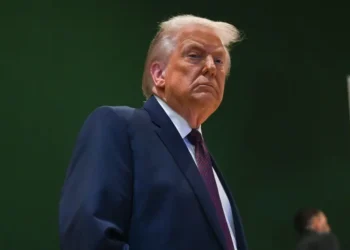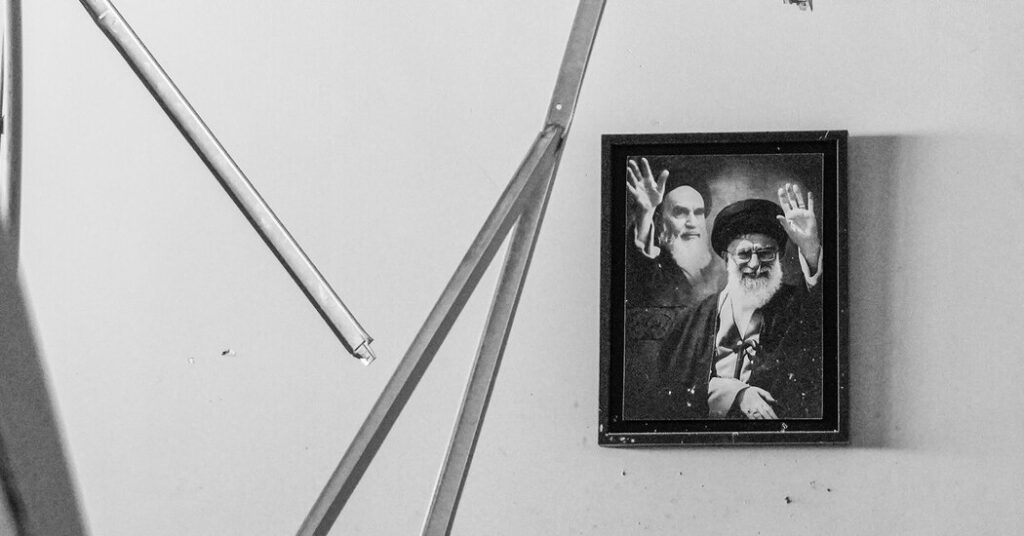
President Trump appears poised to order strikes on Iran — indeed, by the time you read this column, he may already have done so — while barely bothering to spell out his reasons. The lack of explanation is a serious moral and political mistake: At the very least, Americans deserve to know what they’re getting into, why, for how long and for what result.
But it doesn’t mean there isn’t a compelling case for action. Three, in fact.
Iran poses a threat to global order by way of its damaged but abiding nuclear ambitions, its deep strategic ties to Moscow and Beijing, its persistent threats to maritime commerce and its support for international terrorism.
It poses a threat to regional stability, not just through its support for anti-Israel proxies like Hamas and Hezbollah, but also by its meddling in Lebanon, Iraq, Yemen and (until the overthrow of the Bashar al-Assad regime) Syria.
And it’s a mortal threat to the life and safety of its own people, many thousands of whom it slaughtered last month. There was a time not long ago when Americans, both left and right, cared enough about human rights to believe it could, in some circumstances, justify military intervention.
Why is a military attack crucial? Look at what hasn’t worked to change the regime’s behavior.
Economic engagement hasn’t: Europeans have long sought close commercial ties with Iran, only to have Tehran repay the favor by routinely taking European citizens hostage or carrying out assassinations and terrorist attacks on European soil.
Economic sanctions haven’t: The regime has been under some form of sanction since its earliest months. But while sanctions damage economies, they have little effect on despotic rulers who are indifferent to the well-being of their own people and who can always find ways to enrich themselves through sanctions busting, bribery, cybercrime, drug dealing and other black-market transactions.
International institutions haven’t: The International Atomic Energy Agency spent decades engaged in a cat-and-mouse game with Iran as the regime repeatedly hid its nuclear capabilities and prevaricated about its intentions. Ultimately, that led to an I.A.E.A. report last year noting that the regime had failed to provide “technically credible answers regarding the nuclear material at three locations” and that it pursued a “unique and unilateral approach to its legally binding obligation.”
And diplomacy hasn’t.
Whatever one thinks of Trump’s first-term decision to withdraw from the Iran nuclear deal (a good decision about a bad agreement, in my view, though thoughtful people differ), the Biden administration invested months in torturous negotiations trying to entice Iran back into it. They got the back of the ayatollah’s hand. Last year, Trump spent months seeking a diplomatic outcome. It, too, went nowhere, and current negotiations seem to be on a similar course.
The failure of nonmilitary options does not, of course, mean that military ones are destined to succeed. Things will go wrong in any complex operation — there’s a reason the word “fubar” began life as a military acronym — and Iran possesses the means to inflict damage on American personnel and installations throughout the Middle East. The fact that they failed to land effective blows in the June war against Israel and the United States should lull nobody into complacency: Iranians will have learned from their mistakes, and a regime that feels it has its back to the wall will have no reason to pull punches.
In fact, the Iranian regime may want war, on the theory that all they need to do to win it is survive it. In this view, an American strike that further degraded Iran’s military assets but didn’t fundamentally shake the regime’s grip would rally its domestic supporters, demoralize its brutalized opponents, and demonstrate the futility of future military action as a means of altering the regime’s course.
It’s a bad theory. To listen to the regime’s rhetoric is to be reminded of the Black Knight of “Monty Python and the Holy Grail,” who loses limb after limb while insisting he’s still winning. The regime has lost much of its nuclear infrastructure; watched its regional proxies be overthrown, decimated and incapacitated; presided over the implosion of its economy; and lost whatever domestic and international legitimacy remained to it.
No wonder protests in Iran have resumed, this time among university students who are bravely undaunted by the terrifying risk. Their protests seem connected to the 40-day memorials for the victims of last month’s massacres. But it’s not a stretch to assume those protests are also a signal to Trump that his promise last month to Iranians that “help is on its way” hasn’t been forgotten, and that ordinary Iranians are prepared to join the fight for their own liberation.
If so, then there is at least a reasonable chance that a sustained military operation that not only further degrades the regime’s nuclear, missile and military capabilities — a desirable outcome in its own right — but also targets its apparatus of domestic repression could embolden the type of sustained mass protests that could finally bring the regime down. Even more so if the leaders who give the orders, including the supreme leader and his circle, are not immune from attack.
For all of its willfulness and the evil it has wreaked over 47 years, the regime does not stand 10 feet tall. It nearly fell during the 2009 Green Movement against that year’s fraudulent elections. It nearly fell again in 2022 during the Women, Life, Freedom protests.
The difference on those occasions was the absence of external military support. Donald Trump now has a unique opportunity to provide it. Despite the risk that military strikes entail, the bigger risk, in the judgment of history, would be to fail to take it.
The Times is committed to publishing a diversity of letters to the editor. We’d like to hear what you think about this or any of our articles. Here are some tips. And here’s our email: [email protected].
Follow the New York Times Opinion section on Facebook, Instagram, TikTok, Bluesky, WhatsApp and Threads.
The post The Case for Striking Iran appeared first on New York Times.