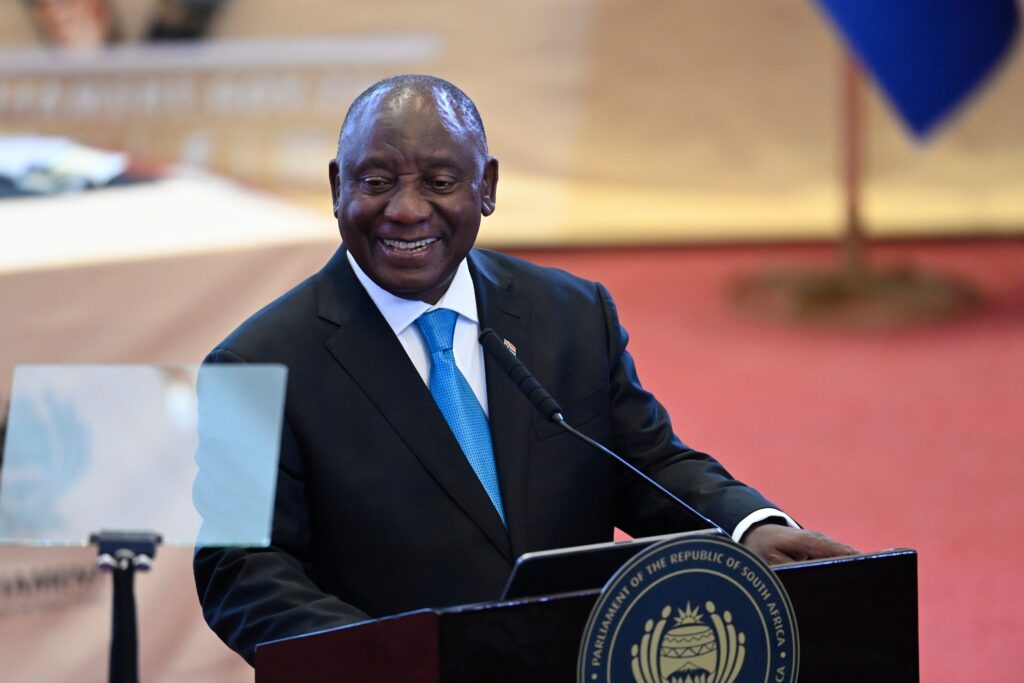
For years, South Africa’s rolling electricity blackouts were a symbol of the country’s dysfunction and decay. But this month President Cyril Ramaphosa delivered an upbeat message in his annual address: South Africa has gone 300 days without an extended power outage. The reason? Ramaphosa and his African National Congress (ANC) party finally dropped their socialist-inspired aversion to markets and unleashed the country’s private sector to keep the lights on.
The reforms seem like common sense in retrospect. The South African government in 2023 lifted a long-standing capon how many megawatts private businesses could generate. That led to a rush of private businesses setting up their own power sources — mostly using solar, wind and batteries. Shopping malls and private factories suddenly could rely on their own power sources. That immediately eased the burden on Eskom, the country’s corruption-plagued electricity monopoly.
Another market reform was allowing private companies to bill individuals directly. Most users previously paid their electricity bills to local governments, which were supposed to pass the money to Eskom. Many never did, instead redirecting the money for their own purposes. That left Eskom drowning in debt. Last year the government rolled out a pilot direct billing program to allow South Africans to pay their electricity bills directly without a government middleman.
While the U.S. power grid consists of a patchwork of public and private utilities, Eskom has dominated every aspect of South Africa’s energy sector, from power generation at inefficient coal plants to the aging transmission grids to the distribution into homes and businesses. In 2024, the government aimed to unbundle the failing state-backed monopoly by setting up the National Transmission Company of South Africa, which is intended to be a neutral player in delivering power. Ramaphosa announced in his speech that the new body would operate independently of Eskom.
These reforms required a change in mindset for the ANC. The party came to power as a liberation movement with a deep-seated suspicion, and sometimes outright hostility, of the private sector. But the party lost its parliamentary majority in 2024 and has since been forced to share power in a coalition with the pro-market, center-right Democratic Alliance. The ANC was also expected to take a beating in local elections by voters fed up with the collapse of basic services.
The government is now partnering with private business to address problems around transportation, crime and dilapidated government buildings. But while South Africa is starting to enjoy the advantages of markets, self-styled socialists in the U.S. are moving in the opposite direction, pushing for expanded state control over private utilities. Supporters of the “public power” movement in the U.S., such as New York City Mayor Zohran Mamdani, might want to take a trip to South Africa to learn firsthand what works and what doesn’t.
The post South Africa’s ANC takes a free market turn appeared first on Washington Post.