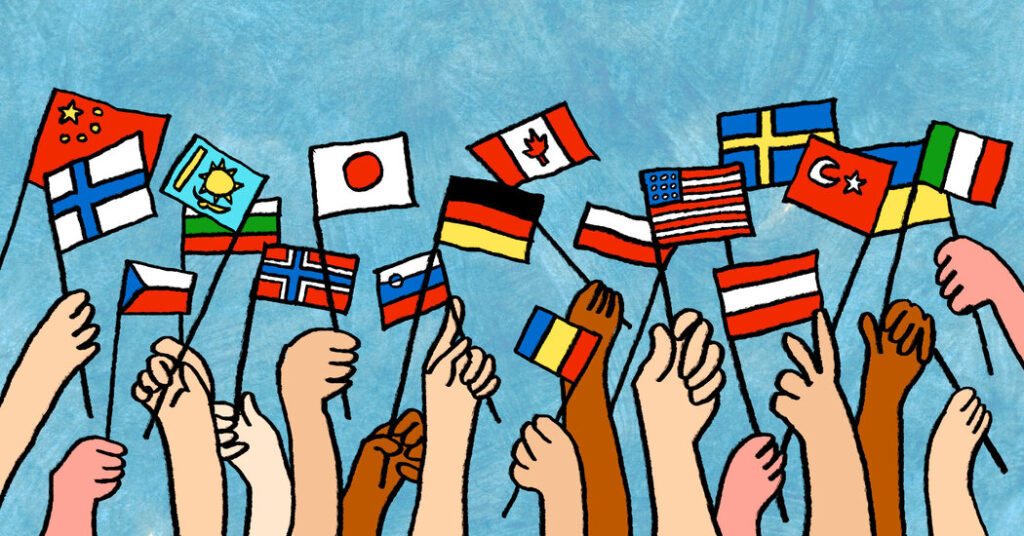
Before leaving for the airport to catch my flight to Milan, I bought one full-size American flag, four 8-by-12-inch flags and two backup smaller flags, just in case. Then — because of Minneapolis, because U.S. Olympic officials had to change the name of its athlete hangout from Ice House to Winter House, because of the Donroe Doctrine and because many Americans, including some Olympians, are struggling with what it means to represent and root for their country right now — I wondered how comfortable I should be about waving them.
Maybe I could try turning the Stars and Stripes upside down, the way Martha-Ann Alito did shortly after Joe Biden had been elected president? Did I need to invent some kind of semaphore to convey support for Team U.S.A. combined with opposition to annexing Greenland or Canada?
I needn’t have worried. Even though we were in the stands to watch a zero-sum competition among nations, I can’t imagine a stronger rebuke of nationalism than the one that was delivered by fans at this year’s Winter Games.
I don’t mean to suggest that sports will bring the world together. And certainly not the Olympics. The 2018 Pyeongchang Games brought North and South Korea no closer to reconciliation. The 2022 Beijing Games very likely delayed Vladimir Putin’s invasion of Ukraine by less than one week.
Instead, whenever my wife and I entered Olympic venues, we witnessed unfussy, entirely organic displays of the difference between patriotism and nationalism: thousands of people, all cheering loudly for their countries while recognizing others’ right to cheer equally loudly for theirs.
The spirit inside the venues was one the TV broadcast often alludes to but can’t fully capture. Yes, one nation’s thrill of victory is another’s agony of defeat. Yet the drive for excellence that the Olympics celebrate — and the courage, triumph and heartbreak of the men and women who compete there — speaks to elements of the human condition that effortlessly cross borders.
This desire for shared global experiences defies the nationalist retrenchment on the rise throughout the world — and the disdain for longstanding alliances that’s become a hallmark of President Trump’s foreign policy. Two days after Chancellor Friedrich Merz of Germany warned at the Munich Security Conference that “the United States’ claim to leadership has been challenged and possibly lost,” we were bonding with an international assortment of fans in the nosebleed seats of the Milano Ice Skating Arena.
A middle-aged German woman offered to help us hoist our big flag each time an American took the ice. Her son, Robert Kunkel, was competing in that evening’s pairs figure skating short program, so in a moment of bilateral cooperation we helped her raise an equally big banner with his face on it.
I spent a week at the Games and never saw a single display of national aggression or even resentment. (I did witness a mob of crazed fans nearly tear one another to pieces, but that was only because a fresh batch of stuffed stoat mascots had arrived at the official Olympic store.) While JD Vance was booed loudly during the opening ceremony in Milan, the American team was cheered.
People can tell the difference; our leaders, however misguided, are not us. “America is not just an idea,” said Mr. Vance at the right-wing Claremont Institute last year. “We’re a particular place with a particular people and a particular set of beliefs and way of life.” In certain ways, this is obviously the case: At the men’s 1,500-meter short track competition, I rooted for American speedskaters, Dutch people for Dutch ones.
But the way Mr. Vance and his MAGA allies extend that claim — to argue that our distinct national culture is part of what makes international institutions suspect, immigration threatening and alliances based on shared principles unwise — is belied by what people spend time happily consuming: a swirly pop culture from anywhere and originally in any language, from “KPop Demon Hunters” to Bad Bunny to Ballerina Cappuccina to this year’s scheduled Grand Theft Auto VI release.
If the old geopolitical order “is not coming back,” as Prime Minister Mark Carney of Canada warned recently, the global cultural order that rose alongside it isn’t going anywhere. On Thursday night the loudest cheers I heard were for Alysa Liu’s powerful, mesmerizing, joyous, life-affirming, gold-medal-winning free skate. But before that, the audience got nearly as loud for the Swiss skater Kimmy Repond, who finished second to last. Repond had just fallen for a second time. Her chances to set a season’s personal best score, let alone to win a medal, had vanished. Yet judging by the crowd’s reaction as she got back to her feet and resumed skating, you would have thought she was the champion of the world.
There were at least a dozen nationalities represented around us in the stands that night. Yet something that tied us together — other than a desire to see our own athletes win, of course — was the shared belief that in difficult times, there is nothing more impressive, nothing more Olympian, than figuring out a way to muddle through.
With our wallets, our attention, our time and our collective groans with every fall and cheers for every newly realized lifelong dream, the world’s citizens are sending a message: We proudly root for our countries, but we are more than just our countries. And in many cases we are better — much better — than the governments in charge of them.
David Litt, a former speechwriter for President Barack Obama, is the author, most recently, of “It’s Only Drowning: A True Story of Learning to Surf and the Search for Common Ground” and writes the newsletter Word Salad.
The Times is committed to publishing a diversity of letters to the editor. We’d like to hear what you think about this or any of our articles. Here are some tips. And here’s our email: [email protected].
Follow the New York Times Opinion section on Facebook, Instagram, TikTok, Bluesky, WhatsApp and Threads.
The post Our Leaders Are Not Us appeared first on New York Times.