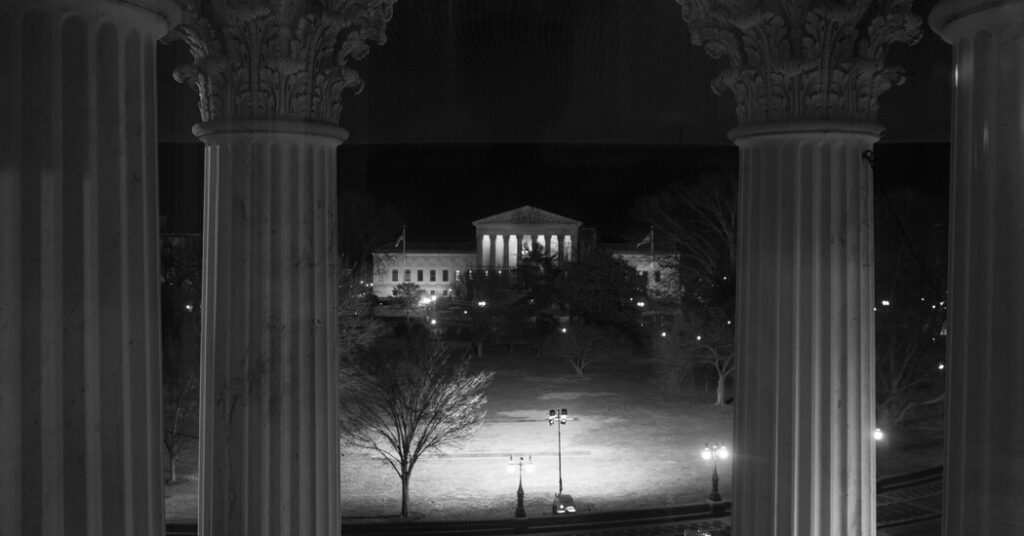
The Supreme Court may have just helped save the Republic.
On Friday, a 6-3 majority struck down President Trump’s use of the International Emergency Economic Powers Act to implement sweeping global tariffs, including tariffs against Mexico, Canada and China.
Justices John Roberts, Elena Kagan, Sonia Sotomayor, Ketanji Brown Jackson, Amy Coney Barrett and Neil Gorsuch voted together — though for different reasons — to block one of the central elements of Trump’s foreign and economic policy. As Roberts explained in his opinion, in terms of sheer economic impact the case dwarfed many of the most contentious cases of the last several terms, including, for example, Biden v. Nebraska, the case blocking President Joe Biden’s student loan debt forgiveness program.
In fact, it may prove to be the most important Supreme Court decision this century. And if you think I’m being hyperbolic, let me explain.
First, the court blocked a monumental presidential power grab — one so big and so bold that it threatened the foundation of our constitutional system.
The chief justice’s opinion hinged on a legal principle called the “major questions doctrine” — the same doctrine that was used repeatedly to block the Biden administration’s regulations and orders.
As Justice Gorsuch explained in his concurring opinion, the doctrine means, “When executive branch officials claim Congress has granted them an extraordinary power, they must identify clear statutory authority for it.”
In other words, relying on broad and vague statutory language, such as the International Emergency Economic Powers Act’s grant of authority to presidents to “regulate” importation when he or she declares an emergency isn’t precise enough to sweep away the Constitution’s explicit language granting taxing authority to Congress.
Other justices, including Kagan, Sotomayor and Jackson, had an even simpler explanation for blocking the tariffs. As Kagan wrote in her concurring opinion, “Ordinary principles of statutory interpretation lead to the same result.”
It’s not that words like “regulate” and “importation” aren’t precise enough to grant the president extraordinary powers. Instead, as Kagan wrote, “IEEPA’s key phrase — the one the Government relies on — says nothing about imposing tariffs or taxes.”
And since the statute says nothing about tariffs or taxes, then the Trump administration can’t use it to prop up the president’s lawless scheme.
The majority’s reasoning alone makes the tariff case extraordinarily important.
For years presidents of both parties have been using broad and vague language in federal statutes as a pretext for engaging in lawmaking in place of Congress.
The expansion of presidential power, which has accelerated exponentially under Trump, has placed our republican form of government under strain. When presidents yank power from Congress, they begin to assume the role of an elected monarch — the exact opposite of the framers’ intent.
Gorsuch explained this masterfully in his concurrence. “For those who think it important for the nation to impose more tariffs,” he wrote, “I understand that today’s decision will be disappointing. All I can offer them is that most major decisions affecting the rights and responsibilities of the American people (including the duty to pay taxes and tariffs) are funneled through the legislative process for a reason.”
The legislative process can be slow and frustrating, Gorsuch explained, but
through that process, the nation can tap the combined wisdom of the people’s elected representatives, not just that of one faction or man. There, deliberation tempers impulse, and compromise hammers disagreements into workable solutions. And because laws must earn such broad support to survive the legislative process, they tend to endure, allowing ordinary people to plan their lives in ways they cannot when the rules shift from day to day.
In a series of interim decisions, the Trump administration recently enjoyed a temporary winning streak at the Supreme Court, but the judicial tide seems to be turning. Combined with its recent decision in Trump v. Illinois, which refused to stay a lower-court ruling blocking Trump’s deployment of the National Guard in Illinois, the Supreme Court has defied two of the administration’s most dangerous, most authoritarian ambitions.
It also appears set to defy Trump yet again in another ruling soon. In oral arguments in Trump v. Cook — a case challenging the president’s decision to fire Lisa Cook, a member of the Federal Reserve’s board of governors — a clear majority of the court seemed skeptical of his actions.
The court will also hear arguments in Trump v. Barbara — the case challenging Trump’s executive order abolishing birthright citizenship as we know it — in April, and the omens are not good for him in that case, either.
Perhaps the most important aspect of the court’s decision is how it may help restore faith in how courts make decisions. The crisis in American democracy isn’t simply a product of the Trump administration’s overreach, it’s also a product of deep public cynicism about government institutions. Trump owes at least some of his appeal to that cynicism. If all that matters is power, then why not pick the man who exercises that power to its fullest?
As a result, millions of Americans wonder, do principles matter at all? Or is all of politics merely a matter of gaining and wielding power, supporting your friends and crushing your enemies?
The tariff decision is a reminder that principles do still matter, that at least one branch of government is not in thrall to the president, and that we can rely on reason and precedent to decide cases rather than simply counting Republican and Democratic appointees.
It is important that Roberts anchored his majority opinion in three cases that struck down the policies of Democratic presidents — Biden v. Nebraska, West Virginia v. EPA (involving environmental regulations), and National Federation of Independent Business v. OSHA (Covid vaccine mandate). That sent a clear signal that presidents of both parties are held to the same standard.
And when you combine the tariff case with Trump v. Illinois, alongside the Trump administration’s terrible record at the Supreme Court during his first term (where he had the worst record of any president at least since Franklin D. Roosevelt), it’s clear that the conservative-dominated judiciary bears little resemblance to the sycophantic Republican Congress.
That doesn’t mean the court has gotten everything right. I still have profound disagreements with its decision to grant expansive presidential immunity in Trump v. United States. That case remains dangerously wrong. I also have qualms about its applications of the unitary executive theory, but the measure of a functioning branch of government isn’t whether I always agree with its decisions (and we should all be thankful for that).
Instead, I measure judicial integrity differently. I ask whether judges are acting in good faith, honestly applying their legal philosophies to the questions before them, regardless of their partisan or ideological affiliation.
There’s also a third, less obvious way in which the court’s decision helps preserve the Republic — by limiting opportunities for corruption.
By assuming vast powers of taxation, Trump made himself the focal point for an enormous amount of lobbying and trading favors. In January, for example, Politico reported that the 20 largest lobbying firms raked in nearly $824 million in revenue in the first year of Trump’s second term, a sharp increase from $595 million in Biden’s last year.
The administration has sent a message, loudly and clearly — almost anything is for sale, at the right price. And as ProPublica reported last April, politically connected people and companies were already benefiting from what appears to be targeted relief from Trump’s tariffs.
The Wall Street Journal’s editorial board called the administration’s opaque process for granting exemptions “the Beltway Swamp’s dream.”
The case is a victory for the Constitution and the rule of law, but there are still causes for concern. Trump is furious. He said he was “ashamed of certain members of the court” and said they were “very unpatriotic and disloyal to our Constitution.”
Those are dangerous words from a dangerous man.
There were also dissents, of course. Justice Brett Kavanaugh wrote one, as did Justice Clarence Thomas. Kavanaugh wrote the principal dissent, which both Thomas and Justice Samuel Alito joined, and his argument was straightforward. When the statute granted Congress the power to regulate importation, the word “regulate” encompasses the power to tariff. “Like quotas and embargoes,” Kavanaugh wrote, “tariffs are a traditional and common tool to regulate importation.”
The most notable portion of his dissent came later in his opinion, when he accurately noted that “numerous” other statutes grant the president the authority to impose tariffs.
Kavanaugh is correct. Other statutes do grant tariff authorizations to the president, and we should expect the administration to try to reconstruct as much of his tariff authority as he can through different means. (Biden did much the same thing in response to the Supreme Court’s student loan decision.)
But Trump’s most powerful tool has been taken away. He’ll have trouble doing tariffs the hard way when he loses the easy way. This is not an administration that is known for its legal competence.
In addition, as Roberts notes in his opinion, those other statutes “contain various combinations of procedural prerequisites, required agency determinations and limits on the duration, amount and scope of the tariffs they authorize.”
Now the ball is on Trump’s side of the net. The court has challenged him on perhaps the signature economic policy of his second term, and he is not taking it well. The threat of Trump defying the Supreme Court hovers over every decision he doesn’t like. On Friday he announced that he would impose a new 10 percent tariff on imports through different legal authorities — a move that will no doubt also be contested in court. Then on Saturday he upped it to 15 percent.
During Trump’s second term, I’ve likened the judiciary to the rear guard of a retreating army. A valiant delaying action can give the army a chance to reinforce, reorganize and strike back. But if the army can’t strike back, then rear guards merely delay defeat.
The judiciary isn’t perfect, but it is performing its core constitutional function. It is preserving the foundation of America’s constitutional structure. But not even the Supreme Court can save Americans from themselves.
If we keep electing men like Trump, they will keep undermining that foundation, until it finally collapses.
One day that may well happen. But on Friday, the Supreme Court said not this day. On this day the presidency is stuffed back into its box. On this day the separation of powers prevails. And on this day the Constitution holds.
It is now our job to make sure that the Supreme Court did not stand in vain.
The Times is committed to publishing a diversity of letters to the editor. We’d like to hear what you think about this or any of our articles. Here are some tips. And here’s our email: [email protected].
Follow the New York Times Opinion section on Facebook, Instagram, TikTok, Bluesky, WhatsApp and Threads.
The post Is This the Most Important Supreme Court Case of the Century? appeared first on New York Times.