On my second day into my 16-month sentence at Federal Correctional Institution in Ashland, Ky., I surprised myself by doing something that I well understood you aren’t supposed to do in prison: I cried.
I had joined the inmate-led Bible study in the prison’s small, drab chapel, pulling a chair up to the circle of a dozen men. A member of the group introduced a short scriptural reading followed by a prompt, and each one of us was given a chance to respond.
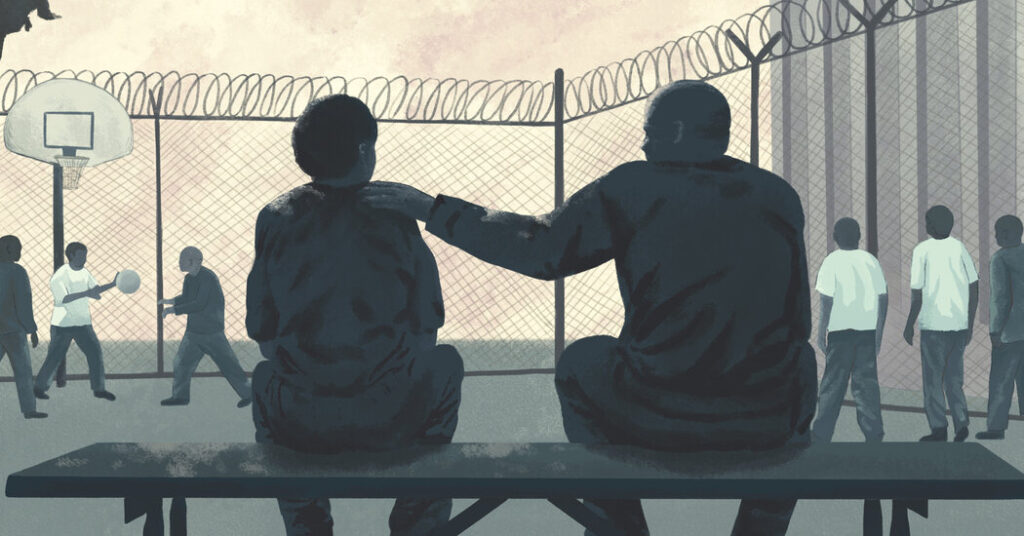
I hadn’t yet been able to access the prison phone room, and when it was my turn to talk, I told the group how desperately I wanted simply to hear my wife’s voice and how our two young sons were doing. From the guys in the circle, there were no insults, no admonishments to toughen up or be a man. They offered encouragement, comforted me and said that we were all navigating a difficult stretch of life together.
I did not fully understand it then, but the place where I was least free in my life would also become a place where I felt deeply connected to those around me, and where I got to experience a level of camaraderie and solidarity that so many on the outside go without. Unlike the version of prison conjured on TV and in the movies, where “shot callers” control subordinates, I found a community quick to be generous and much less inclined to try to assert superiority over one another.
My celly, or cellmate, went by “Crum” and became my closest friend at F.C.I. Ashland. He’d grown up poor in Appalachia, was quick to admit he resembled the leader of a biker gang and was serving a 20-year sentence on drug charges.
I was a lanky, bespectacled Princeton grad and former Cincinnati City Council member acquitted on four counts and convicted on one count of federal extortion and one count of federal bribery. That put me in the category of what guys with long sentences referred to as “short-termers.”
Crum and I hit it off from the start, connecting easily with a shared sense of humor. “If you’d told me that I would go the last eight years without ever eating bacon,” Crum once said, somewhat seriously, “then I would have stopped dealing drugs on the spot.”
We would have bunk-side conversations at night about religion, our childhoods and outer space — and in a place where most prisoners suffered from a scarcity mind-set, I was always touched that every time Crum came into anything tasty to eat, he offered me half.
As I settled into prison, I got a quick education in the robust social economy there. There were group workouts and communal recreation, including drug dealers versus white-collar basketball games. (There were, in fact, robust friendships and much intermingling between those tribes, but it was also a simple and quick way to choose teams.) There were shared meals in the chow hall, where the awfulness of the food was a source of both griping and bonding. There was endless lively conversation, known as “chopping it up.” And there was daily, sometimes hourly, commiserating with one another as we endured indignities and cruelties at the hands of the corrections officers, or COs.
During my imprisonment, I felt many things: Aggrieved every day at being separated from my family. Perpetually fearful about being thrown in the Special Housing Unit, or SHU, also commonly called “the hole,” where prisoners could be kept for 23 hours a day in a roughly 6 feet by 9 feet cell for no reason other than crossing paths at the wrong time with a guard in a foul mood. Dizzied by the many, and seemingly intentionally nonsensical, aspects of our justice system.
But the one thing I never felt was lonely or alone. I was awash in community.
One of the most refreshing parts of prison friendships was how men would form bonds with guys they never would have even crossed paths with in normal life. I remember walking by a former drug dealer, a former Drug Enforcement Administration agent, a former mobster and a former preacher all sitting around a table together in the prison yard. Surely this was not happening anywhere else in America.
Another friend of mine, who went by Smooth, had grown up in inner-city Cleveland and was serving a long drug sentence. As we were shooting hoops one day, he said, “The difference between prison and the outside is that here, where we’re all kind of equal and in the same boat, I can have a conversation with a white-collar business guy and get some career mentoring from him, whereas on the outside I’d never even have access to someone like that.”
When I made my first cheesecake in prison (using Sweet’N Low and Coffee Mate among other adaptations), there were a lot of comments along the lines of, “All right now, homeboy’s becoming a real inmate!” as well as friendly skepticism and trash-talking about how my inaugural attempt would turn out.
When I distributed slices to 10 of my friends, one of them, Moe, kept saying, “This is actually really good!” — to which I kept telling him, “Stop saying ‘actually!’”
The sheer density of the physical environment in prison promoted these kinds of connections. Sixty or so men lived in my housing unit, which was the size of a middle school gym. About 200 men lived on the prison camp compound, which was the size of a small high school campus. A game of cards, a boisterous conversation and a burpee competition were never more than a few feet away.
It often felt like a dorm, a church, a gym and a frat house all rolled into one. There was no privacy or peace and quiet, but it was easy to be social. Because we all lived in cubicles without doors, it actually took more effort to isolate yourself.
And there wasn’t just physical density — there was time density, too. In many adult relationships, we might be fortunate to see people we consider close friends on a monthly or even a quarterly basis. In prison, we would often share multiple meals, a workout, a Bible study, a walk around the prison yard and three or four additional separate conversations all in a single day. Twenty-four hours in prison could be the equivalent of months or even years of adult friendship on the outside.
Throughout my legal ordeal, I believed with all my heart that I was innocent. But once I was imprisoned, rather than thinking to myself, “I’m not like you; I shouldn’t be here!,” I quickly felt kinship with my fellow inmates. Regardless of how justly or unjustly we’d ended up there, we were all prisoners now.
In normal life, far removed from the razor-wire fences of prison, I have been around plenty of men who might have otherwise been enjoyable company but couldn’t get out of the way of their own egos, in the form of one-upmanship about things like titles, degrees and salary. Which is not to say there wasn’t puffery or braggadocio among men in prison, but the reality was, by the sheer fact of being there, you’d been knocked down many pegs and you knew it. Acting as though you were on top of the world or better than other guys when you were a prisoner would have been absurd.
Being humbled was its own form of liberation. Rather than creating facades or jockeying for superiority, men were free to be their authentic, broken selves. The two least popular people on the compound were the two guys who couldn’t help acting like they were better than the rest of us. To my surprise, my fall from an Ivy League and political career actually expanded my social circle rather than shrinking it.
And there were comedic episodes on the inside that would be impossible to recreate on the outside. One night, a bird took a wrong turn and flew into our housing unit, causing a great deal of commotion among the inmates. The next five or six hours were quite lively, as the bird alighted on various perches, and prisoners provided running commentary. A few guys expressed anxiety that the bird might divebomb them or do something else aggressive. I heard one guy exclaim, using an expletive, “It’s gonna poop on me!” Another told me, also using an expletive, “Man, I don’t mess with no birds, no fish, no rats.”
I overheard yet another inmate mutter under his breath, also, yes, using an expletive, “Some of these guys are coldblooded gangsters on the street, and they’re scared of a bird.”
Four and a half months into my incarceration — in an incredibly rare occurrence in our legal system — three federal judges ordered my immediate release after hearing oral arguments in my appeal, pending the final outcome of the appeal. (One year later, I received a pardon from President Trump; my appeal remains pending before the Supreme Court.) My friend Doug, a lawyer by background who was serving a 10-year sentence, heard the news and came to find me. We’d met in Bible study, of which he was the leader, and now he embraced me and said, “I am so happy for you.” He was beaming, perhaps the happiest I’d seen him.
When other Ashland friends were about to be released, each man’s response was always some version of, “I’m happy as hell to be getting out of here, but it’s really hard to be leaving some of these men behind.”
Now, it was my turn to leave, and I felt that sentiment acutely. I wished that when I walked out the prison’s front door, I could take Doug, Crum, Smooth, my Bible study brothers and many others with me.
P.G. Sittenfeld is a freelance writer working on a memoir.
The Times is committed to publishing a diversity of letters to the editor. We’d like to hear what you think about this or any of our articles. Here are some tips. And here’s our email: [email protected].
Follow the New York Times Opinion section on Facebook, Instagram, TikTok, Bluesky, WhatsApp and Threads.
The post I Went to Prison and Found Support and Community appeared first on New York Times.