Reporters are generally in the business of telling you what they know. Members of the New York Times Weather team like to emphasize what they don’t know.
That’s a defining feature of the team’s approach to extreme weather coverage. They capture the uncertainty in a forecast through explanations and visualizations of weather data, preparing readers for a range of possible outcomes rather than leaning into hard predictions.
Created in 2022 and expanded in 2024, the team includes reporters, a meteorologist, graphics editors and data engineers. When severe weather threatens, they work closely with our graphics department and other journalists across the newsroom to cover the event’s approach, impact and aftermath.
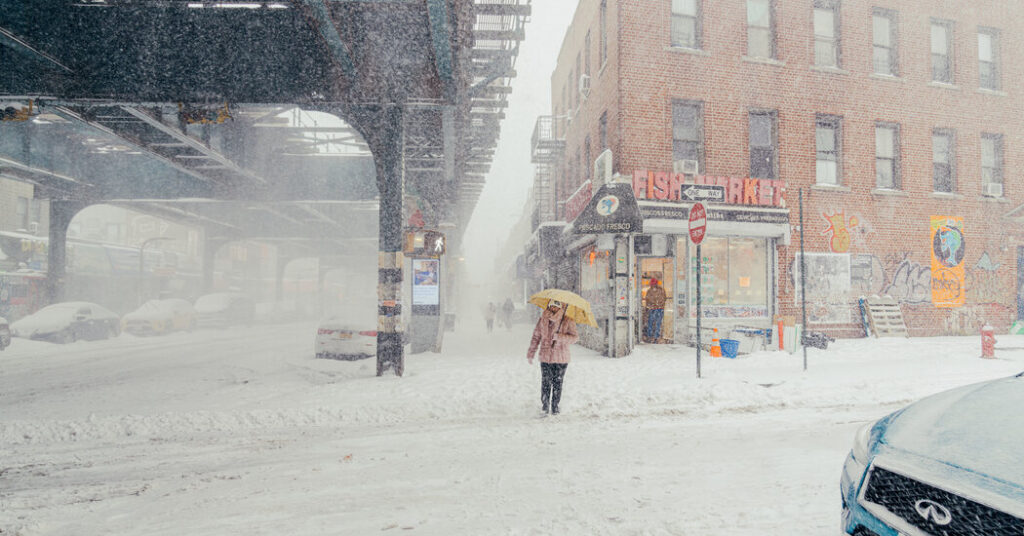
This weekend, the team was tracking a nor’easter that could bring blizzard conditions to the coastal Northeast. And that was just the latest big weather story. In the last week, the team covered a powerful storm system headed to California, the deadly avalanche it caused when it got there, deadly strong winds in Colorado, wildfires in Oklahoma, a dip in air quality in New York and more avalanches in Austria.
Several members of the Weather team recently answered questions about their work: John Keefe, who leads the team; Erin McCann, the deputy editor; and three weather reporters: Judson Jones, Amy Graff and Nazaneen Ghaffar.
Their responses have been edited and condensed.
How is what we’re doing in 2026 different from what we used to do?
JOHN KEEFE: The two main differences you’ll see today compared with what The Times has done in the past are that we cover extreme weather — such as snowstorms, hurricanes and heat waves — more often and, in many cases, before it happens.
Weather forecasting has improved so much that often we can reliably tell people when bad weather is headed their way several days out. And even when there’s uncertainty in the forecast, we have the expertise to explain that, too.
How does our approach differ from other forecasters?
KEEFE: We try to be as useful, measured and grounded as possible. Headlines about possible weather disasters get attention, but they’re often overblown. We hope that The Times is where people seek out the real story, without hype. On occasions when we do publish an alarming forecast, such as when we warned about wildfire risks a day before last year’s catastrophic Los Angeles fires, you can trust that we’ve thought hard about it and decided that a story is warranted.
Also, I think The Times has the best visual journalists in the world. That’s not just because I work here; I believed that even when I worked elsewhere and was trying to compete.
We are often explaining the forecast as it develops. We also emphasize the uncertainty in the predictions. Talk about the Weather team’s approach.
JUDSON JONES: Weather apps provide a lot of raw data, but they rarely explain the reasoning behind a storm watch or a warning. Our goal is to provide a trusted signal within the noise. We avoid purely deterministic forecasts and instead offer a probabilistic view. By laying out the most likely scenarios alongside the outliers, we treat the reader as a collaborator.
NAZANEEN GHAFFAR: Weather forecasting has improved hugely over the years, but predictions are still based on likelihoods, not guarantees — small atmospheric variations can lead to very different outcomes on the ground. It’s important for us to be clear and honest with readers about what a forecast can and can’t tell us.
How do we decide what weather to cover? Does an event have to be a certain size or affect a certain number of people to get our attention?
ERIN McCANN: We’re a small team and it’s a big world, so we try to find targets where we can be the most useful to the most people.
We focus mostly on weather that is extreme or unusual in some way. That can run the gamut from coverage of a major winter storm system affecting half the U.S. population to a story about a quirky water feature in Northern California that appears only after exceptionally heavy rain.
We also think about how many people may be in danger, and how our stories can help them make choices to mitigate that danger. The days leading up to a hurricane can be tricky. We spend a lot of time in those moments explaining how the forecast is evolving so people on the ground can make informed decisions about when and where to evacuate.
People can take one outlier model and start to freak out — a foot of snow when an inch is more likely. If we see something like that start to gather steam online, and we know we can provide context, we’ll try to do that: Hey, yes, that could happen but it probably won’t, and here’s some more information to arm yourselves with.
Can you explain how we develop forecasts? Do we have formal relationships with meteorologists? Do we have meteorologists on staff?
JONES: Our process begins each morning with a survey of global forecast models. We flag anomalies and potential major events on the horizon, though anything more than a week out is treated merely as a signal to monitor.
As the window narrows and the models start to find consensus, our scrutiny intensifies. If the data remains consistent as we approach the three-day mark, we begin planning our coverage.
I have a certificate in meteorology from Mississippi State University and I maintain my own independent forecasts, but I view my role primarily as an interpreter. My goal is to translate the often-dense jargon of weather specialists into a clear, actionable narrative.
AMY GRAFF: We discuss forecasts with meteorologists at local National Weather Service offices across the country. These offices are generally open 24/7. The forecasters who answer the phone are experts in the weather in their regions and watch the forecast models closely. We often ask what they’re most concerned about or where they think the most uncertainty lies.
Sometimes we seek out additional experts. If there’s a risk of rain and flooding in California, we might call the Center for Western Weather and Water Extremes at the University of California, San Diego, where scientists closely track West Coast storms.
KEEFE: We take in forecast data from the National Weather Service and other sources, in some cases every few minutes, and work to make the most accurate, clear and useful visualizations. In special cases, we use special data — such as NASA satellite and Cal Fire data for monitoring wildfires, U.S.G.S. data for tracking and mapping earthquakes and data from PowerOutage.com to track power outages.
It sounds like we rely quite heavily on the National Weather Service; have we noticed any change in the quality of their data or our access to their meteorologists since cuts were made to the agency last year?
JONES: The thing about the Weather Service is that they were pretty understaffed before the cuts — and also pretty good at rearranging their limited resources to focus on storms when they’re brewing. That continued through last year even as the agency lost hundreds more people.
They’ve put out the same early warnings on big storms that they would have before. And we’ve watched closely for any stumbles. Some of the experts we’ve talked to suggested those stumbles may not happen for a couple of years, as cracks start to show in the data and in the stressed-out staffers.
How do we think about climate change in our weather coverage and drawing connections between specific events and long-term trends?
McCANN: The Times has a world-class Climate team, and we look to them for a lot of the long-term, big-picture context about how the world is changing. That work is often intertwined with ours, which focuses mostly on the day to day of forecasting and explaining the current weather.
There’s more extreme weather than there used to be, but we want to be upfront with readers about what scientists can attribute to climate change and what they haven’t yet been able to.
GRAFF: It’s difficult to attribute unusual weather in a year, season or even on a single day solely to climate change, but studies have found that climate change DNA exists in extreme weather.
Our forecasting seems to mostly stop at the U.S. border. How much do we pay attention to international weather, and are there any plans to expand there?
KEEFE: Yes, we are actually in the process of expanding now. When we started the Weather team, we limited our scope to the United States, mainly so we could get our systems up and running.
But some of the forecast data we use for the contiguous United States already extends north, so we’ve started to remake our maps to include southern Canada, covering a large percentage of the country’s population.
While our hurricane and earthquake trackers have always used global data, we’re publishing trackers for more of those events from around the world, too.
Stay tuned. We have some new projects underway that include areas beyond North America.
John Keefe leads The Times’s Weather team, which helps readers understand extreme weather events.
The post How the Times Weather Team Tracks Big Storms: More Data, Less Hype appeared first on New York Times.