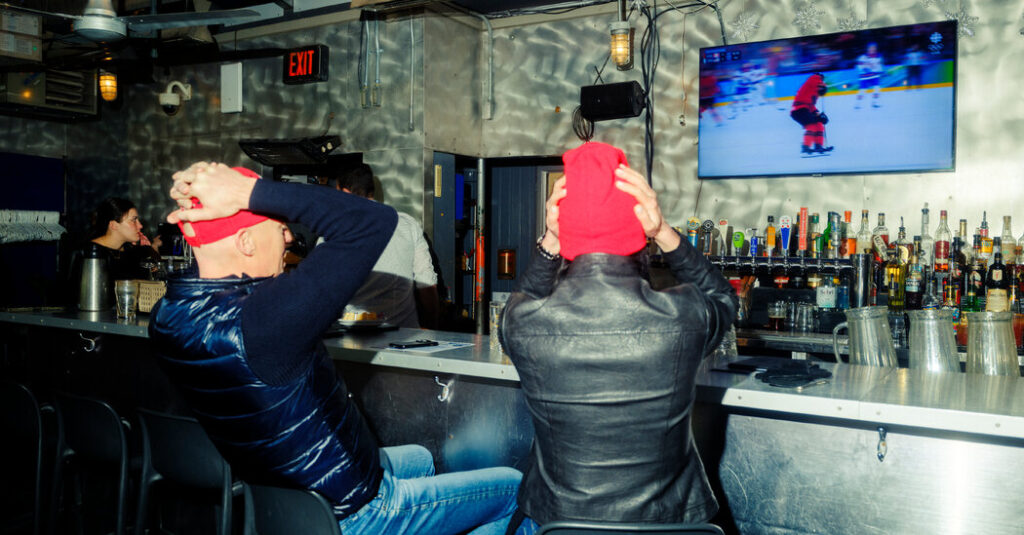
It’s not every day you can order a beer for breakfast in Toronto or most of Canada, but Sunday, the occasion of the Olympic men’s hockey gold medal game between Canada and the United States, dawned like a national holiday.
By 11 a.m. it felt like a national day of mourning, as the U.S. defeated Canada 2-1 in overtime at the Milan-Cortina Olympics.
At the Pilot, one of Toronto’s oldest bars and on this day a barometer for bars from Cole Harbour, Nova Scotia, to Coquitlam, British Columbia, more than 300 people, most wearing red, jammed onto two floors beginning around 7:30 in the morning to watch Canada play on big screens.
Plates of bacon and eggs, pints of Guinness, pitchers of lager and tall Caesars, Canada’s version of a Bloody Mary, crowded the tables, because provincial liquor laws had been loosened for the game.
The story of Sunday morning at the Pilot is best told in reverse.
Third period, game tied, nervous bar patrons. Anxious screams. Hands in the air. Hands on heads. Heads in hands. Shouts of unprintable expletives when Canada got a four-minute penalty.
Then, squeals for a Canada power play. A tense overtime brought many to their feet, as people alternated between collectively holding their breath and hollering encouragement.
Then, stunned silence as the U.S. scored. Followed by caterwauls of “Oh no!” and “No, dammit!” And worse.
Duane and Angela Green of Toronto, seated at the bar, put their heads in their hands and then consoled each other. “The Canadians had so many opportunities,” he said.
“This has been a day,” Ms. Green said. “I feel really sad. It’s hard to watch them lose, hard to watch the women lose. It’s different, when hockey loses.”
A few hours earlier, everyone had been bullish.
“It’s the game everybody wanted and hoped for,” the Canadian star Connor McDavid said on the eve of the game.
And it was.
The match was playing out as political tensions continued to simmer between the neighboring countries.
President Trump before his inauguration began suggesting that Canada become the 51st state, and has threatened and levied staggering tariffs on exports like steel, aluminum and lumber. He has condescended to Canada’s prime minister, Mark Carney, calling him “governor.”
Canadians — for the most part — have retaliated by ceasing travel to the United States and boycotting American products. Rallying around the flag is most apparent — and most fun, usually — when it happens over hockey.
The game was a rematch of the testy Four Nations tournament final that Canada won, and that has fueled the hockey portion of this rivalry between the countries. The U.S. had not beaten Canada to win a best-on-best competition in 30 years.
“It’s our pride, it’s our sport, and if we look at all the things that have happened, for us to win would be very big,” Renay Russell of Toronto said before the game. “The U.S. is more powerful than us, the U.S. is bigger. They can have all that. This is ours.”
Trump Administration: Live Updates
Updated
- Trump calls on Netflix to oust Susan Rice from its board.
- Trump’s aides project confidence on tariffs after the loss at Supreme Court.
- Law enforcement officers fatally shot a man at Mar-a-Lago, the Secret Service says.
Not this year.
Late on Thursday morning, bars had been packed for the women’s gold medal game between Canada and the U.S., which also ended in overtime in favor of the Americans. A silver medal is an accomplishment in individual sports but in hockey, Canada’s national winter sport and a deep part of the country’s identity, it tends to register as failure, especially to the players.
On Sunday, it seemed like the entire country stopped in place to watch. In Toronto, thousands of people piled into the Scotiabank arena, ordinarily the host to professional hockey and basketball games. City squares across the country, libraries, community centers and even churches set up televisions and big screens.
Even at the Canuck, a primarily Canadian bar in Manhattan, lines formed before the sun came up, with beer pouring shortly after for a crowd that tilted Canadian.
When the U.S. scored first, small pockets erupted in cheers, and folks wearing red stared silently at the television. A group of six Canadian men, in Canada jerseys, sat in a corner table. One wore a hat that said “Canada is not for sale.”
Among the patrons was a double agent.
Kyle Costanzo, a dual American-Canadian citizen who was born in the United States and went to a university in Montreal, was rooting for Canada. “For Canada, hockey means more,” he said.
He decides which team to support based on “which would be more heartbroken,” he said, adding, “This hockey game, the stakes feel higher with the trade stuff.”
A few days before the game, the Canadian forward Mitch Marner told CBC Sports: “You’re playing for your country against another country, and it’s pride, and it’s everyone watching at home, on their couches, at a bar, with their buddies, with their families, with their loved ones, and, you know, all cheering for the same team, and wanting the result of what all Canadians want: the gold.”
Since the Olympic tournament began, fans have gathered to watch the morning games in bars or the electronics department at Costco, and even classrooms have come to a halt.
As the tournament wore on, the games became closer, more frantic and tense.
“A lot of stressful mornings for everyone back home,” Mr. McDavid said a few days ago.
Tell us about it.
I watched, in this same spot 16 years ago, as Canada beat the U.S. in overtime to win the gold medal at the Vancouver Olympics. Barack Obama was president, and Canada had a Conservative leader in Stephen Harper. There was the usual friction — over trade and the war in Afghanistan — but the hockey game did not feel like a mirror for those tensions.
In fact, a month or so after the game, Mr. Harper collected on a bet with Mr. Obama — two cases of beer, and the White House press secretary Robert Gibbs wore a Canada hockey jersey at his daily press briefing.
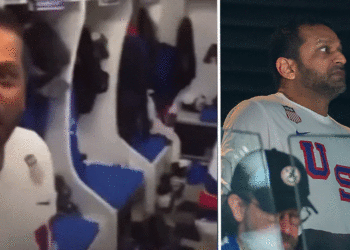
“It is more meaningful,” said Dion Ahwai, a political consultant from Toronto. “Obviously with everything going on right now it means a lot to beat the U.S. The Trump administration I’m sure is watching this closely.” (Kash Patel, the F.B.I. director, at least, was watching from a box inside the arena in Milan.)
A year ago, after Canada won the Four Nations tournament, Justin Trudeau, then the prime minister, posted on social media: “You can’t take our country — and you can’t take our game.” On Sunday afternoon, the White House Instagram account posted a meme of a bald eagle pinning a Canada goose to the ice with the message: “WE JUST DID.”
The first few hours of the day had been thrilling. Canada’s smothering attack in the first five minutes had the Pilot crowd roaring early. A McDavid scoring chance — missed — brought a wrenching chorus of “Ugh!”
When the U.S. scored, everyone groaned and some spat profanity. The crowd was frustrated with Canada’s failure to score during a 5-on-3.
Then, unbridled joy as the Canadian defenseman Cale Makar scored to tie the game. Almost everyone in the place jumped to their feet, hollering, high-fiving, fists pumping.
It would not happen again.
Rylee Kirk contributed reporting from New York.
Shawna Richer is an editor working on coverage of sports in America.
The post Canada’s Spirit Rises and Falls With Its Olympic Hockey Teams appeared first on New York Times.