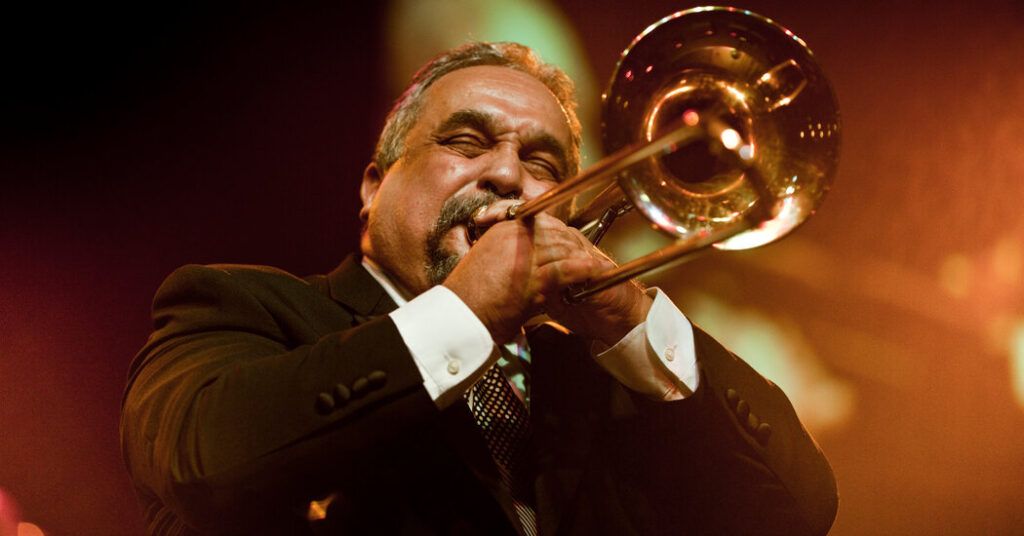
Willie Colón, a trombonist, singer, bandleader, composer and producer whose driving musical energy and mischievous bad-boy image — he was long promoted as “El Malo” — helped made him a luminary of New York salsa music, and whose 1978 collaboration with Rubén Blades, “Siembra,” became one of the top-selling salsa albums of all time, died on Saturday. He was 75.
His family announced the death on Facebook but did not provide further details.
Raised in the South Bronx by his Puerto Rican grandmother, who encouraged his early interest in music, Mr. Colón showed virtuosic ability on the trombone and was working professionally by his early teens. He arrived on the scene in the mid-1960s, at the vanguard of rapidly changing musical tastes among the young in a politically charged era.
The big band-influenced sounds and cha-cha rhythms of the 1940s and 1950s that had defined a great deal of Latin music was coming under the influence of American pop, funk and rock. That blend, which included elements of R&B and jazz as well as Caribbean dance rhythms, became synonymous with the emerging salsa sound.
“It was rebellious music,” Mr. Colón told The Miami Herald in 2006. “We were watching Martin Luther King walking into Selma and the dogs and water cannons. The music wasn’t explicitly political yet, but the music was a magnet that would bring people together.”
His first album, “El Malo” (1967), recorded when he was 17, featured him in tandem with the glistening vocal power of the Puerto Rican-born singer Héctor Lavoe, and propelled a career spanning nearly six decades. Often depicted on album covers as menacing, with a glower and in dark clothes, he embraced the bad-boy image with a swaggering playfulness.
On “Cosa Nuestra” (1970), he stood over a corpse on a dock. “Lo Mato — Si No Compra Este LP” (“I’ll Kill Him — If You Don’t Buy This Record”), made in 1973, he held a gun against a man’s head. Other titles of this era, all of which helped make the Fania label a prime source of salsa, included “Crime Pays” (1972). Decades later, Mr. Colón, then living in suburban New Rochelle, N.Y., said the marketing of “the bad boy thing” was “always tongue-in-cheek.”
The music itself was a glorious hodgepodge of sound and story, featuring characters like “Vicente el carterista” (Vicente the purse snatcher), as Mr. Lavoe showed off a dazzling improvisational skill on tongue-twisting lyrics, and Mr. Colón brought a thrilling brassy pulse with his trombone-heavy arrangements.
The relationship with Mr. Lavoe, who developed a drug addiction, deteriorated, and Mr. Colón found other fruitful musical partnerships, including with his mentor, the singer Mon Rivera, on such irresistible dance songs as “Tinguilikitín,” and, most especially, with Blades, the Panamanian-born singer and songwriter.
Their release, “Siembra” (which can mean sowing or planting), was widely considered a genre landmark, with a frisson of barrio-centric political consciousness. Wildly ambitious thematically and lyrically, it even paid homage to German expressionist-era cabaret like “The Threepenny Opera” with “Pedro Navaja.” That song, modeled on “Mack the Knife,” detailed the unraveling of a East Harlem criminal after he commits a murder.
Mr. Colón, who also recorded with Celia Cruz and Tito Puente, among others, received the Latin Recording Academy’s award for lifetime achievement in 2004. In 2015, Billboard magazine named him one of the 30 most influential Latin artists of all time, and younger musicians such as Rauw Alejandro and Daddy Yankee expressed their admiration for him.
William Anthony Colón Román was born on April 28, 1950, in the South Bronx. He said his grandmother, who worked in a sweatshop, raised him because his father was repeatedly in jail and his mother was 16.
Mr. Colón’s foray into music began when his grandmother, who introduced him to the music of her homeland, bought him a trumpet for his 11th birthday. A neighbor and professional musician taught him to play the instrument and to read music. “I would practice all day, which would drive everybody crazy,” he told The Herald.
Three years later, he had swapped his trumpet for a valve trombone — he loved its “roar,” he said — and began playing weddings and other events with his own bands. At 16, he started shadowing Mon Rivera in nightclubs.
“I would hang around with my trombone and a long face until Mon gave me a break,” he recalled. “He would say ‘OK, come up’ and let me play. He called me ‘el Americanito.’”
After “Siembra,” Mr. Colón and Mr. Blades partnered on acclaimed albums like “Canciones del Solar de los Aburridos” (1981) — which featured the hit singles “Tiburon” and “Ligia Elena” — but they fell into an acrimonious dispute over money that lasted years and severed the relationship.
Even as he continued to record, Mr. Colón told The Herald, he felt increasingly at odds with an industry focused on commercial appeal over innovation, including a trend toward performers who in his estimation were far more physically attractive than musically gifted.
“When the corporations came in, it naturally turned into something else, because they need formula and dependable product,” he said. “The genius of salsa was the freedom — there were no rules.”
Long interested in politics, he unsuccessfully challenged a Democratic incumbent for state senator in the Bronx and lower Westchester County in 1994. A decade later, he worked for Mayor Michael Bloomberg as a liaison to the city’s Latin Media and Entertainment Commission.
In 1991, he married Julia Craig, and they had children. A complete list of survivors was not immediately available.
In later years, Mr. Colón embraced reggaeton for its streetwise bluster and energy, and he dismissed peers who criticized its violent and vulgar lyrics. Reggaeton, he told The Herald in 2006, “came in under the radar because it came from the streets,” adding, “I identify a lot with it.”
He was in harmony with the new style’s emphasis on breaking with tradition. “It might have been said about some reggaeton beats that it’s wrong — you can’t do this,” he said. “But if it feels good musically, you do it.”
Derrick Bryson Taylor is a Times reporter covering breaking news in culture and the arts.
The post Willie Colón, a Luminary of Salsa Music, Dies at 75 appeared first on New York Times.