European officials have been hoping that 2026 would bring a measure of calm after a year of trans-Atlantic chaos. But even as many in Europe welcomed a U.S. Supreme Court decision overturning President Trump’s across-the-board tariffs, the ruling kicked off a new period of trade uncertainty just as leaders were hoping to move on to other pressing issues.
Any renewed turmoil could suck up the geopolitical oxygen at a moment when many in Europe had hoped to focus on other priorities like securing the fate of Ukraine and protecting themselves against what they say are unfair Chinese trade practices.
The court ruled on Friday that the president had exceeded his authority when he imposed sweeping tariffs on imports from nearly every U.S. trading partner, including 15 percent tariffs on the European Union.
Many trade experts say they believe that the decision will not ultimately upend a trade deal that the 27-nation European Union and Mr. Trump struck last year, in large part because the Trump administration has been clear that it has other tools to keep higher tariffs in place. Already, Mr. Trump has ordered a 10 percent across-the-board tariff based on a temporary authority, and has hinted that he could push tariffs even higher using other means.
But the court decision creates major questions: Will the tariffs collected so far be refunded? The Supreme Court did not say. Even more pressingly, how exactly will the Trump administration replace the old tariffs in the longer term?
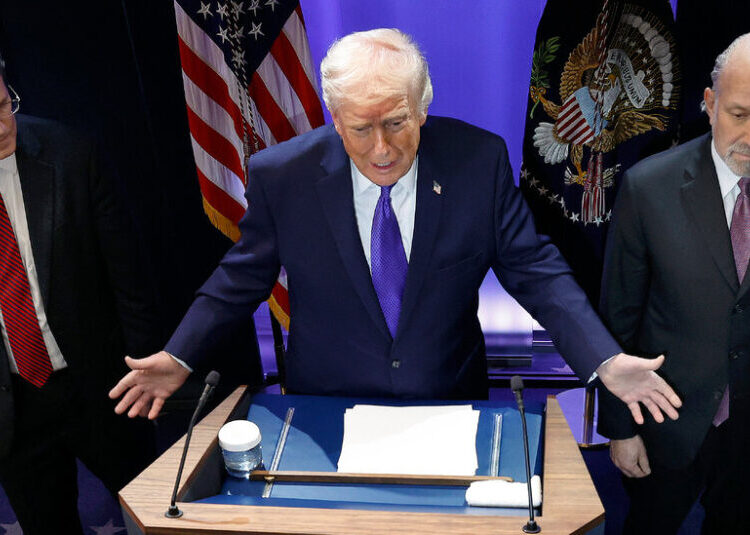
Those unknowns are likely to occupy leaders and officials on both sides of the Atlantic for months. European leaders are closely watching to see how Mr. Trump reacts.
“His back is against the wall — what do you think he’s going to do? There is uncertainty,” said Neil Dutta, the head of economics at Renaissance Macro Research. “Europe is definitely going to be affected by that.”
For now, Europeans have mainly welcomed the Supreme Court’s decision without saying much about how exactly they will respond.
“We remain in close contact with the U.S. administration as we seek clarity on the steps they intend to take in response to this ruling,” Olof Gill, a spokesman for the European Commission, the European Union’s executive arm, said after the decision.
Brando Benifei, the chairman of the European Parliament’s delegation for relations with the United States, called the decision “a signal of hope and vitality in the system of checks and balances.”
But the Supreme Court’s ruling leaves the E.U.-U.S. trade deal in limbo. Ursula von der Leyen, the president of the European Commission, struck an agreement with Mr. Trump last year to set tariffs on many European goods at 15 percent, and that package is still being finalized by the European Parliament.
The process has already faced delays: Lawmakers hit pause on the package during recent tensions over Greenland, which Mr. Trump has pushed to acquire. Now, the question is whether members of the European Parliament will take another break.
There are reasons to follow through with the deal, even though the original basis for the 15 percent tariffs is now invalidated. For one thing, America is clearly willing to find different ways to keep tariffs higher. For another, many European businesses want the certainty that comes with a concrete agreement.
“No one in Europe should get overly confident,” said Jörn Fleck, the senior director at the Europe Center at the Atlantic Council, the research organization. “The administration’s goals haven’t changed, and U.S. officials before the ruling said they will find new ways to recreate these tariffs.”
Still, several European lawmakers said on Friday that they would need to do more analysis in light of the decision.
Bernd Lange, the head of the committee in European Parliament that is working on the finalization, posted on X that he had “convened an extraordinary meeting” of the negotiating team for Monday to discuss what the Supreme Court decision meant for the agreement.
If the decision were to blow up or delay the trade deal, the development would plunge Europe and the United States into a new round of intense economic uncertainty. But even if it did not, the months ahead are now likely to be politically fraught.
Mr. Trump and his administration are likely to be distracted as they try to keep tariffs intact. The methods they use would probably leverage existing trade weapons that can be deployed to justify tariffs, including national security investigations and inquiries into unfair trading practices.
For instance, the United States could make the case that Europe’s digital regulations — which it has long loathed — amount to a tax on American companies.
That could intensify the tension between the United States and Europe.
“In the very near term, there is going to be a degree of uncertainty,” said Jacob Funk Kirkegaard, a senior fellow at the research organization Bruegel, even if it means that, in the longer term, the Trump administration will have less total discretion over trade policy, leading to greater stability.
For now, without knowing exactly how the Trump administration will move to keep tariffs intact, it could be hard for European businesses to plan.
“European business wants stability and predictability in the trans-Atlantic relationship,” BusinessEurope, a trade group in Brussels, said in a statement after the court decision.
European policymakers could face challenges as they prod their American counterparts to focus on other joint concerns.
The war in Ukraine tops that list. American officials met with Ukrainian and Russian officials in Geneva this week in an attempt to broker a peace deal, but progress has been halting. European officials have worked over the past year to keep the Trump administration engaged in helping Kyiv, as the fourth anniversary of Russia’s full-scale invasion approaches.
China is another area of shared concern that risks being overlooked as other trade issues dominate the agenda. The United States and Europeans have a shared interest in securing a supply of critical raw materials, including rare earth minerals, that does not depend wholly on the Asian nation.
But Mr. Fleck of the Atlantic Council said that even if this new source of uncertainty did not “make things easier,” European leaders have spent the past year figuring out how to work on other priorities even as trade overshadows other issues.
The European Union “seems to have learned to adapt and compartmentalize,” he said.
Jeanna Smialek is the Brussels bureau chief for The Times.
The post U.S. Tariff Ruling Brings Uncertainty Just as Europe Hoped to Move On appeared first on New York Times.