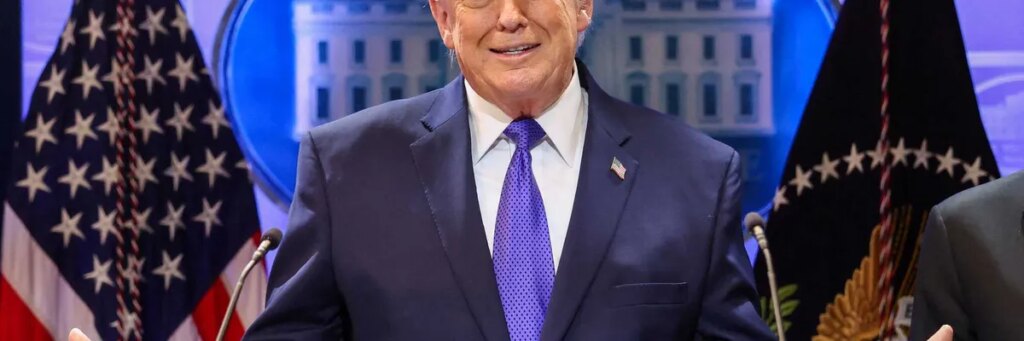
A 6-3 majority of the Supreme Court decided yesterday that Donald Trump cannot take core powers that the Constitution gives Congress. Instead, Congress must delegate that power clearly and unambiguously.
This is a big decision. It goes far beyond merely interpreting the 1997 International Emergency Economic Powers Act not to give Trump the power over tariffs that he claims to have. It reaffirms a basic constitutional principle about the division and separation of powers between Congress and the president.
On its face, this decision clarifies that Trump cannot decide on his own not to spend money Congress has authorized and appropriated — such as the funds for USAID he refused to spend. And he cannot on his own decide to go to war.
“The Court has long expressed ‘reluctan[ce] to read into ambiguous statutory test’ extraordinary delegations of Congress’s powers,” Chief Justice John Roberts wrote for himself and five other justices in the opinion released yesterday in Learning Resources vs. Trump.
He continued: “In several cases involving ‘major questions,’ the Court has reasoned that ‘both separation of powers principles and a practical understanding of legislative intent’ suggest Congress would not have delegated ‘highly consequential power’ through ambiguous language.”
Exactly. Trump has no authority on his own to impose tariffs because the Constitution gives that authority to Congress.
But by the same Supreme Court logic, Trump has no authority to impound money Congress has appropriated because the Constitution has given Congress the “core congressional power of the purse,” as the Court stated yesterday.
Hence, the $410 to $425 billion billion in funding that Trump has blocked or delayed violates the Impoundment Control Act, which requires Congressional approval for spending pauses. This includes funding withheld for foreign aid, FEMA, Head Start, Harvard and Columbia universities, and public health.
Nor, by this same Supreme Court logic, does Trump have authority to go to war because Article I, Section 8, Clause 11 of the Constitution grants Congress the power to “declare War … and make Rules concerning Captures on Land and Water” — and Congress would not have delegated this highly consequential power to a president through ambiguous language.
Presumably this is why Congress enacted the War Powers Act of 1973, which requires a president to notify Congress within 48 hours of deploying troops and requires their withdrawal within 60 to 90 days unless Congress declares war or authorizes an extension. Iran, anyone?
The press has reported on yesterday’s Supreme Court decision as if it were only about tariffs. Wrong. It’s far bigger and even more important.
Note that the decision was written by Chief Justice John Roberts — the same justice who wrote the Court’s 2024 decision in Trump v. United States, another 6-3 decision in which the Court ruled that former presidents have absolute immunity for actions taken within their core constitutional powers and at least presumptive immunity for all other official acts.
I think Roberts intentionally wrote yesterday’s decision in Learning Resources v. Trump as a bookend to Trump v. United States.
Both are intended to clarify the powers of the president and of Congress. A president has immunity for actions taken within his core constitutional powers. But a president has no authority to take core powers that the Constitution gives to Congress.
In these two decisions, the Chief Justice and five of his colleagues on the Court have laid out a roadmap for what they see as the boundary separating the power of the president from the powers of Congress, and what they will decide about future cases along that boundary.
Trump will pay no heed, of course. He accepts no limits to his power and has shown no respect for the Constitution, Congress, the Supreme Court, or the rule of law.
But the rest of us should now have a fairly good idea about what to expect from the Supreme Court in the months ahead.
- Robert Reich is an emeritus professor of public policy at Berkeley and former secretary of labor. His writings can be found at https://robertreich.substack.com/. His new memoir, Coming Up Short, can be found wherever you buy books. You can also support local bookstores nationally by ordering the book at bookshop.org
The post This almighty blow to Trump is about much more than tariffs appeared first on Raw Story.