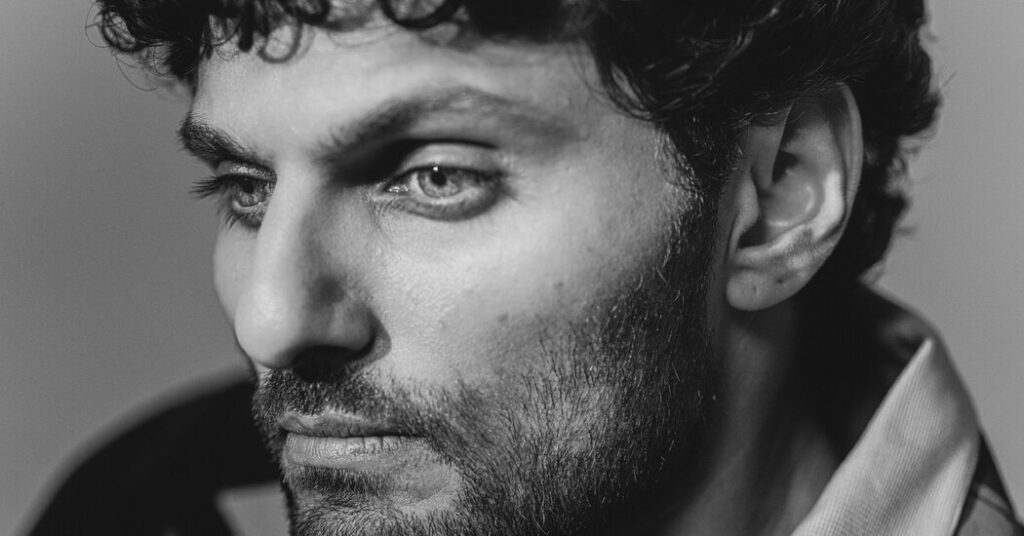
Jay Shetty is without a doubt a giant in the world of wellness and self-help. His podcast, “On Purpose,” which features interviews about personal growth with various experts and celebrities, is wildly popular. The show’s YouTube channel, which features those interviews as well as Shetty’s video essays about self-improvement, has more than five million subscribers. His books “Think Like a Monk” and “8 Rules of Love” were best sellers. And he has just started a production company, Perfect Strangers, that has already announced deals with Netflix.
Part of Shetty’s success has to do with his message: a breezy, New Age-leaning blend of pop psychology and life tips overlaid with a reassuring patina of Eastern spirituality. Another part surely has to do with his back story. As he tells it, Shetty was a wayward young man who wandered into a lecture by a monk from the ISKCON movement — that’s the International Society for Krishna Consciousness, better known as the Hare Krishnas — and then decided to change his life and become a monk himself. He eventually left that life behind and became an influencer, determined to, as he has put it, “make wisdom go viral.”
While there’s no doubt about Shetty’s success, I had some skepticism about him and his ideas that I wanted to explore. They were partly to do with a 2024 article in The Guardian that included allegations of plagiarism on Shetty’s social media platforms earlier in his career, pointed to allegedly misleading certification information put out by his online life-coaching school and even challenged the extent of Shetty’s training as a monk. (His lawyers defended his training and his school when that article was published, and they reiterated that defense to The Times. Shetty and I also discussed it.) But perhaps a greater part of my skepticism came from the seeming contradiction of a man who espouses monastic thinking while living a glamorous life in Los Angeles as a superstar influencer. But if there is a tension there, it’s one that, apparently, Shetty has been grappling with too.
Subscribe: Apple Podcasts | Spotify | YouTube | Amazon | iHeart
For people who aren’t familiar with you or your work, which of your beliefs are most fundamental to what you do as a wellness influencer? What are you trying to teach? I wouldn’t even say I’m trying to teach. The four things I’m encouraging people to reflect upon are the four most important questions I believe that we all have to answer in life. The first is, How do I feel about myself? The second is, What do I do for work? The third is, Who do I choose to love and receive love from? The fourth is, How do I choose to serve the world? All of my work is dedicated to helping people answer these questions for themselves.
To my mind, the big differentiator for you is the fact that you trained as a monk. Because of that training, there’s a sense of spiritual wisdom around your content. But it’s interesting because when I read your books or listen to you, I’m reminded of a lot of self-help material that I’ve encountered before, things like list making, gratitude journaling and the importance of breathing. So can you tell me about the interplay in your work between your spiritual training and secular self-help ideas? I’ve always been fascinated by the intersection between ancient wisdom and modern science. The Bhagavad Gita — which is the primary text that I reference in my books, that pretty much every modern growth idea or personal-development idea can be traced back to — is an incredible map and conversation starter for so much of the spiritual wisdom that I love to share. Recently we’ve been talking about the value of circadian rhythms and the need to see sunlight early in the morning. There’s something known as sun salutations in the Eastern tradition of yoga, where that’s exactly what you would do. They didn’t talk about it as a circadian rhythm starter, but that’s exactly how you’d start your morning. It’s really beautiful when there are practical ways of showing how these old ideas have a lot of validity today.
I wonder if people mistakenly think that they can decouple the spiritual practices from the true religious root of these things and use them in a fast-food kind of way. Do you see any inherent problem in that? I have a different perspective. Sometimes someone’s starting point in a deep practice may be really simple, and that may be them just dipping their toe in the water. That’s how we all start at something. During the pandemic, I did 40 days of meditation live on Instagram, Facebook Live and YouTube Live, and people could just join from their home. Is meditating on Instagram Live the deepest, most profound meditation? Probably not. But if that’s their starting point, then what a beautiful thing.
I’m interested in people’s turning points, so I’d like to ask about what I think was yours. You were a young man in London, going to business school, and on a whim ended up at a lecture by a monk whose name was Gauranga Das, and you had this epiphany. Can you tell me what you heard in that moment that was so powerful to you? It was beyond what I heard. It was seeing a man who externally was not attractive to me in any way, in robes with his head shaved, with an Indian accent. I didn’t understand why I was so attracted to him. But it was his sense of peace, his sense of ease, his sense of confidence in being so different. At that age in your life, you’re always trying to fit in, and he was someone who didn’t fit in at all but felt like the most comfortable person in the room. That was more important than anything he even said.
I think that one of the things that’s unusual about your arc is that it looks like an inversion of a typical monk’s journey. In the typical version, somebody decides to embrace monastic life and then renounces material things. It seems as if you decided to pursue monastic life, and now you’re doing pretty well for yourself financially. You hang out with glamorous people. You’re a successful entrepreneur. Are there any ways in which the spiritual tradition you trained in is in tension with the life you’re living? There’s a beautiful statement in the Bhagavad Gita that says attachment and aversion are two sides of the same coin. Often in our Western understanding, we see detachment as better than attachment. However, the spiritual understanding is far more refined. Detachment doesn’t mean aversion. Detachment means you can be close to anything in the world and use it for a higher purpose. Now, I’m not saying I’m doing that. I’m saying I’m trying my best. Every day I’m living in the quote-unquote real world, I’m reminded of my flaws. I’m reminded of how far away I am from truly living up to the spiritual pursuits that I have had for most of my life. I love that. I love being reminded of how far I have to go. And I would argue that I feel closer to growth in my current life than I ever did in the ashram, because in the ashram I could almost forget or think maybe I’d already found it.
Is there any part of you that thinks that’s an elaborate self-justification? I have questioned that many times. I think the spiritual philosophy of 5,000 years is pretty clear, so I take that as my authority. However, the other side of it, to be quite frank and honest, is I think it’s also a graduation. I’m married, I have businesses, we have teams, we have companies. I’m not a monk anymore. It’s partly why I wrote a book called “Think Like a Monk,” not “Live Like a Monk.” That was intentional, because everyone can think like a monk; I don’t think everyone, including me, can live like a monk for the rest of their life.
Is there a point at which thinking like a monk — if you’re not also living like a monk — stops being monklike thinking? That was my version of a Zen riddle. It’s a koan. [Laughs.] David, I really appreciate you. I can tell that you’re trying to understand it, so I want to try and meet you there and help you with that. Let me really sit with your question.
How much can you think like a monk if you’re not really trying to live like a monk? That’s the question. And my response to that is: What if thinking like a monk was the beginning of that journey, and living like a monk could end up being a potential pathway for the person who tries to do that? If every person in the world started to think like a monk, things would just improve in general, right? So I don’t want to force everyone to try to live like a monk because that’s not going to happen tomorrow or ever. I don’t think that’s ever been the goal, but it’s how can we take these mental practices and apply them to our everyday lives to improve our sense of peace and purpose? That’s the goal.
When I watch your material, there are some guests like Adam Grant, who is a highly credentialed organizational psychologist. Then you also have folks on like John Edward, the psychic medium. Do you think about what responsibility you have as far as the credibility of a given guest? Our team works very hard on figuring out who we think would be great to introduce to our audience. It’s a responsibility that we take very seriously. At the same time, we’re also listening to our audience as to whom they’d like to learn from, what kind of things they’re struggling with and challenged by. My job is to be curious for my community and to allow them to be involved in finding people that they believe are important for their healing.
Does skepticism fit into what you do? Absolutely. For example, I recently interviewed an astrologist, and that’s something that I had a lot of questions about, because I’ve never really felt that it was valuable or valid. So definitely my own personal interpretation comes into it, but it’s still coming from a place of wanting to learn. That doesn’t mean I always walk out a believer, but I am fascinated for my audience. Avoiding topics doesn’t gain any value.
But how do we figure out what’s true? Like, isn’t there also value in trying to determine whether or not astrology or psychic mediumship is actually true and not just a pseudoscience? I think you’re absolutely right. I just think that truth when it comes to healing is really, really open. Healing doesn’t look the same for everyone, and what helps some people won’t help other people, and that’s also true. So it depends what your definition of truth is. How do I prove that my love for my wife is true? What proves that? I’m not saying that there isn’t a way of answering that question, but it’s a very hard question to answer as fact because everyone will say something different. If I asked your wife, what proves to you that David loves you, and you asked my wife, they’d probably give very different answers.
The answer to what is proof of my love for my wife would be my actions every day. But the truth of that proof is a very different kind of truth than: Can the stars tell me what’s going on in my life? Or: Can we communicate with the dead? I don’t disagree with you at all. I’ve been both curious and skeptical in those interviews. I guess what I’m debating with you — and enjoying the discussion that we’re having — is that I think it’s really hard to call someone else’s personal experience of healing not true. And that is something that I’m not willing to put aside. I think it’s easier to be like, The facts are all that matters.
There was this Guardian article that came out in 2024, where the writer said you fudged specific details about what your actual training was as a monk, how much time you spent in India and the timeline of how all that happened. My question about that is whether you felt you had to simplify or elide details about your back story to make your story more legible to more people. I’ve always been open and honest about that time in my life. I lived as a monk for three years. I traveled across India, the U.K. and Europe. The value I gained from that time is the teachings and the lessons I share. That’s my focus, and that’s what I’m really about.
Were there things about the timeline that you felt you had to simplify? No, not at all. I am extremely clear and open about my experience. It was three years. It was traveling. I was learning deep meditation in India and then traveling to Europe to share and teach. That was part of our practice. I’ve created so much content, whether it’s my books, my podcasts, everywhere, that it would be hard for anyone to consume all of that, to really get the full picture. If someone was reading and listening and following me on Instagram and social media, they’d be able to very clearly see it. And they do.
There has been criticism of you for earlier in your career sharing words of wisdom without attribution. There were questions about whether aspects of your online coaching school’s accreditation were misleading in various ways. As far as I can tell, that stuff has all been cleaned up. But my question to you is, what might account for those missteps? Was there any intention to mislead? If you look at my videos, from Day 1 you’ll see me quoting, sourcing, crediting appropriately all the time. I value the work of so many other people that I share and wisdom from others that I’ve gained from and want to pass on. We actually have a team now that’s fully dedicated to crediting and sourcing and researching to make sure that all of those things are kept intact, and I’m really proud of that, because it’s such an important thing, to make sure that people who deserve the credit receive it.
But that was an issue earlier, right? What you’re describing is a change in practices? There’s so much wisdom out there, there are so many things being shared. It was never intentional, and that’s why if there were any discrepancies, they were definitely cleared up.
Are there things that you feel you’ve learned from criticisms you’ve encountered over the years? I’ve learned that intention is important and that there’s such a profound need to see anything that comes your way as a mirror, to see how you can improve in every way. Whether it’s feedback, whether it’s criticism, I look at it from the perspective of, How can I be better? I’m always willing to take that responsibility, because I think that’s what my teachers would want me to do. I mean, I’m so excited about the production company we’re building. I’m excited about all the work that we’re up to. I almost can’t believe that I get the opportunity to do this. I feel very grateful for it.
I was talking to someone about the production company that you’re launching, Perfect Strangers, and she said that one of the things that you’re interested in is being a destination for a certain type of celebrity interview. Is that accurate? No. “On Purpose” already is that. I want to tell stories that make people feel less alone. Did you see “Adolescence”?
Yeah. I was extremely moved by that. That’s like a gold standard of things that I’d love to be able to create and put out there. Stories that help parents have better conversations with their children, help partners have more efficient conversations with each other, content that allows people to have deeper conversations about mental-health awareness, to raise awareness of these things in a way that isn’t on the nose. I’m glad that you’ve seen “Adolescence” because that’s a really good example of something that I would aspire to make.
You talked about the subject of detachment in your work. Do you think you’ve practiced detachment in this interview? What’s your definition of detachment in that question?
In some of my questions around criticisms or controversies, you gave answers that felt safe and maybe a little more comfortable rather than detaching from what was safe. That’s why I ask. My definition of detachment is, Am I able to be present and open and honest and clear with you? And I’ve tried to do that to the best of my ability.
I spoke to Shetty again two days later.
Do you have any thoughts from our first conversation? Anything lingering? There’s something I wanted to share that maybe I didn’t get a chance to share with you. We talked a bit about criticism. For me, that’s uncomfortable. It’s hard because you’re trying to do something with the best of intentions. We all want to feel understood and seen. When you’re misunderstood or not seen in the way that you would like, it’s hard for everyone. It’s been very hard for me. And I think when you’re being judged, the first point is not to push that person away — it’s to see whether that exists in you. You can find that every intention, every desire exists within you, if you really take a look in the mirror and if you’re not scared. So when I look at my experience, I’ve come to this conclusion: I want to be deeply spiritual, and I want to be really successful. I want to be deeply connected to my monk principles, and I want to do really well as an entrepreneur. The balancing of that, very honestly and candidly, is worth pursuing rather than this fixation we have specifically in the West on being like, Well, I’m just going to be this.
I definitely have judged you in a certain way, and it’s a skepticism that comes from a particular perception of you. When I think of you as someone trying to operate within a spiritual or a mental-health realm, my skepticism grows. If I think about you as someone operating within an entrepreneur or influencer realm, you are much easier for me to understand. But those are my own hangups. I want to know how you think you should be perceived. What is the correct lens through which to understand Jay Shetty? I don’t fault you for that skepticism and that thought process because I’ve felt the same. The paradoxical nature of my journey is something I’ve had to live through and reconcile mentally, emotionally, spiritually, practically. It’s something I’m wrestling with on a daily basis. So when you ask how I want to be seen, it’s not an easy answer because I’d say that I want to be seen as someone who is striving spiritually and entrepreneurially at the same time. And I’ll tell you why I believe it’s a worthy pursuit: because the other choice is to say, OK, people can just be successful and not be spiritual. I don’t know if you want to live in that world, David. I don’t want to live in a world full of successful people who don’t have deeply held values and integrity and try to be of service.
I realize I didn’t ask this earlier: Why did you stop training as a monk? It was one of the hardest points in my life because it was my dream while I was at college. At one point I was thinking of quitting university and doing it then, and the monk teacher said to me, No, you should finish your education. I really believed that that was going to be my path. I really believed I was going to do it for the rest of my life. Whether that was me being naïve or my youthful enthusiasm at 22, I really believed it. So leaving wasn’t easy because I felt like I was failing. It felt like a divorce.
Was there a precipitating incident? It was extremely rough on my health. I’d spent time in the hospital during my time in the monastery both in India and the U.K. I was struggling. I had had polyps in my throat that had to be lasered out a year before I left. I had exhaustion, which some doctor said was chronic fatigue. I was emaciated. I weighed around 60 kilograms. So there was a massive health component that hit me hard. When your physical health goes, it affects your mental and emotional health even more. So, partly, feeling like a divorce and a failure was also because my physical health was falling apart. At the same time, I genuinely believe that all of that self-awareness made me realize I wasn’t a monk. Maybe I don’t have what it takes. That realization — I’m a bit distant from that emotion now — still hits me.
Jay, I know I’ve been implicitly critical or skeptical about the idea of quick-hit fixes or easy answers, but what’s one thing we can leave people with? [Laughs.]
What is one piece of advice you want to give people here at the end of our conversation that could help them when they go back to their lives? [Very long pause.] Sorry, I’m taking my time because you’ve asked me such a big question. [Pause again.] As humans, we have this tendency to say, God, the last five years in that job were a waste of time; now I’ve found my path. Or, That relationship just wasted three years of my life, and I don’t know if I’ll ever find love again. We have this habit of almost disregarding our experience, our lessons, our emotion, everything we’ve been through, and now saying we found it. I would encourage people to reflect on those moments, to learn from them, to value them, no matter how difficult and painful they might be. There will be so much value in it.
This interview has been edited and condensed from two conversations. Listen to and follow “The Interview” on Apple Podcasts, Spotify, YouTube, iHeartRadio or Amazon Music. Follow us on Instagram and TikTok.
Director of photography (video): Aaron Katter
David Marchese is a writer and co-host of The Interview, a regular series featuring influential people across culture, politics, business, sports and beyond.
The post The Wellness Guru Jay Shetty Has Raised Some Doubts. Including His Own. appeared first on New York Times.