The speculation about then-D.C. Mayor Marion Barry’s political future was mounting as scandals enveloped his administration and his reelection prospects grew dimmer.
A slew of names emerged as potential challengers, the most famous of whom had recently moved to Washington after losing the 1988 Democratic nomination for president: the Rev. Jesse L. Jackson.
The mayor waved off the chatter with his usual swagger.
“Jesse don’t wanna be no mayor,” Barry told the Los Angeles Times at the time. “Jesse don’t wanna run nothing but his mouth. Besides, he’d be the laughingstock of America! He’d be run outta town if he ran against me.”
Jackson, who died last week, was best known as the nation’s preeminent Black leader in the decades after the assassination of Martin Luther King Jr., advocating for racial and economic parity through his Chicago-based Rainbow Coalition and two presidential campaigns.
Yet, soon after losing the Democratic nomination in 1988, the reverend relocated to Washington, where he trained at least part of his attention on persuading Congress to grant D.C. statehood, a local issue that aligned with his broader focus on human rights.
For a time, Jackson also contended with persistent questions about whether he would campaign for the city’s top seat.
With speculation cresting in early 1990 after Barry’s arrest on cocaine charges, Jackson said he would not seek the mayoralty. Instead, the reverend later that year won a race to become D.C.’s shadow senator, an unpaid position that seemed like more than a step down for a man who got nearly 7 million votes in his second presidential race.
But Jackson saw possibility in the seat. It provided a Washington-based platform as he considered a third White House run, and he could also continue to champion D.C. statehood.
“As he went around the nation and the world promoting the National Rainbow Coalition, he was also talking about statehood,” recalled Bernard Demczuk, a onetime Barry adviser who also worked for Jackson at the coalition during those years. “Statehood was on the agenda wherever he went. He catapulted the issue to a higher level.”
The reverend’s interest predated his move to Washington. In 1988, he successfully lobbied Democratic Party leaders to include statehood as part of the party’s platform.
“Common good is finding commitment to new priorities to expansion and inclusion,” Jackson told delegates at the Democratic National Convention in Atlanta that year. Those priorities, he said, included “a commitment to D.C. statehood and empowerment — D.C. deserves statehood.”
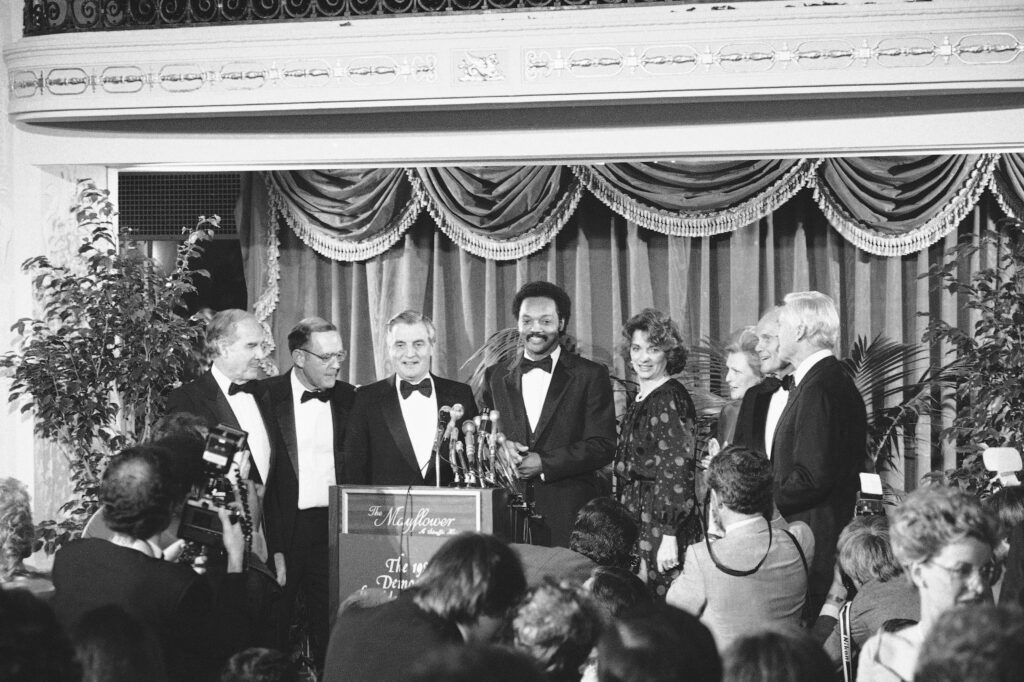
Jackson’s arrival generated excitement in Washington, known at the time as “Chocolate City,” home to a majority-Black population. Jackson had picked D.C. as the place to announce his 1984 campaign for president, addressing 2,500 supporters at the city’s convention center, on a stage alongside Barry.
“The reverend understood that D.C. was a power base for him,” said Donna Brazile, at the time an adviser to Eleanor Holmes Norton, who was running to become D.C.’s nonvoting representative in Congress. “It was a natural transition. This was the epicenter of the civil rights movement when the leaders settled down for the second phase of their careers.”
But it was also unclear what Jackson would do with the political capital he had amassed after two failed presidential campaigns. “There was a sense that he had reached his ceiling,” said Michael Fauntroy, a George Mason University policy and government professor. “The thought of a third presidential campaign did not look particularly legitimate. There was no real option in Chicago. He couldn’t win a governor’s race or a Senate race in Illinois.”
In Washington, Jackson chose to live in LeDroit Park, a predominantly Black neighborhood, buyinga two-story house on T Street NW for $100,000 from Howard University. His neighbors included Walter Washington, D.C.’s first mayor, and Frank Smith, a civil rights leader who had been a founder of the Student Non-Violent Coordinating Committee (SNCC).
The Jacksons embraced their new neighborhood. The reverend became a regular at Ben’s Chili Bowl, where he liked to eat breakfast a couple of times a week — “scrambled eggs and toast and raisin oatmeal,” Demczuk said.
The Jacksons also experienced the dangers that many Washingtonians were exposed to in the early 1990s, when the city’s homicide rate made it known as the nation’s “murder capital.”
Early one morning in 1992, as she and other family members were taking out the trash, Jacqueline Jackson, the reverend’s wife, saw two men race past and then heard gun shots. A man was shot dead a half-block from the Jacksons’ home. The reverend, asleep at the time, later characterized what his wife saw as “an execution.” Ten months before that incident, their house had been burglarized.
Jackson’s move to Washington made sense, primarily because he spent so much time in the nation’s capital, attending meetings at the White House and the U.S. Capitol, as well as political events around town.
But his move also raised questions about his plans, speculation that intensified as Barry’s own political footing became more tenuous. Jackson kept the chatter alive in 1989 by declining to comment when asked about running for mayor or by saying he had not yet made up his mind.
A Washington Post poll in May 1989 showed Jackson easily defeating Barry in a one-on-one race. But the poll also found that nearly half of those surveyed thought the reverend should stay out of the race. At the same time, the city’s deepening dysfunction fed the public’s appetite for new leadership.
“People were looking for a savior,” said Julius Hobson Jr., a Barry staffer around that time who had worked on Jackson’s presidential campaign. “I just didn’t see Jesse Jackson as that person. It had to be someone who understood the city and was prepared to do the grunt work of mayor. It’s trash pickup, it’s schools, it’s fire, it’s police, it’s roads. I knew him well enough to know that wasn’t Jesse.”
Regina Thomas, a Jackson staffer at the time, said the rumors about the reverend running for mayor were mainly driven by reporters’ inquiries and Washingtonians encouraging him. “I don’t think it was a burning desire of his,” she said. “It was more like, ‘I’m traveling the world, why do I want to do this?’”
On Feb. 25, 1990, Jackson put the speculation to rest at a news conference at the Metropolitan Baptist Church. Surrounded by clergy, he said he could best help the city “by continuing my work at the national level.” He acknowledged that his candidacy could have prompted accusations that he was a carpetbagger, but added: “We, in fact, in a tough contest could win.”
Five months later, he announced his candidacy for one of the city’s two shadow senator seats, a race he easily won. But his new job came with stark limitations, including that the position was unpaid and had no physical office.
The reverend did not hide his disdain for his new job title, including the word “shadow.” “That’s not the title,” he told reporters. “It’s United States Senator from Washington.”
A more substantive problem was that Jackson, as a shadow senator, could not speak from the Senate floor. Those who blocked him included moderate Democrats who feared that Republicans would seek to turn Jackson into the face of the national Democratic Party.
“The Democratic establishment didn’t want to be anywhere near Jesse Jackson, who was like a Bernie Sanders or an AOC figure at the time,” said George Derek Musgrove, a history professor at the University of Maryland at Baltimore County. “He was the leader of the progressive wing.”
Despite the limitations, Jackson turned his attention to the statehood battle. In 1993, he was among more than 30 demonstrators chanting “Free D.C.!” as they were arrested for blocking an intersection near the Capitol. Jackson said at the time that protests were necessary to pressure federal lawmakers into granting statehood.
“We will fill up these jail cells for righteousness’ sake,” Jackson told supporters.
In November 1993, the House voted 277-153 to reject a statehood bill.
Jackson, in remarks after the vote, chided the administration of then-President Bill Clinton and House Democrats for not pushing hard enough for passage. “This is a lost opportunity for Democrats and democracy,” Jackson said. “If the White House had pushed this, we would have won.”
D.C.’s quest for statehood endured, leading to congressional votes over the years, most recently when advocates won House approval in 2021 before the legislation died in the Senate.
Jackson did not seek a second term as shadow senator and returned to Chicago in 1996.
“He had given it an honest effort between 1990 and 1993,” Musgrove said. “But he was undercut by his own party and injured by his friends. They didn’t give him the one thing he was best at — a voice.
“If they had given him floor privileges, he would have easily been the most eloquent advocate for D.C. statehood to ever walk into the Senate chamber.”
The post The lesser-known part of Jesse Jackson’s legacy: His fight for D.C. appeared first on Washington Post.