When most people walk into a museum or a gallery, their eyes dart about the walls of corridors and halls, taking in whatever is on display: paintings in frames, sculptures on plinths, pottery shards in vitrines — the art, in other words. They are not necessarily preoccupied with where the dust sits in the room.
Bruno Goppion is not like most people. When he enters a museum, he is looking for, as he put it, an invitation to a pristine experience. Are the display cases cloudy? Is the paint on the wall chipped? Is there an exposed outlet? Is the work greeting the visitor, or is he or she left having to search for connection?
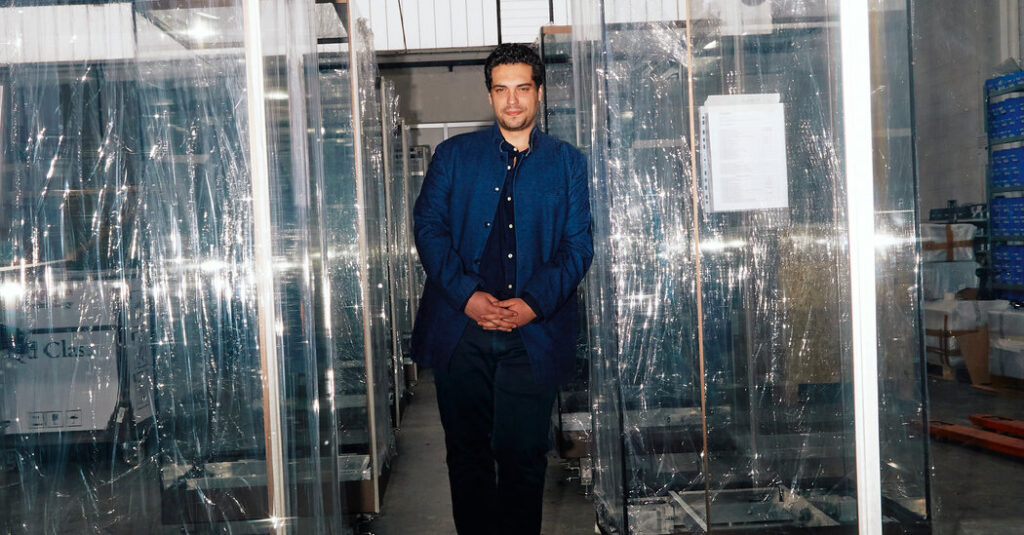
Mr. Goppion, 33, is the third generation of Goppion at Goppion, an Italian company that crafts display cases and exhibits for many of the world’s leading museums, including the Met, the Louvre and the National Gallery. As he sees it, if he does his job right, no one else will notice what he notices upon walking into a museum.
“I am figuring out always, when I enter a space, what it is this institution is trying to tell about the history or the meaning of what they’re exhibiting,” Mr. Goppion said. “What is it that makes a museum of art in Tokyo different than a museum in New York or Milan or Paris or London?”
In 1952, Mr. Goppion’s paternal grandfather, Nino Goppion, opened a modest glassmaking workshop in Milan. The younger Mr. Goppion studied history and economic geography at the Ludwig-Maximilians University in Munich, but his real education came from the company. He often sat on the floor of his mother’s office, crawling around, then toddling around, until finally he was walking around world-class museums with his parents.
“They involved me in everything, even when I was a little baby,” Mr. Goppion said. (His father, Alessandro, took over the company in the early 1990s.) “I got very curious in understanding why each museum and each architect wanted to have their own details and their own different characteristics. This trained my eyes and my perception.”
The company continued to grow from its humble origins, picking up high-profile institutional clients from Milan to Benin into the 21st century. Britain’s crown jewels are housed in a Goppion display, as are Neil Armstrong’s spacesuit and a 1297 issue of Magna Carta. But the company was jolted to a new level of prominence when it was entrusted to create a new display case to protect the Mona Lisa.
In 2005, Mr. Goppion’s parents brought him along to the unveiling ceremony at the Louvre. His eyes were peering at the Mona Lisa at such close range that he could see the striations of da Vinci’s brushwork. While others fawned at the masterpiece during its insertion in the display case, Bruno, then 12, was pantomiming soccer moves with a nearby security guard.
“It was not only a moment of celebration but also a moment of responsibility,” Mr. Goppion said of the ceremony. “If I get to have this privilege, to see these things and to be so near to them, well, then I also have the responsibility to bring them on and protect them with everything that I’ve got.”
Years of discernment have led him to be able to quickly home in on the strengths and shortcomings of a particular institution. “A beautiful collection but dusty displays is either a sign of missing fans or missing care,” he said. “And in each of the two cases, something needs to be done.”
In addition to a considered sightline or a crystal-clear display case, Mr. Goppion loves an icy serving of oysters and his Australian shepherd, Spritz — the official Goppion mascot. When he is in New York, usually for work, he can often be found at the Grand Central Oyster Bar.
Goppion’s clients in the city include institutions both large (the New York Public Library) and specific (the New York Yacht Club). On the 15th floor of the New York Times Building, notes from the Pentagon Papers and other ephemera from 175 years of reporting are presented behind Goppion glass.
The company recently supplied 282 display cases for a splashy 2025 redesign — led by WHY Architecture — of the Michael C. Rockefeller Wing at the Metropolitan Museum of Art. Now, Goppion is working on another gallery renovation at the Met that will bring together art from West Asian antiquity and ancient Cyprus.
Declan Kiely, the executive director of the Grolier Club, a 142-year-old bibliophile society in Manhattan, is one of the few current or former clients who spoke freely about his experiences working with Goppion. (Several nonprofit and state-run institutions, including the Louvre, declined to comment, citing a desire not to be perceived as endorsing a for-profit concern.)
Mr. Kiely, who has worked with Mr. Goppion at the Grolier Club and in his former capacity as director of exhibitions at the New York Public Library, described Mr. Goppion as “incredibly respectful of the items he gets to protect.”
At the library, Mr. Kiely enlisted the Goppion company to encase a Gutenberg Bible from 1455 (the first to come to the United States,) the original Winnie-the-Pooh as well as a desk and chair that were used by Charles Dickens for many years.
“We went with Goppion because the cases, they disappear,” Mr. Kiely said. “What I wanted was people to have as unobstructed, close encounter with those materials as you possibly could. The downside of that is that people frequently bang their foreheads on the glass because it’s almost invisible, and so you hear these bumps throughout the day.”
Mr. Kiely suggested that Mr. Goppion’s “enormous curiosity for the works that are displayed in the cases” makes for better cases. He said, “He is absolutely devoted to ensuring that the type of case that they’re making is best suited for the artifacts that you’re showing.”
That care comes through in conversations with Mr. Goppion, which, no matter the question, have a way of bending back toward the importance of crafting a seamless encounter between art, history and visitor.
“The fact that these museums in different parts of the world go through the same process, and I get to see some of them, I think that is a real privilege,” Mr. Goppion said. “It gets me going and motivates me to work and to build for what comes next.”
Sandra E. Garcia is a Times reporter covering style and culture.
The post See a Museum Through His Eyes? He’d Rather You Not. appeared first on New York Times.