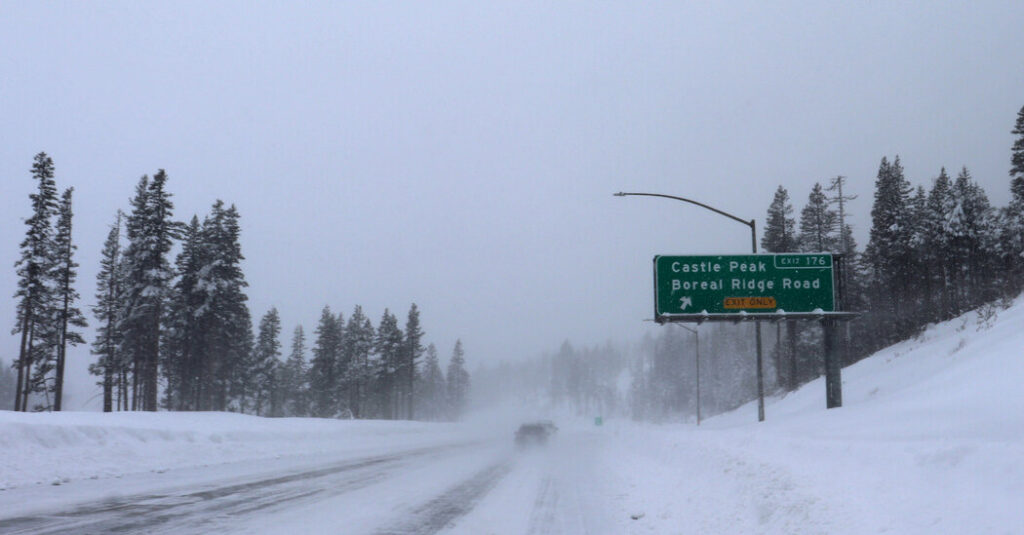
This week’s avalanche near Lake Tahoe, which killed at least eight skiers, along with an unusually high number of avalanche deaths in Europe this winter — more than 90 people, many of them skiers — has raised questions about safety in the backcountry.
Lured by the siren song of untouched powder and solitude, these skiers and snowboarders explore slopes in areas away from ski resorts, where, unlike in the backcountry, avalanche hazard is largely mitigated.
While avalanche fatalities make headlines, they remain rare. Last winter, 22 people died in avalanches in the United States, half of them backcountry skiers or snowboarders. Over that same period, an estimated one million skiers entered the backcountry away from ski resorts, according to figures from Snowsports Industries America, a trade group (the number doesn’t include backcountry snowboarders). This winter, there have been 15 U.S. avalanche fatalities, including 12 backcountry skiers or snowboarders.
More common risks of backcountry skiing include injury, hypothermia, equipment failure and getting lost. “Over the past 10 years, backcountry skiers and snowboarders have the most rescue calls,” said Matt Hansen, the communications director for the Teton County Search and Rescue Foundation in Jackson, Wyo., a popular destination for winter sports.
How do backcountry skiers manage risk?
Do the dangers of backcountry skiing mean you should just stay home or stick to the relative safety of a ski area? Or take up pickleball?
A more realistic view is that taking precautions can greatly minimize the odds of being caught in an avalanche or requiring rescue.
As the specialized skis, boots and bindings used by backcountry skiers have become lighter and better performing, so has the essential safety gear: beacon, shovel and probe.
Additionally, backcountry skiers have increasingly easy access to educational resources about how to approach avalanche terrain and other backcountry hazards. The American Institute for Avalanche Research and Education started a free, hourlong online course last fall called Avalanche Aware, aimed at backcountry novices. The nonprofit organization also maintains a list of the in-person classes it strongly recommends.
Likewise, in January, the Colorado Avalanche Information Center introduced several updated tools that help people gain access to and analyze information critical for backcountry travel. These include a statewide map of weather stations with real-time data, an expanded accident database and an easier way to submit and read field reports from skiers around the state.
The nonprofit 10th Mountain Division Hut Association, which oversees a well-established system of 35 huts in the Colorado backcountry, last year produced a six-minute video that examines two real rescues. “We realized a need to improve the information for backcountry visitors. Often, it’s not just one mistake but several, and then they all pile up,” said Ben Dodge, 10th Mountain’s executive director. “We want to increase the odds that people’s trips go according to plan, and that if one or two things go wrong, it doesn’t result in a major rescue or a fatality.”
Is backcountry skiing becoming more popular?
In the United States, the pandemic-driven backcountry surge has leveled off, according to numbers tracked by S.I.A., though participation remains strong.
The huts in Colorado receive a high level of demand, Mr. Dodge added, because of population growth in the state and an increased desire to experience quiet and solitude in nature. Prime weekends and holidays book up for the following winter through a lottery held in March. Yet these hut users rarely require rescuing, he said, even though 95 percent of them travel to the huts on unguided trips.
Can an experienced guide keep you safe?
Hiring a guide can reduce much of the uncertainty — though, as the recent Lake Tahoe avalanche showed, it’s no guarantee.
“Anytime you go into the backcountry with a guide, you need to be an active participant,” said Lynne Wolfe, a longtime ski guide and educator in Driggs, Idaho, and a former editor of The Avalanche Review, a publication of the American Avalanche Association. “Pay attention, look at the avalanche forecast and have honest conversations with your guide.”
The American Mountain Guides Association accredits backcountry ski and snowboard guides in the United States. Candidates must first complete a series of courses and demonstrate proficiency in a breadth of skiing, mountaineering and first-aid skills. The process can take several years to complete, said Eric Henderson, a former A.M.G.A.-certified guide and the chief executive of an outdoors-oriented public relations firm, Meteorite PR, in Colorado. A guide must then have a permit or, more likely, work for an outfitter that holds a permit to bring clients to specific locations on public lands.
Being a ski guide requires “an interesting mix of technical skills and people skills,” said Jeff Banks, a guide based in Crested Butte, Colo., and a founder of AspectAvy, an app that maps real-time avalanche danger. Those skills include being able to expertly analyze terrain and snowpack, navigate in the backcountry, manage group dynamics and handle medical emergencies with minimal resources. Mr. Banks, who received European accreditation from the International Federation of Mountain Guides Associations, noted that in Switzerland and Italy, guides can face stiff penalties for accidents that occur in areas of high avalanche hazard.
What happens before an outing?
If you join a guided outing, you can expect several pretrip steps.
Your guide will brief everyone, either the night before or on the morning of a trip, about snow and weather conditions, intended routes and the risks you may encounter, as well as the steps everyone can take to reduce them, said Mr. Banks. You’ll also practice using your beacon, shovel and probe.
Before hitting the trail, the guide will check that all members of the group have their beacons turned on and in “send” mode (an important step for any self-guided group, too).
Mr. Banks encourages participants to ask questions, both before and during a trip. Doing so not only helps them better understand current conditions and decisions but also learn more for future trips. Guides can benefit, too. “I believe in no hierarchy,” said Mr. Banks. “A client briefing, for example, is a great opportunity for an untrained person to inject some common sense.”
So, is backcountry skiing safe?
As with any sport, risks can never be entirely eliminated. Equipment failures, errors in judgment and unforeseen weather events — especially when compounded with each other — can all tip the scales.
Emma Walker, education director for the A.I.A.R.E., points out one vulnerability in backcountry decision making that’s hard to avoid: false confidence. “We don’t get real-time, consistent, reliable feedback on whether the choices we made were right or if we just got lucky,” she said. “This is especially true when there is uncertainty because of weather, snowpack conditions, the humans in a group or a combination of factors.”
Experts say that turning around, in the event of fear or discomfort, is always an option.
“The mountains will be there another time,” Ms. Walker said. “And that’s how you can make sure you are, too.”
Follow New York Times Travel on Instagram and sign up for our Travel Dispatch newsletter to get expert tips on traveling smarter and inspiration for your next vacation. Dreaming up a future getaway or just armchair traveling? Check out our 52 Places to Go in 2026.
The post Powder’s Siren Song: The Risks and Rewards of Backcountry Skiing appeared first on New York Times.