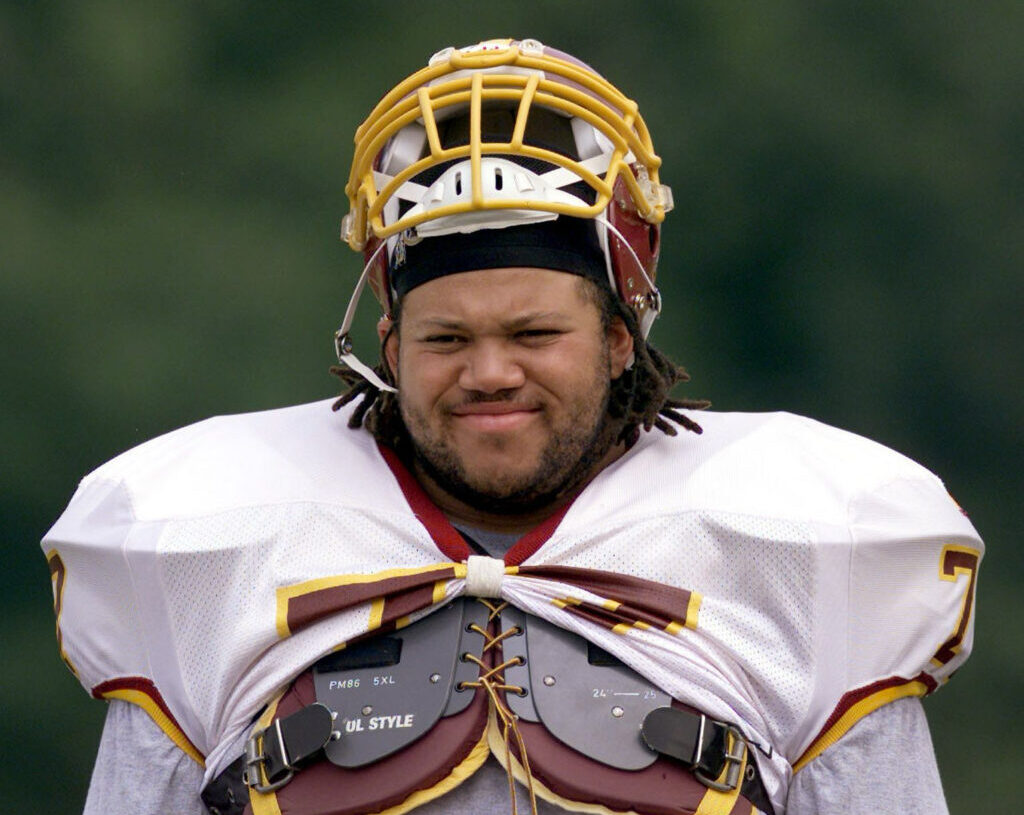
On the football field, Tre’ Johnson was a warrior — a bruising 300-plus-pound offensive lineman who protected Washington quarterback Brad Johnson from cheap shots; cleared the way for Stephen Davis, the team’s all-pro running back; and proudly called himself a “head banger,” punishing opponents with his body even as he embraced the sport’s cerebral side, spending hours in the film room to refine his technique.
But after nine seasons in the NFL, eight of them in Washington, Mr. Johnson found a new calling, one that offered him a chance to showcase the easygoing wit and charm he had flashed in radio hits and postgame interviews: high school history teacher.
Trading his burgundy-and-gold uniform for khakis and a sweater, Mr. Johnson taught and coached track at Landon, a private boys’ school in Bethesda, where he worked with teenagers who considered him as much a mentor as an instructor.
“He had this incredible ability to make everyone feel that their voice mattered,” said Spencer Whalen, a Landon alum who arrived at the school in 2004, the same year Mr. Johnson did.
“I was not a traditional Landon student, didn’t really have the same means as everyone in the class,” Whalen said. “Came from over an hour away; had a single mom. To add insult to injury, I was also gay, which I didn’t know at the time. Tre’ knew I was a different person before I did.”
Mr. Johnson turned his classroom into a refuge, Whalen said, and offered track advice that went far beyond the mechanics of long-distance running.
“Spencer,” he offered before one race, “in order to find yourself and be the best you can be, you’ve gotta be you.”
“It was earth-shattering at that moment, as a teenager trying to be like everybody else,” Whalen recalled. “He got me to see more in myself than I knew was there.”
Mr. Johnson continued to teach at Landon until last fall, when he went on leave while dealing with unspecified health issues. He was 54 when he died Feb. 15, “suddenly and unexpectedly,” after collapsing during a family trip in High Point, North Carolina, said his wife, Irene Johnson.
His death brought an outpouring of grief from colleagues and former students who remembered Mr. Johnson as a warm and gifted teacher, someone who wore his NFL accolades lightly — he earned Pro Bowl honors in 1999 — but wasn’t shy about speaking out against his former team’s name, which he and many others considered a racist slur.
“He was an all-pro football player, but he was also an all-pro intellectual,” said John Bellaschi, Landon’s director of ethics, service and leadership. “He had a real ability to connect with, engage and inspire students.”
At a predominantly White school where annual tuition costs more than $50,000, Mr. Johnson proved adept at helping students navigate thorny discussions of race, history and culture. “There’s a certain trust in his classes that makes you want to speak,” 15-year-old Josh Hunter told The Washington Post in 2012. “Some teachers don’t rub off on you the same way.”
Landon has grown more diverse in recent years. But “when you’re looking at your teachers, there’s not necessarily teachers that look like you,” said Joel Desroches, a Landon graduate with Haitian heritage. “Tre’ was that person for a lot of us.”
“Knowing somebody that achieved so much but cared about us,” he added, “was kind of an indicator that hey, nothing’s too big, nothing’s too small.”
The 6-foot-2 Mr. Johnson was hard to miss on Landon’s 75-acre campus. Few of his students were around for his NFL glory days, but they knew his highlights and reputation. When Washington Post reporter Liz Clarke visited his classroom for a story in 2012, she watched as students peppered him with questions.
Could he have blocked Baltimore Ravens linebacker Ray Lewis? How about Hannibal? Genghis Khan? “The whole Trojan army”?
Mr. Johnson responded with some of his old gridiron swagger before steering the conversation back to the day’s lesson. “There’s nobody on the planet I couldn’t block!” he said. “All-pro or not, I’m gonna put him on his pockets!”
On the field, his success seemed almost preordained. Born in Manhattan on Aug. 30, 1971, Edward Stanton Johnson III was a third-generation pro athlete. His father played professional basketball; one of his grandfathers was a boxer, and the other played in baseball’s Negro Leagues.
Raised mainly by his mother, a nurse, Mr. Johnson grew up in Peekskill, New York, where he played football and starred on the track team. He was a standout in shot put and discus, with exceptional upper-body strength that helped him play left tackle, looking after the blind side of the quarterback, while at Temple University in Philadelphia.
Mr. Johnson was projected to be a first-round NFL draft pick as a junior. But he stuck around for one more year, long enough to complete a master’s in social work to go with his bachelor’s degree in social administration. He was selected by Washington with the 31st overall pick, early in the second round.
“Tre’ is the most physical athlete I’ve been around,” Coach Norv Turner told the New York Times in 1995.
Mr. Johnson battled repeated injuries while playing on Washington teams that struggled to sustain success. The franchise made the playoffs only once with Mr. Johnson, in 1999, when the team went 10-6 before losing to Tampa Bay in the divisional round. He later played with the Cleveland Browns for a year, then returned to Washington for one last season in 2002.
In 2005, he married Irene Johnson, whom he had met at training camp years earlier, when she was filming practice sessions as a videographer for NewsChannel 8. “Why is all the video of Tre’ Johnson?” her producer had asked.
During his playing days, Mr. Johnson said, he had promised his mother he “would never let football define me.” As a teacher, he said he aimed “to make an imprint on these students about accountability and responsibility,” demonstrating how “you’ve got to be willing to do the little things, and whatever it takes, to be successful.”
Mr. Johnson kept his health struggles private — “he had a lot of underlying conditions,” his wife said — but acknowledged that football had taken a toll. He endured 19 surgeries, found it difficult to look at bright or fluorescent lights, and was unable to sleep for more than three hours at a time, Clarke reported in 2012.
But among students and teachers, his energy seemed boundless. He was enthusiastic about psychology and sociology, French bulldogs and lacrosse. He rode a motorcycle and dreamed of taking his car all the way to Alaska, telling friends about the modifications he wanted to make so that he could travel cross-continent, across stretches of western Canada devoid of gas stations and asphalt.
Above all, friends said, he was a devoted father of five, going to lacrosse games and football practices to see his children in action. “He did everything he could for those kids,” said W.T. Miller, a French teacher at Landon.
The day before he died, Mr. Johnson and his wife were at Hampton University in Virginia, attending one of their sons’ college lacrosse games. Mr. Johnson had been in and out of the hospital for months, Irene Johnson said, but was determined to see his son play.
“He did what he wanted to do,” she said. “He wanted to go to that game. We went to that game. And he was happy.”
The post NFL Pro Bowler Tre’ Johnson, dead at 54, found a new calling as a teacher appeared first on Washington Post.