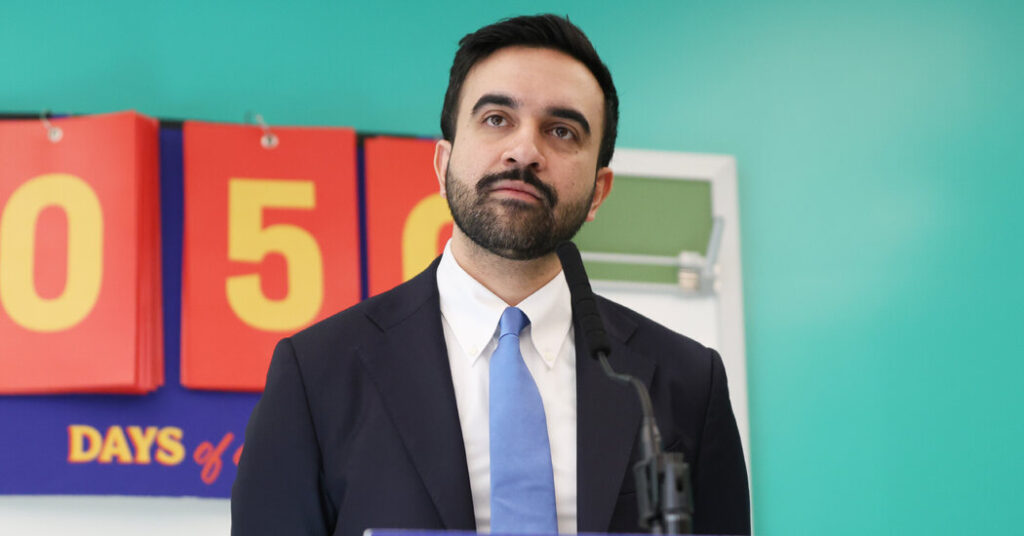
Mayor Zohran Mamdani on Friday announced an enforcement push by the city to crack down on employers that might be violating the city’s worker protection laws, days before a new law takes effect expanding time-off protections for more than five million New Yorkers.
At a news conference at a deli in Maspeth, Queens, an industrial neighborhood where some warehouse workers have complained about their employers’ time-off policies, Mr. Mamdani praised a law enacted last fall that assured 32 hours of unpaid time off for most full-time workers in the city. The law also expands the situations in which workers can take time off to include caring for children on school holidays, providing care to family members with disabilities and attending court hearings.
The law, which is scheduled to take effect on Sunday, is important for workers “to make sure that they don’t have to choose between their lives and their livelihood,” Mr. Mamdani said during the event, which was held at Angelo’s Deli.
Mr. Mamdani and Sam Levine, the commissioner of the city’s Department of Consumer and Worker Protection, also introduced a new enforcement effort to help workers take the time off that they are afforded by law. The push began with warning letters to 56,000 companies across the city — including every restaurant — informing them of the law’s requirements and the consequences for violating them. Employers that violate the law could face $250 to $2,500 in civil penalties per employee, plus back pay.
The department will also begin tracking employers by how much time their workers take off. In a report published this month, the city found that among workers who could take paid sick leave, half reported having missed at least one day of work last year because of illness, injury or disability. When the city finds companies where workers consistently take no days off, the Department of Consumer and Worker Protection “will treat that as strong evidence of potential violations,” according to a news release by the city, and will carry out formal investigations into employers suspected of such violations.
“There are folks who feel if they stay home to care for a family member or respond to an emergency, that they could risk losing their job,” Mr. Levine said. “Workers are humans. Humans get sick. Humans have families. Humans are not robots.”
The City Council passed New York’s first law on paid sick time in 2013, overcoming a veto by former Mayor Michael Bloomberg and years of lobbying, much of it by fast-food companies opposed to the bill, said Gale Brewer, the council member who proposed the legislation. The law has been revised several times since then, and it currently affords 40 hours a year of paid sick time to workers at small companies and 56 hours to those at larger businesses. Employers also must provide 20 hours of paid prenatal leave.
The latest changes, passed by the council in October, add 32 hours of unpaid time starting immediately when a worker is hired and again on the first day of every new year. Workers also can take time off during public emergencies, such as snowstorms, and to respond when the employee or a family member is the victim of workplace violence.
Violations of the law are especially common in the food service, retail and warehouse industries, said Inimai Chettiar, the president of A Better Balance, a nonprofit advocacy group that operates a phone line for workers seeking legal help.
In contrast to when the city passed its first sick-time protections, in 2013, this time around there were no major objections from local political figures or trade groups, said Sandy Nurse, the council member from northeast Brooklyn who introduced the measure.
“This wasn’t a hard sell to the council at all,” Ms. Nurse said.
Christopher Maag is a reporter covering the New York City region for The Times.
The post Mamdani Announces Plan to Enforce Time-Off Protections for N.Y.C. Workers appeared first on New York Times.