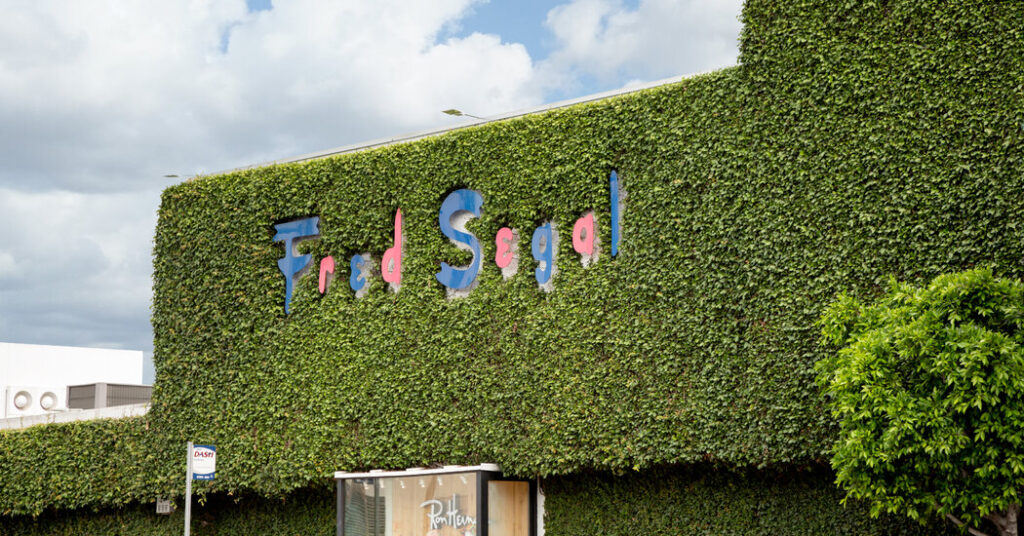
Will the third time be the charm?
Fred Segal, the Los Angeles retailer that was once synonymous with pop culture and celebrity, but more recently has been known for its frequent changes in ownership, has once again found a new owner. This time, Aritzia, the Canadian mass-market retailer known for its minimalist styles, is trying to revive the beleaguered American brand.
Aritzia Inc. has acquired Fred Segal from the Segal family, and has signed a lease agreement to open a Fred Segal store at 8100 Melrose Avenue, the former site of the iconic Fred Segal flagship store which opened in the 1960s and shuttered in 2017. Jennifer Wong, Aritzia’s chief executive, said in a news release that the company plans to “steward and evolve this iconic brand for a new generation.”
Aritzia and a representative of the Segal family did not disclose the financial terms of the acquisition nor Fred Segal’s valuation.
The fact that Aritzia, which sells fashion marketed as accessible luxury, absorbed a legacy brand known for an emphasis on tight curation and for spotlighting emerging designers, is somewhat emblematic of the current retail landscape.
Traditional luxury retailers, such as department stores, have long been troubled by a lack of innovation. This has helped to put Aritzia in a position where it can cater to luxury shoppers who want to spend less because of high inflation and tariffs, which the U.S. Supreme Court struck down on Friday, and appeal to fast-fashion fans who see Aritzia’s items, which are priced between $28 and $598, as an investment purchase.
Fred Segal founded his namesake brand in 1961 and opened its first store in Los Angeles that same year, selling jeans for $19.95 a pair. It was a steep ask at the time, considering that the average cost for jeans was $3 a pair.
The brand quickly gained attention with the private-school set, musicians and mothers and daughters looking to splurge. Mr. Segal, who died in 2021, was credited for pioneering a style that would soon become synonymous with Los Angeles: low-slung denim, tight fitted T-shirts and Danskin leotards.
His brand also gained cultural cache as it became known for its careful curation of young designers, with whom Mr. Segal had close relationships. The retailer carried brands like Kate Spade, J Brand and Juicy Couture alongside European labels like Dries Van Noten and Maison Margiela. Fred Segal attracted figures such as Diana Ross, Lenny Kravitz, Paris Hilton and Kendall Jenner, and it was name-checked in films including “Legally Blonde” and “Clueless.” The store was often included as a stop on tours of Los Angeles.
At its height, the brand operated nine stores in California as well as locations in Switzerland, Taiwan and Malaysia. The business, however, struggled to stay relevant in the advent of e-commerce and as other retailers piggy-backed off what Fred Segal was long the purveyor of: experiential retail.
In 2012, the brand’s licensing rights were acquired by Sandow Media, with Evolution Media Partners owning a minority stake. Then in 2019, Fred Segal was sold to Global Icons, which sought to expand the brand’s footprint, including in home décor. In 2024, Fred Segal closed its clothing stores in Los Angeles, which by then had been reduced to two, citing “challenges in the retail industry and the impact of the Covid-19 pandemic.”
In an interview with the Los Angeles Times in 2024, Jeff Lotman, the chief executive of Global Icons, discussed the headwinds that Fred Segal faced. “One of the challenges for us was that 90 percent of the brands that we carried were available elsewhere online,” he said. “Margins became very thin.”
The Segal family, via a legal representative, told Forbes in 2024 that “this is not the end of the road for the brand” and that it would be seeking a new operator for the business.
With Aritzia, it has found a partner that will “guide the brand to new glory,” according to a statement from the Segal family shared by Larry Russ, the family attorney. Aritzia’s success has ballooned under the leadership of Ms. Wong, who has overseen its continued expansion into the United States. In January, the company reported net revenue of 1.04 billion Canadian dollars in the three months ending Nov. 30 2025. Last year, Aritzia opened more than a dozen new stores in the U.S., some of which are outfitted with larger dressing rooms, styling suites, lounge areas and cafés. To propel Fred Segal forward, Aritzia plans to lean on “curated product and immersive experiences,” according to the news release announcing the acquisition.
“We have enormous respect for Fred Segal’s heritage and legacy,” Ms. Wong said in an email, “and our goal is to protect what made the brand a cultural icon while bringing it under Aritzia’s creative direction and operational rigor.”
Yola Mzizi is a reporter for the Styles section and a member of the 2025-2026 Times Fellowship class, a program for journalists early in their careers.
The post Fred Segal Has a New Owner. Again. appeared first on New York Times.