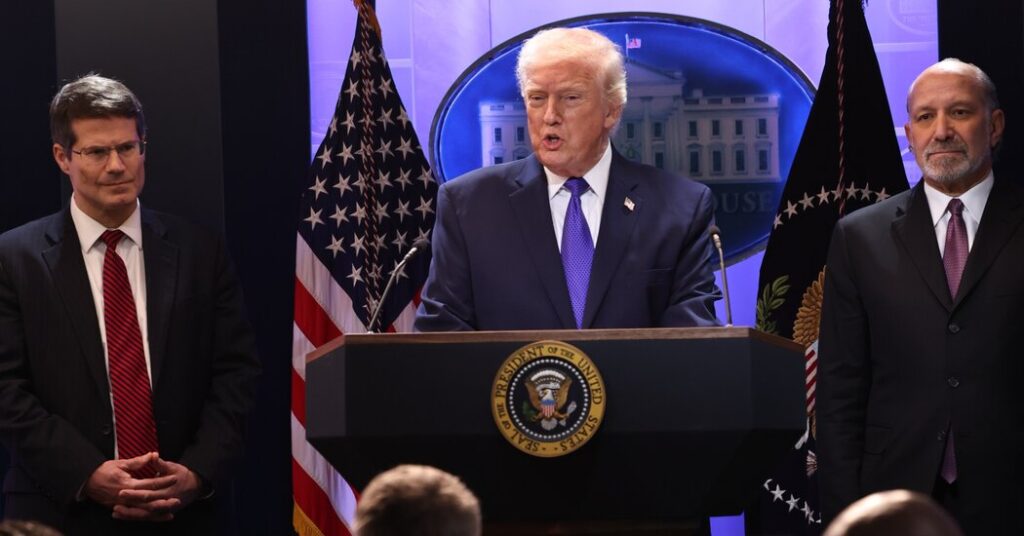
President Trump’s furious response on Friday to the Supreme Court’s tariffs decision underscored his insistence that he should be granted expansive powers to carry out his agenda as he wishes.
Lashing out after the court decided that he had exceeded his authority in imposing an array of tariffs over the last year, Mr. Trump labeled the justices who ruled against him “fools and lap dogs” and suggested that they had been corrupted by unspecified foreign influence and “slimeballs.”
“I’m ashamed of certain members of the court, absolutely ashamed for not having the courage to do what’s right for our country,” the president said. He suggested that Justices Neil M. Gorsuch and Amy Coney Barrett, whom he nominated during his first term, were “an embarrassment to their families” because they sided with the majority against him.
The Trump administration has consistently criticized and sometimes defied lower court rulings that it does not like. Mr. Trump’s bitingly personal attacks on the highest court in the land on Friday appeared intended to undercut the authority of the justices to rein him in and highlighted his lack of deference to the constitutional separation of powers.
At the same time, Mr. Trump gave no indication that he would defy the court’s ruling, pivoting quickly to impose new tariffs using other, more constrained, mechanisms that are still available to him.
He said one set of trade powers, known as Section 122, would be used to impose an across-the-board 10 percent tariff, starting on Tuesday. And he said he would use another set of powers, Section 301, to open investigations into unfair trade practices, which could yield additional tariffs.
The president’s remarks on Friday were revealing about how he views Supreme Court justices, not as independent legal thinkers appointed for their expertise or as a constitutional check on his administration, but as appointees who should be loyal to him.
Until now, the court had been remarkably deferential to him, repeatedly allowing policies that have been challenged in court to go into effect while litigation proceeds. Friday was the first time the court has issued a final ruling on the legality of a piece of Mr. Trump’s agenda.
“Before the entire world, it was the president’s most spectacular display yet of his utter disrespect for the Constitution and his contempt for the Supreme Court of the United States,” J. Michael Luttig, a conservative retired federal appeals court judge, said in an interview.
And while the president ripped into the justices who opposed him, he lavished praise on those who sided with his administration.
“I’m so proud of him,” Mr. Trump said of Justice Brett M. Kavanaugh, whom he referred to as a “genius.”
Mr. Trump said the three justices who ruled in his favor were “happily invited” to his State of the Union address next week.
The others?
“They’re barely invited,” he said. “Honestly, I couldn’t care less if they come.”
He said members of the court who were appointed by Democratic presidents were reflexively against him.
“I can assure you, the Democrats on the court are thrilled, but they will automatically vote no,” Mr. Trump said of the justices who ruled against him, adding: “They also are a frankly, a disgrace to our nation, those justices. They’re an automatic no, no matter how good a case you have. No, you can’t knock their loyalty. It’s one thing you can do with some of our people.”
But Justices Gorsuch and Barrett, in particular, seemed to get under his skin.
In his concurring opinion, Justice Gorsuch wrote that Mr. Trump had illegally gone around Congress in ordering his sweeping tariffs. He said the legislative process is a “bulwark of liberty” and warned that if Mr. Trump subverts the Constitutional process, a Democratic president could be justified in doing the same.
“They’re just being fools and lap dogs” for political opponents, Mr. Trump said, adding: “They’re very unpatriotic and disloyal to our Constitution. It’s my opinion that the court has been swayed by foreign interests and a political movement that is far smaller than people would ever think.”
Later, of Justices Gorsuch and Barrett, he said, “I think it’s an embarrassment to their families, the two of them.”
Mr. Trump said he had tried mightily not to offend the justices before the ruling.
“I wanted to be very well behaved, because I didn’t want to do anything that would affect the decision of the court,” the president said. “Because I understand the court. I understand how they’re very easily swayed. I want to be a good boy.”
Legal experts said Mr. Trump’s broadside against the court was remarkable.
“In my professional career, I don’t remember any president attacking judges in quite so personal way,” said Jeremy Fogel, a retired federal judge and former executive director of the Federal Judicial Center. “Presidents of both parties have been unhappy with major decisions. That’s not unusual and sometimes they’ll express pretty extreme disappointment about what the court did, but the name-calling in my experience is unprecedented.”
And even though Mr. Trump gave no indication that he would defy the court, his rhetoric was damaging nonetheless, legal experts said.
“The larger problem is that in the long term, the more that government actors — and the president’s obviously the most visible one — are stirring up public clamor over the legitimacy of the court, the more that has the effect of potentially weakening the court,” said Stephen I. Vladeck, a Georgetown University law professor.
Luke Broadwater covers the White House for The Times.
The post Even After Supreme Court Ruling, Trump Insists He Can Do as He Wishes appeared first on New York Times.