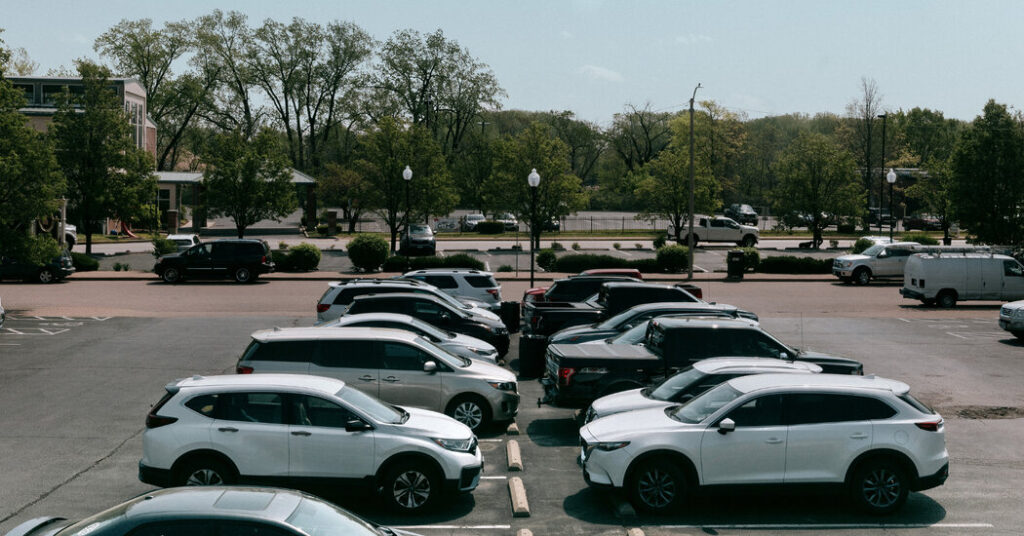
America, we often hear, is a deeply divided country. To our ideological divisions, allow me to add one of the vehicular kind: people who pull into a parking lot space versus those who back in.
For decades, there were generally agreed-upon standards and norms around parking. You entered a lot, saw an open spot and pulled in, like everyone else. But in the past few years, it seems to me something has changed in our national parking lots.
Perhaps you’ve noticed it at the supermarket or CVS. Amid all the cars that are parked headfirst, a seemingly increasing number have instead been backed in. These dissenters face out, like getaway drivers in a bank robbery ready to make a clean escape. Some people, myself included, find the move annoying.
William Van Tassel, the manager of driver training programs for AAA, confirmed my suspicion — and said that perhaps it was because they were following AAA’s updated guidelines.
“We started promoting this around 2020,” he said, in curriculum distributed to driving instructors at public and private driving schools throughout the United States.
“In general,” said Mr. Van Tassel, 59, who lives in Orlando, Fla., and drives a Porsche Cayman that he indeed backs in, “it’s a good idea from a safety perspective.”
My own theory is that reversing into a space is a response to the ambient anxiety in our society, akin to privately noting the exits in a movie theater. In a nation of rampant gun violence, backing in so you can quickly get out provides a sense of security.
Imminent Threat Solutions, a Texas-based company that teaches people to “prevail against all threats,” as its website says, recommends “tactical parking” — i.e., backing in — for swift evasion. “Next time you park somewhere, start war-gaming it,” the company suggests. “What if I was being chased?” they advise drivers to consider.
But perhaps there are more prosaic reasons, too. Some years ago, Matthew Dicks, a schoolteacher in West Hartford, Conn., noticed that a colleague would back in each morning, despite the extra time it took her to fit between parked cars.
One day, he asked her why.
“She hated her job,” Mr. Dicks, 55, said. “She told me, ‘I just want to get out of here as quickly as possible at the end of the day.’”
Although Mr. Dicks thought backing into a space was “ridiculous,” he kept an open mind, as you might if a friend said they dressed their hot dog with mayonnaise. He decided to try it for a week.
“Right away, I discovered that backing up is always harder than driving forward,” said Mr. Dicks, who wrote a blog post in 2016 laying out his arguments, including that the narrowness of a standard parking space (7.5 to 8.5 feet) relative to the width of a highway lane (12 feet) makes it more dangerous to reverse into a spot.
Mr. Dicks also believes reversing into a spot is discourteous: Other drivers must wait while you position your car, causing congestion in busy parking lots. He concluded his study with a message for his fellow drivers: “Stop backing into parking spots. It makes no sense.” (He has received multiple emails every month for several years from angry backer-inners making their case.)
Lately, I find myself doing the lazy man’s version of backing into a spot — that is, finding two open spots in a line and “pulling through” so I’m facing forward. This way, I don’t have to back up at all.
Still, like Mr. Dicks, I find reversing into a spot awkward, and I couldn’t help but wonder if there was a demographic profile of backer-inners. My wife suspects they’re mostly men showing off — was that true? And it seemed to me that a disproportionate number of them drove big American work trucks, but could you really peg backer-inners by their vehicles?
I recently drove out to the suburbs north of New York City to do a little field work. At the Ardsley Diner, in Ardsley, N.Y., amid all the cars in the lot parked the typical way, I watched Antonio Mateo back his maroon S.U.V. into a space.
Mr. Mateo, 49, who was picking up a breakfast order, said he found it easier to back in. “I get out quickly,” he explained.
Eighteen miles north, at a Home Goods in Mount Kisco, there were 38 spots in the parking lot, which was full. Five cars — or around 13 percent — were backed in. They ran the gamut of make, model and price, from a Chevrolet Trax to a Ford F-150 to a Mercedes-Benz GLK350.
The owner of the Mercedes S.U.V., Mirna Martinez, said that she started backing into spots about 10 years ago, for reasons she couldn’t remember. It has since become habit. When I asked why, she offered the same rationale I heard repeatedly.
“Convenience,” Ms. Martinez, 55, said. “It’s easier to get in and go.”
A profile was emerging, but it didn’t seem to be shaped by gender or car make — it was more of a mind-set. Backer-inners, it seemed, preferred doing the harder maneuver first. They prioritized leaving a little more quickly.
Some people, I discovered upon further investigation, are required to back into a space. Luke MacGregor, 44, is an engineer in New Brunswick, Canada.
“I do a lot of work at industrial sites, like power plants, refineries,” he said. “Our corporate policy is to back in. The idea is if there was any reason to leave quickly, like an evacuation, everyone could get out a little faster.”
Mr. MacGregor’s 81-year-old mother, Sandra Phinney, appears to back in — but she actually pulls through, as I do, because craning her neck is painful, she wrote in an email. “It’s much easier to drive straight out.”
And safer, as Mr. Van Tassel, the AAA instructor, said. He cited a 2020 study from the journal Transportation Research that found, among other things, that the pull-in, back-out maneuver had a higher crash risk. Since pedestrians are most likely to be found walking in the major lanes, not in a parking space, it’s safer to back into the area with fewer people. This was a major factor in the updated AAA recommendation, he said.
So now that backing into a space is doctrine, it seems likely the practice will proliferate.
But I can’t bring myself to join in, and I don’t fully accept the safety argument. Since 2018, new vehicles sold in the United States have been federally mandated to have backup cameras, which can assist in reversing out of a spot without plowing into someone.
Mr. Dicks is firmly in my camp. Indeed, it has become something of a small crusade to convince the fellow drivers in his life not to back in.
Not long ago, Mr. Dicks rode with a friend to Boston for a night out.
“We arrived and he was pulling into a parking lot, and I saw he was lining up to back in,” he said. “I said, ‘No! What are you doing?’ He tells me, ‘I thought we could save time, get out quicker.’ What are we going to save? One second in a day?”
And, thus, the friend pulled in.
Audio produced by Jack D’Isidoro.
Steven Kurutz covers cultural trends, social media and the world of design for The Times.
The post Do You Back Into a Parking Spot or Back Out? appeared first on New York Times.