People who know nada about aviation history still know who Amelia Earhart is.
People who know squat about American labor unions still know who Jimmy Hoffa is.
People know them — the pioneering flier and the Teamsters union president — because both of them vanished dramatically.
Both were famous in life, and now enduringly so in the mystery of their disappearing.
Death itself holds tragedy but rarely mystery. We can tell that some animating spirit has left a body; we can see the corporeal before and after.
Yet with a disappearance, there is no “after,” no finale. And that unsettles and engrosses us.
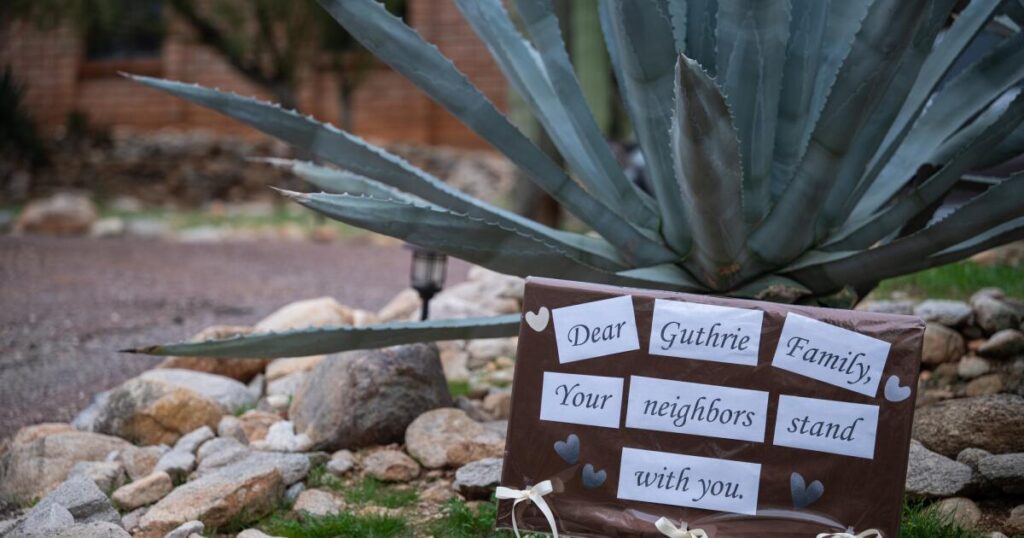
Now we have the vanishing of Nancy Guthrie, the octogenarian mother of a TV news personality, evidently carried off from her Arizona home into … a void. No trace, no proof of life, and all the while, the nation is informed of every twist of what mostly is not happening.
It turns out there are several kinds of “disappeared”:
There are people who choose to disappear. It’s practically a founding American tradition. Our continental spread allowed people to “light out for the territory,” in Mark Twain’s phrase, to shed one identity and assume another — a cowboy, maybe, or a con-man.
The American West was a magician’s box: go in as one person, emerge as another. This is much harder to do now that tech can foil any vanisher’s plans, from renting cars to getting cash. And those who fake their own deaths usually get caught. More than 20 years back, a Newport Beach doctor dodging nearly $2.5 million in insurance fraud charges bought himself a fake Russian death certificate. He got nabbed after almost 14 years on the lam, some of them spent teaching scuba in Egypt.
The people who are stolen away, like Nancy Guthrie. Some are found soon, some much later, some living, and some not. The 1974 political kidnapping of newspaper heiress Patricia Hearst was front-page news for a year and a half — her abduction, then her announcement that she was joining her captors, then her discovery, arrest, and prosecution.
One of California’s most heartbreaking stolen children was 12-year-old Polly Klaass, kidnapped in 1993 from a slumber party and murdered. Grieving volunteers and friends searched for two months before her body was found. Her parents became ardent advocates on behalf of missing children. And in 1991, 11-year-old Jaycee Dugard was dragged into a car in a small Sierras town by a husband-and-wife pair of rapist-kidnappers, and disappeared — for 18 years. In 2009, a pair of UC Berkeley police noticed something was “off” about a man on campus with two little girls — girls he had fathered during his rapes of Dugard, as it turned out — and discovered he was on parole for rape and kidnapping.
Then there are the people who go permanently missing, of whom no trace is ever found. Some have been kidnapped and some, emotionally vulnerable kids especially, may have left home and then been snatched and killed. Young women of color have disappeared and not made news headlines at all. Serial killers have played peek-a-boo guessing games with investigators, and the names and whereabouts of some of their victims are never to be known.
In the 1920s, on a chicken ranch in Riverside County, a mother-and-son pair was abducting boys, molesting them and murdering them with an ax. Some of their remains were found, but no trace was ever found of Walter Collins, a 9-year-old Los Angeles boy who disappeared in 1928. Director Clint Eastwood turned the saga of Walter’s mother’s quest for him into a film, “Changeling,”
And there are the people, usually in totalitarian countries, who are snatched up by government forces for speaking out against the regime and “disappeared” — imprisoned without trials or any public account of what has become of them. The Spanish noun for them is “desaparecidos,” and English has adapted the word as “the disappeared.”
In parts of California, it is not hard to make a body vanish. An hour’s drive from Los Angeles are deserts, canyons and the thousand square miles of the Angeles National Forest. The 10th victim of the notorious Hillside Strangler — stranglers, plural, a pair of cousins in Glendale — was found there, as were other killers’ victims. One man supposed to have been left there and never found was Beverly Hills’ Ron Levin. He invested in and then reputedly conned the 1980s rich-kids “Billionaire Boys Club” private-school students’ investment group. One of its members was convicted of ordering Levin’s murder, but thereafter Levin, or someone resembling him, was sighted hither and yon, on a Greek island, at a funeral [not his own], and behind the wheel of a brown Mercedes in LA.
It’s inevitable that sightings like that come hard on the heels of vanishing acts. Maybe there’s a reward in it, or maybe the reward is just getting your name in the papers, your face on TV.
Until Earhart disappeared on a round-the-world flight in 1937, New York judge Joseph Crater was the most renowned vanishing act. On the eve of a corruption investigation, he dematerialized from a New York street in 1930, perhaps carrying thousands of dollars from checks he’d just had cashed. Like the late Elvis, Crater was spotted here, there, and everywhere. In 1936, in the deserts of San Diego County, a couple of prospectors and a shopkeeper all declared that a “miner” with a New York accent, a big vocabulary, and smooth, un-minerly palms told them that he was the mystery judge, and then, as “Crater” told one of them, “Take my burros and the mining equipment, and never tell anybody you ever saw me.”
And then there was Aimee Semple McPherson, the “lady preacher” who founded the Angelus Temple in Echo Park. She was for years one of the most famous and recognizable women in the country, which is why her own vanishing act, in May 1926, as she swam off Venice Beach, created a nationwide uproar of despair, and gossip.
McPherson had immense social as well as religious influence here and with millions elsewhere through her vast church radio network. Her reappearance five weeks later, her implausible account of being kidnapped, and the evidence of her trysting with a married man scorched her reputation and took down some high-profile public figures. This extraordinary saga of Los Angeles, celebrity and religion are laid out in the recent book “Sister, Sinner” about McPherson’s vanishing act and the optics of her “resurrection.”
And there’s this one, a pioneering one in California criminal law: a crime even without a corpse, the body of evidence — the corpus delicti.
Evelyn Scott was older and considerably richer than her charmer of a husband, L. Ewing Scott, and they lived in Bel-Air. Evelyn disappeared from that home in 1955. She’d gone out to buy tooth powder, her husband said, and never came back.
In time, investigators found Mrs. Scott’s dentures and eyeglasses behind the backyard incinerator … but no body. It was a civic guessing game as to where the presumably late Mrs. Scott might be — maybe under an avalanche of concrete being poured for one of L.A.’s new freeways. Scott, theatrically, pleaded for his wife to return to clear his name. The actor and L.A. pioneer Leo Carrillo testified that a couple of men showed up at his house one night as he was watching TV to pressure him to clear Scott’s name and declare that he had spotted Mrs. Scott in Brazil.
In a case already staggering with dramatic twists, this may have been the best: Scott’s lawyer pointed out that no body had ever been found, and indeed, Mrs. Scott might walk through this courtroom door “at any minute.” Jurors turned to look. Aha, the lawyer said — that shows you don’t believe that her death has been proven beyond a reasonable doubt.
Then the prosecutor had his turn. Yes, he agreed, every head had turned toward the door “except one” — Scott’s. He didn’t look, because he killed her. Cue the “Perry Mason” theme, except this jury voted to convict.
The post Amelia Earhart, Jimmy Hoffa and Nancy Guthrie: How notable disappearances captivate and unsettle us appeared first on Los Angeles Times.