President Trump moved swiftly on Friday to resurrect his punishing tariffs and circumvent a stunning loss at the Supreme Court, ordering a new 10 percent tax on all imports along with other trade actions in a bid to preserve his primary source of economic leverage around the world.
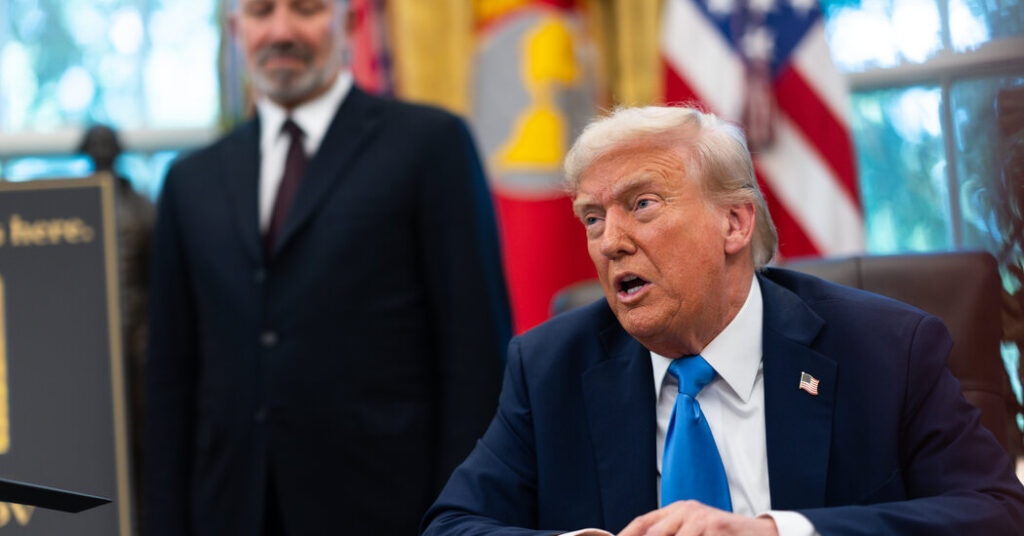
Striking a defiant tone in the face of a legal defeat, Mr. Trump asserted at a news conference that he remained unbowed in a global trade war that has come to define his second term in office. The president even signaled that the tariffs he is now pursuing may yet prove more painful and lasting than those they are meant to replace.
“I can charge much more than I was charging,” Mr. Trump declared as he brandished his remaining trade powers, contending at one point that he could still “destroy foreign countries” by other means.
Mr. Trump said he would revive his tariffs using a series of authorities provided under the 1974 Trade Act. He took his first steps late Friday, invoking a provision of the law known as Section 122 to impose a 10 percent tariff starting on February 24. No president before him had invoked that provision.
Mr. Trump also said he would tap a second set of authorities under Section 301 to open investigations into other countries’ unfair trade practices, which would most likely yield additional tariffs. It was not immediately clear if the administration had commenced that process, or which countries it had targeted.
Together, Mr. Trump tried to frame the twin actions as a close substitute for his newly invalidated emergency duties, many of which he enacted on a historic scale during the highly disruptive rollout billed as “Liberation Day” last spring.
Some experts appeared to agree: By one measure, the average tax owed on all imports may end up at 15.4 percent if the president proceeds as planned and keeps those tariffs in place. That would be only a slight dip from 16.9 percent before the court’s ruling, according to the Yale Budget Lab, a nonpartisan research group, which conducted the analysis. Ultimately, that may spell little practical change to the economic forces that have strained U.S. consumers and companies, who bear the brunt of the bill from Mr. Trump’s taxes on their imports.
But the president’s moves underscored just how central tariffs are to his second-term agenda, which has hinged on an ability to raise or lower punishing levies at a moment’s notice to achieve economic and foreign policy goals. Mr. Trump’s objectives have extended well beyond the remit of trade, as he has looked to use duties to raise money, stop the flow of illicit drugs, intervene in foreign conflicts, and protect political allies and interests abroad.
With that boundless and legally fraught ambition, Mr. Trump has hammered allies and adversaries alike, including Canada, China and the European Union, which faced steep tariffs that the president relaxed only once they struck deals, opened their markets and invested in the United States.
Going forward, Mr. Trump’s tactics are now limited by law in their scope, and he may no longer be able to act with the same speed and latitude to exact his agenda on a global scale. The timing of his loss also seemed particularly stinging, with the president set to deliver his State of the Union address next week before heading to China for another round of high-stakes trade negotiations with his counterpart, President Xi Jinping.
Still, Mr. Trump repeatedly stressed on Friday that he was not deterred, and at times, he sought to reframe elements of his defeat as a victory.
“While I am sure they did not mean to do so, the Supreme Court’s decision made a president’s ability to regulate trade and impose tariffs more powerful, and more crystal clear, rather than less,” Mr. Trump claimed to reporters.
Mr. Trump had long brandished his ability to impose duties instantly and without the approval of Congress, using a decades-old law that did not actually enumerate tariffs among its conferred powers. His tactics rattled consumers, businesses, foreign powers and global markets, and in the United States, the president’s approach drew a pair of legal challenges in which he never once prevailed.
In the hours after the Supreme Court announced its decision on Friday, much remained uncertain, including the fate of the billions of dollars in duties already collected by the United States — and the future of dozens of trade deals that Mr. Trump had already cemented with the help of the International Emergency Economic Powers Act.
Many of those deals have termination clauses, and some countries have not yet taken formal steps to enact their sides of the bargain. The pacts also include substantial, albeit tentative, commitments by foreign countries to invest in the United States, which may be in jeopardy, potentially undercutting one of the president’s reasons for engaging in trade brinkmanship in the first place.
Even Mr. Trump alluded on Friday to the possibility that the deals he previously struck may soon change. “Some of them stand, many of them stand, some of them won’t, and they’ll be replaced with the other tariffs,” he said.
But as the justices handed down their rebuke, they did not render the president totally powerless to pursue his tariffs using other means. He may still invoke a handful of additional authorities, which are more limited in scope, or turn to Congress to set his tariff policies more firmly into law.
Nick Iacovella, the executive vice president at the Coalition for a Prosperous America, which supports the president’s trade policies, said the justices had only “narrowed” the options available to Mr. Trump. “Going forward,” he said, “tariffs are still going to be a central piece of the administration’s agenda.”
The 10 percent tariff that Mr. Trump ordered late Friday applies globally, but the White House took steps to carve out certain imports. That includes beef and other agricultural products, for which the president had previously relaxed some of his tariffs in an attempt to keep prices from rising. He also included exceptions for goods already subject to certain other duties, as well as imports covered by an existing trade agreement between the U.S., Canada and Mexico.
The duties may be in place for only 150 days, unless lawmakers approve an extension, and its parameters are largely untested given that it has never been invoked or challenged. Still, it generally empowers the president to use the duties to address issues including a widening trade deficit.
Under the law, the administration may actually set those tariffs as high as 15 percent. Patrick Childress, a partner at the law firm Holland & Knight, said that as a result the White House had “left itself room to increase tariffs if it needs to ratchet up pressure on a particular trading partner.”
The promised federal investigations into unfair trade practices may also take time, perhaps delaying the administration’s efforts to reimpose steep import taxes. That pathway is more legally settled, and the president has used the provision of law known as Section 301 since his first term, particularly to impose duties on China.
But the White House is set to engage that process at a fraught political moment, as Americans prepare to head to the ballot box in November for the midterm elections. In many polls, majorities of voters have expressed anxiety about the state of the economy and rising prices, a concern that Mr. Trump must balance against his desire to reimpose tariffs perhaps at even higher rates.
“They want to be sure they’re not undertaking actions that could have significant unintended consequences right before midterm elections,” said Penelope Naas, a senior vice president at the German Marshall Fund of the United States.
Still other tariffs enacted by Mr. Trump in his second term on national security grounds were unaffected by the Supreme Court decision. That means his high taxes on a wide set imports, including foreign autos, steel, copper and other goods, are set to stay in place, with additional investigations that may yield further U.S. tariffs still underway.
“There are whole bunch of other statutes the president could use to achieve the same purpose,” said Ted Murphy, a top trade lawyer at the firm Sidley Austin.
“It’s not about whether or not the president can impose tariffs,” he explained of the Supreme Court decision, but rather if he may do so “unbounded completely at his discretion.”
Ben Casselman and Ana Swanson contributed reporting.
Tony Romm is a reporter covering economic policy and the Trump administration for The Times, based in Washington.
The post After Stunning Setback, Trump Finds Other Ways to Impose Tariffs appeared first on New York Times.