In early August, on a thickly hot and humid day, I stood in the Apple Store across from The Plaza Hotel buying AirPods for my husband. The store was busy; it’s always busy because it is a tourist attraction and has abundant air conditioning. I was wearing shorts and an old Batman T-shirt that used to be his. I thought I was doing fine.
I was not.
I floated somewhere above my body, watching a woman who looked exactly like me swipe her credit card for wireless, noise-canceling headphones and thinking, almost clinically: “That woman sure is going through it.”
The salesperson asked whether I wanted the AirPods engraved. I nearly laughed. What would I have chosen? Property of N.Y.U. Psychiatric Unit? Please Return to Room 401A?
My husband, Jonathan, had checked himself into the psychiatric unit two days earlier, terrified of what he might do if he stayed at home. On that ward, anything that you can use to harm yourself or someone else is forbidden: shoelaces, hoodie strings, headphone cords. For Jonathan, wireless headphones weren’t a luxury; they were the only form of privacy available. A small island of quiet inside the storm of his mind.
We have been together as a couple since 2001, but the first time I saw him was the summer before, when I wandered into an outdoor sporting goods store during a brief and delusional period after my divorce when I had believed I was a person who goes camping. (I am not. I am a person who enjoys a view of the Pacific Ocean from a well-appointed hotel room.)
Jonathan was the boot-fitting expert. When he walked toward me, I could have sworn I heard The Pixies singing “Here Comes Your Man.” He looked like a young Gary Sinise: hazel eyes that changed color, I would later learn, with his moods, and the lean body of a cyclist. But his beauty wasn’t what stopped me. It was the calm he radiated, like the quiet of an old tree you lean against in the summer: shaded, steady, safe.
I bought more than a thousand dollars’ worth of camping equipment (used once) and handed him my business card.
He blushed and stammered that he had a girlfriend.
“Things change,” I said with a shrug, and left.
Things did change.
The day after the 9/11 attacks, he left me a voice mail message: “I carry your card in my wallet. I think about you every day. Please call and tell me you’re OK.”
Our first date lasted six hours. It started at a diner and then, when they asked us to leave, continued at a bar.
On our second date we went to see “The Royal Tenenbaums,” which left me so vulnerable and raw that he mistook my silence as not wanting to date him anymore.
On our third he took me on a tour of Grant’s Tomb on the Upper West Side of Manhattan, where he regaled me with fascinating Civil War history, and then to his favorite bar, which just happened to be in the building next to his apartment, where we kissed for the first time.
On our fourth date we went to eat Chinese food, and he talked about the heavy sadness that sometimes enveloped him, how sometimes he didn’t want to die exactly but no longer really wanted to be alive. He told me about his therapy and his medication. He offered me an out.
We have always joked that, technically, we are still on that fourth date, because after dinner we climbed the five flights to his apartment, and I didn’t go home for two days. Since then, we have rarely been apart. We married in 2004, had our daughter in 2005, and built a life on acceptance, adoration and a trust wide and deep enough to hold us both. He stayed in therapy. He took his meds. He had bad days and hard seasons but never anything that took him so far from me that I doubted his return.
Two years before that day in the Apple Store, Jonathan suffered a life-threatening pulmonary embolism. He made a full physical recovery, but some piece of him broke loose afterward. Instead of a cinematic “new lease on life,” he sank — slowly, then all at once — into a depressive spiral no amount of coffee, chocolate croissants or pep talks could lift. He cycled through treatments: therapy, psychiatrists, eye movement desensitization and reprocessing, ketamine, an intensive outpatient program that drained our savings. Nothing touched the core of his despair.
And then, last summer, he collapsed in our bedroom, wailing, gagging on his tears, unable to meet my eyes. He said we had to go to the hospital right away or he was afraid he would kill me and our daughter and then himself.
This was the nightmare I had both dreaded and avoided thinking about since the day we married: the day love would collide with illness so violently that I would lose him not to death but to a locked ward. I packed him a suitcase because I knew he wouldn’t be coming home. We took a Lyft to N.Y.U. It seemed somehow inevitable that our long fourth date was going to end at the double doors of a psychiatric unit.
When his doctors recommended electroconvulsive therapy, I flinched. Everything I knew about ECT came from the musical “Next to Normal,” where a suburban mother suffering from bipolar disorder undergoes the procedure, which looks terrifying and violent, and loses 19 years of memory, including any memories of her own son. But the modern version is nothing like that. It is deliberate, quiet and suffused with care. On treatment days, he was escorted from the unit to a different floor, given medication to relax, then anesthesia. The actual procedure lasted minutes.
When he moved to outpatient treatment, I accompanied him to the hospital and stayed with him for everything except the ECT itself. I asked if I could watch, but he didn’t want me to. He was worried it would upset me; he himself had never seen it, and he didn’t want me to have the experience of his treatment without him.
His memory remained intact, save for small lapses — an appointment forgotten, a day misremembered. At night, after treatment days, I would test him.
“Who am I?” I would ask.
“You’re Stefanie,” he would say, steady and sure. “You’re my wife. You’re my life.”
Slowly, he began to return. Watching Jonathan recover was like watching an Edison bulb warm and begin to glow after being dark for too long. Before he had been hunched, pale, haggard, deathly, his eyes flat and his voice high and whiny. After, his posture lifted, his eyes regained their shifting greens and golds, his skin flushed with color and his voice deepened.
One night while we were watching “The Great British Bake Off,” he made a joke — something once entirely typical of him — where he started yelling at the contestants not to use matcha because Paul Hollywood, the celebrity baker, hates it.
I turned to him, startled by the sound of his old humor.
“Hey!” I said. “You’re back.”
Jonathan grinned at me, surprised himself. “Yeah. It’s me. I’m back!”
We regret that we waited so long to consider ECT. The measure of last resort turned out to be his salvation. These days he sees a therapist weekly, a psychiatrist monthly, and we both have the number for the psychiatry chair at N.Y.U. Langone saved in our phones like an old good luck charm. We have abandoned shame altogether. There is nothing we don’t tell each other now. No secrets scribbled in hidden away diaries. No fear held alone.
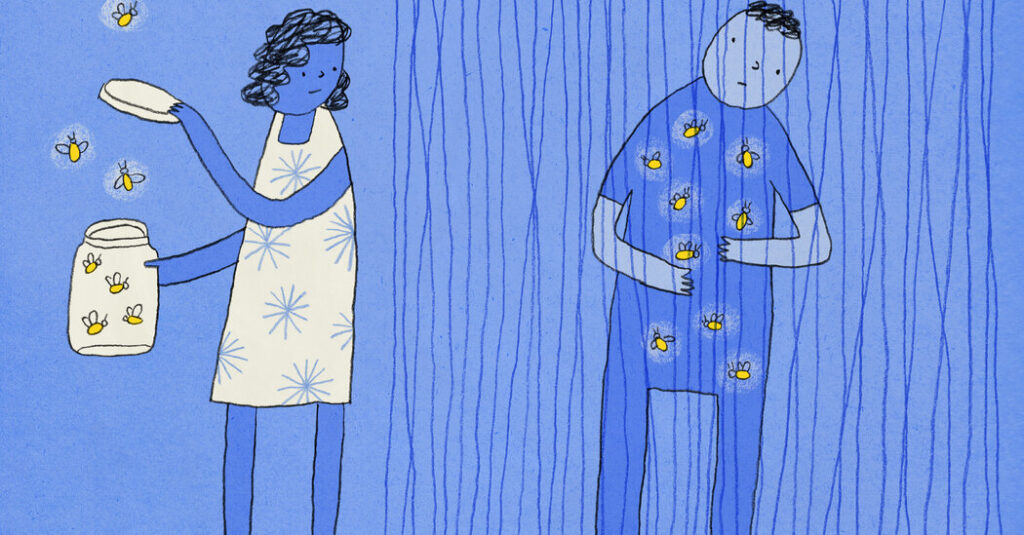
His near loss to the psych ward, along with our encroaching middle age, have turned us into people who embrace joy anywhere and everywhere we find it, for however long it lasts. We gather it like fireflies, understanding that we will need to set it free if it’s going to survive.
The day he came home from the hospital, Jonathan handed me the AirPods — the ones I had bought during that surreal afternoon in the Apple Store. “These are yours,” he said. “I like the ones with wires.”
I never did engrave them, either with his name or his room number in the psych ward, so now they’re mine. I use them when I walk the dog, when I commute, when I need my own small island of quiet. And every night when I get home, he takes them from me without a word and plugs them in, making sure they are charging while we sleep.
Stefanie Gunning is a writer who lives in Brooklyn. You can read more of her work at workingwithoutanet.blog.
Modern Love can be reached at [email protected].
To find previous Modern Love essays, Tiny Love Stories and podcast episodes, visit our archive.
Want more Modern Love? Watch the TV series, sign up for the newsletter and listen to the podcast on iTunes or Spotify. We also have two books, “Modern Love: True Stories of Love, Loss, and Redemption” and “Tiny Love Stories: True Tales of Love in 100 Words or Less.”
The post ‘You’re My Wife. You’re My Life.’ appeared first on New York Times.