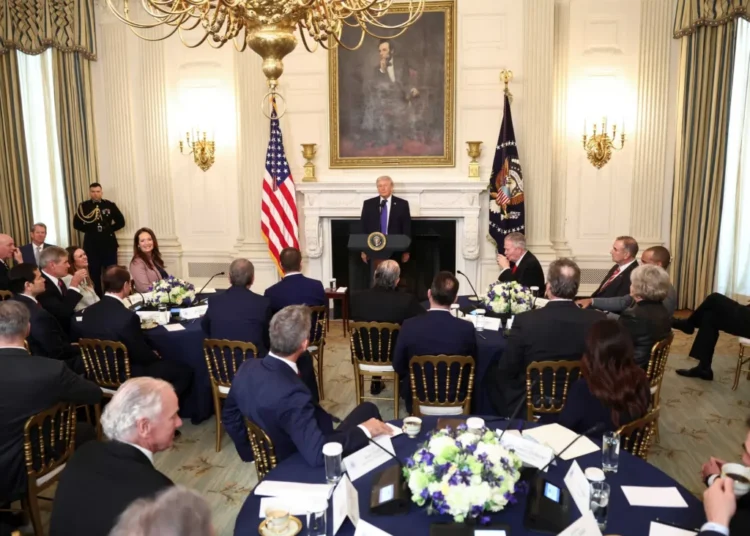
President Donald Trump presided over Thursday’s inaugural meeting of his Board of Peace, a new body he created to end the Middle East conflict, telling the smattering of world leaders and diplomats assembled in Washington that “there was nothing more important than peace.”
Mostly unsaid, but lingering over the self-congratulatory proceedings, is every indication that Trump is preparing for war in the same region.
Thousands of miles away the United States is gathering a massive amount of war-fighting machinery. U.S. officials have said that the Trump administration soon will be ready to use this firepower for an extended conflict against Iran, despite risks of entanglement in yet another Middle Eastern war.
The U.S. could strike Iran as soon as this weekend, although officials caution the president has not made a final decision. “They must make a deal,” Trump said of Iran’s leaders during the Board of Peace event. He added that if they did not, “bad things will happen.”
The split screen between talk of peace in Washington and drumbeats of war in the Middle East struck some analysts and former officials as incongruous, if not incoherent.
Trump is the “main threat to peace in the Middle East at the moment by assembling this huge ‘armada’ to threaten Iran,” said Rosemary Kelanic, director of the Middle East program at Defense Priorities, a think tank that advocates a restrained role for the U.S. military in the world.
To supporters of the president’s foreign policy, the threats of war only show how far the Trump administration is willing to go to ensure peace. “There’s no contradiction here. Diplomacy works best when it’s backed by credible deterrence,” said Jason Greenblatt, a lawyer who served as White House envoy to the Middle East during Trump’s first term.
“Showing both a willingness to negotiate and the capacity to seriously act strengthens, rather than undermines, the pursuit of peace,” Greenblatt said. “This is not mixed messaging — it’s stability through strength.”
Democrats have criticized Trump’s Board of Peace as a self-serving gesture that, so far, has seen numerous autocrats take up the invitations for a seat while traditional U.S. allies question the initiative’s remit, scope and funding requests.
“I welcome any President who wants to bring peace to the globe, but actions matter far more than words,” Sen. Jeanne Shaheen (New Hampshire), the top Democrat on the Senate Foreign Relations Committee, said in a statement, adding that Trump had overseen “strikes against targets in multiple countries and is now amassing an armada off the coast of Iran with no articulated strategy to the American public or Congress.”
Trump has given little firm explanation for why the United States should strike Iran now or how it would fit with his “America First” vision of foreign policy. Trump had threatened action in January, citing support for widespread anti-regime protests in Iran that were suffering a violent state crackdown. But the demonstrations have largely ended amid massive human rights abuses.
Aaron David Miller, a former U.S. negotiator who has advised Republican and Democratic administrations on Middle East policy, said that it was unlikely there was any contradiction between the Board of Peace and the threats of war against Iran in Trump’s mind.
Trump was using the “mass demonstration of American military power to deal with one of the obstacles — in many people’s mind the primary obstacle — to a more stable, functional Middle East,” said Miller, referring to Iran.
Experts have long been confounded by Trump’s dual identities as peacemaker and warmonger, with the president often weaving between the personas within the same speech. Although Trump had campaigned on ending “endless wars” before his first term, the idea of “Donald the Dove,” was laid to rest after he ordered the killing of Iranian Maj. Gen. Qasem Soleimani in early January 2020.
In the first year of his second term, Trump ordered military attacks on more than half a dozen countries — including strikes against Iranian nuclear sites that marked the first time the United States had directly targeted the country’s forces.
He has even hinted at military action toward Denmark, a European NATO ally, over his aims to gain control of Greenland.
But Trump has also shown a preoccupation with peacemaking, at least partly driven with a long-standing desire to be awarded the Nobel Peace Prize.
Trump has claimed to have ended “eight wars,” with the ninth — Russia’s invasion of Ukraine — soon to come, at least in his telling on Thursday.
The “Board of Peace” is, at least initially, focused on securing a lasting peace in the Gaza Strip and rebuilding the destroyed territory. It was formed as part of a 20-point peace plan designed to end the conflict between Hamas and Israel and set the Palestinian enclave on the course of a brighter future.
The peace plan, which largely ended the devastating Israeli strikes in Gaza, came after Steve Witkoff, a special envoy, and Trump’s son-in-law Jared Kushner negotiated a deal that saw Hamas release the remaining hostages it had seized during attacks on Oct. 7, 2023.
Witkoff and Kushner are now focused on talks with Iran aimed primarily at ending its nuclear weapons program. Although a first round of negotiations in Oman in early February showed some promise, Tuesday’s talks with Iranian officials in Geneva concluded without any breakthrough.
“It’s clear Trump covets stability and prosperity in the Middle East as a bedrock for U.S. policy,” said Behnam Ben Taleblu, an Iran analyst with the Foundation for Defense of Democracies think tank in Washington. “But the direction Gaza and Iran are heading in will throw more than a wrench into those plans.”
“How Hamas is disarmed and the costs of defanging and rolling back the regime in Tehran may well tie-up the administration’s limited political capital in the region,” Taleblu said.
Tehran has long been a backer of Hamas, as well as other proxies in the Middle East that threaten Israel and U.S. interests. The Iranian government has said that if it were attacked, all U.S. forces would be legitimate targets for retaliation — including the gulf states, whose vast oil wealth and support is vital for rebuilding Gaza.
Arab gulf states could become “sitting ducks or even collateral damage in a war between Iran and the United States,” said Joost Hiltermann, a Middle East expert at the International Crisis Group, pointing to the large American troop presence in countries including Qatar, Bahrain and the United Arab Emirates. Some of these nations were key to convincing Trump not to strike Iran in January, with Saudi Arabia and UAE refusing to allow their airspace to be used for military acts and calling for further dialogue.
Trump’s top national security advisers met in the Situation Room on Wednesday to discuss the Iran situation, according to a U.S. official, who spoke on the condition of anonymity to discuss sensitive diplomatic discussions.
The U.S. forces deployed to the region will all be in place by mid-March, the official said. Iran has been asked to submit a written proposal within two weeks for how to resolve U.S. concerns. It has not yet done so, the U.S. official said.
Trump is “pro-negotiations,” said Hiltermann, “but in the end, he’s also impatient.” Threats of violence may “increase the Americans bargaining power,” Hiltermann said, but “on the other hand, it puts him more in a corner.”
They may be little time left for negotiation. The aircraft carrier USS Gerald R. Ford and its accompanying warships are in the Mediterranean Sea, joining a second aircraft carrier strike group already in the region. Huge masses of military hardware have been moved into play in recent weeks, including advanced stealth F-35 fighter jets.
Trump has often tried to split the difference between war and peace with short, sharp military action. He claimed victory last year after a two-month bombing campaign against Yemen’s Houthi rebels, which served to reopen dangerous shipping lanes but left the group largely intact. In Venezuela this year, U.S. Special Operations forces undertook a stunning raid to arrest President Nicolás Maduro but left his regime largely intact.
Trump “has more faith now than ever in the competency, the brilliance, the tactical ingenuity of the U.S. military,” said Miller, the former U.S. negotiator. But, although experts point to the differences between a midnight raid in Caracas and a sustained military effort against Iran’s entrenched military and leadership, Trump may not care.
“This guy rolled the dice three times on Iran when all the experts told him, ‘Do not do it,’” Miller said, pointing to Trump’s decision to abandon an Iranian nuclear deal in 2018, the killing of Soleimani in 2020 and last year’s strikes on Iran’s nuclear facilities.
Now, Miller said, “he’s risk ready.”
Dan Lamothe, John Hudson and Michael Birnbaum contributed to this report.
The post Trump talks peace in the Middle East as he readies war on Iran appeared first on Washington Post.