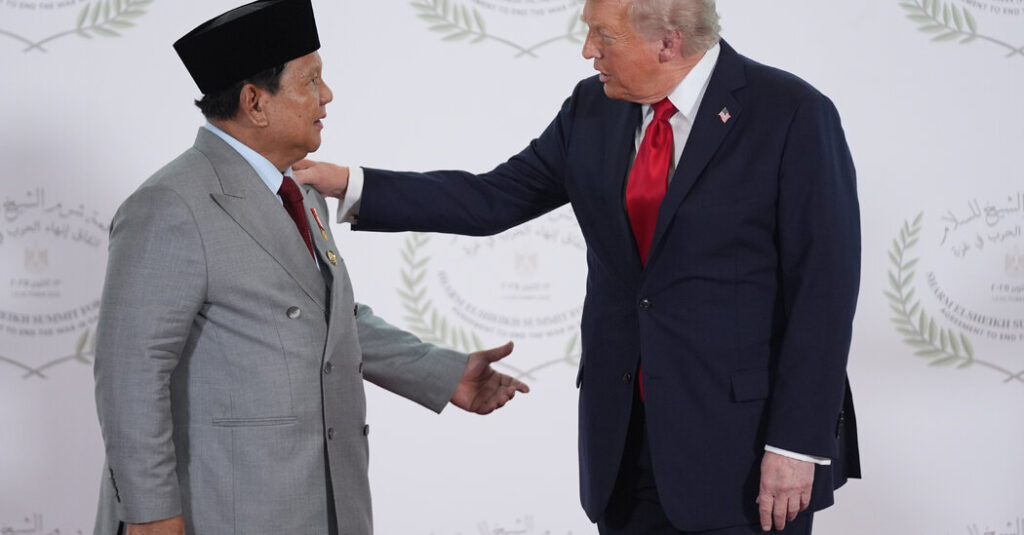
The United States and Indonesia announced they have signed a trade deal, with Indonesia agreeing to open its borders wider to American goods.
The deal, announced on Thursday, includes zero tariffs on virtually all U.S. exports to Indonesia and a 19 percent tariff on Indonesian goods. It formalizes an agreement the two countries made last July, making Indonesia the third country in Southeast Asia to lock in lower tariffs after Malaysia and Cambodia. Mr. Trump had threatened Indonesia with a 32 percent tariff at one point last year.
After seven rounds of negotiations and four trips to Washington, Indonesian officials agreed to roll back several long-prevailing trade barriers, including inspections of farm products, export restrictions on critical minerals and local content requirements.
Indonesia also committed to import $15 billion worth of U.S. energy including coal, oil and gas, and $13.5 billion in American airplanes and aviation equipment.
Importantly, Indonesia agreed to align with Washington on using trade policy to advance U.S. national security goals. For example, the agreement said Indonesia will restrict the export or transfer from its country of any goods that are subject to U.S. export controls, including American technology. The U.S. government has increasingly used trade rules to keep certain sensitive American products out of the hands of Chinese companies.
Indonesia agreed to give American companies access to its critical mineral and oil resources to “explore, mine, extract” and export. The Indonesian government has traditionally been quite cautious of opening its natural resources sector to foreign companies.
The deal with Indonesia could strengthen Mr. Trump’s hand in his trade negotiations with China ahead of his expected visit to Beijing in April. But it comes with risks for Indonesia, which like other countries in Asia counts China as its biggest trade partner.
The governments of Malaysia and Cambodia have been under intense scrutiny both at home and regionally since signing similar agreements to cooperate with the United States on national security issues.
In Malaysia, the prime minister, Anwar Ibrahim, was accused by critics of sacrificing the country’s sovereignty after he made a trade pact with Mr. Trump in October. In Cambodia, the government was criticized by China, which said it had “grave concern” about the deal.
Indonesia could also risk raising the ire of China, said Deborah Elms, the head of trade policy at the Hinrich Foundation in Singapore.
“The more of these that get signed, the harder it will be for China to remain quiet,” she said, adding that so far China’s response has been relatively muted.
China is a main customer for the palm oil, coal and nickel that drive the Indonesian economy, and Chinese investors have sunk billions of dollars into Indonesia to build factories, rail lines and other infrastructure. So interlaced is Indonesia’s economy with China’s that when China’s growth slows by one percentage point, it causes a 0.3 percentage-point decrease in Indonesian growth, according to one estimate.
The agreement with Indonesia allows Mr. Trump to claim a victory as he faces growing scrutiny at home for his immigration policies and sweeping tariffs. The Supreme Court is set to consider his sweeping use of emergency powers to enforce many of his tariffs.
Indonesia’s president, Prabowo Subianto, was in Washington on Thursday for a meeting of Mr. Trump’s Board of Peace, intended to solve global conflicts. Indonesia’s military said this week that it was preparing to send thousands of troops to Gaza for a peacekeeping mission, pending approval by Mr. Prabowo.
While Mr. Prabowo was in Washington, Indonesia announced what it said were $38.4 billion worth of trade and investment deals with American companies to deepen private-sector cooperation between the countries.
Indonesia was not in a strong position to bargain over the terms of the trade deal, said Priyanka Kishore, an economist in Singapore.
“Already under pressure from a flood of cheap Chinese imports, these industries are not in a position to withstand steep U.S. tariffs,” said Ms. Kishore. “By signing the U.S. deal, the Prabowo administration is effectively accepting an unfair bargain in order to stave off a wave of factory closures and manufacturing layoffs.”
Muktita Suhartono contributed reporting from Bangkok.
Alexandra Stevenson is the Shanghai bureau chief for The Times, reporting on China’s economy and society.
The post Trump and Indonesia Sign Trade Deal, Locking in 19% Tariffs appeared first on New York Times.