Occasionally, in a slightly reckless state of mind, I have the thought that the real believers where the novel is concerned, the people who truly appreciate the force of fiction, might be those hellbent on banning it. What powers they ascribe to it, what fearsome potential to corrupt, to alter minds, to sow unrest, to matter. A critic might envy such conviction.
Few American writers have proved so alluring to the censors as Toni Morrison. Her first novel, “The Bluest Eye,” published in 1970, remains one of the most challenged titles in America, according to the American Library Association; others, like “Song of Solomon” (1977) and “Beloved” (1987), are regularly and vigorously contested. Conservative groups have claimed that her work is being used to teach critical race theory; parent boards protest the graphic depictions of sexual violence. Roiling beneath the response — reactionary and muddled though it may be — is a real acknowledgment, and fear, of the power of Morrison’s vision of American history, her depiction of the blood at the root.
Last year, her publishers announced that they would reissue 11 of her novels in an effort to counteract fresh censorship. The new editions join a wave of Morrisoniana that has followed her death in 2019, including “Toni at Random” (2025) by Dana A. Williams, which covers Morrison’s years as a book editor, and two new books: “On Morrison,” essays by the novelist and critic Namwali Serpell, and “Language as Liberation,” a collection of her lectures delivered while teaching at Princeton.
A fuller picture of Morrison’s achievement emerges, the aim of her writing and editing: to confront the immense silences in the archives where Black life and thought are concerned. She would have made a lousy activist, she held, but as an editor she found a way to make her contribution. “I thought it was important for people to be in the streets,” she said. “But that couldn’t last. You needed a record. It would be my job to publish the voices, the books, the ideas of African Americans.” The reissued novels — with new introductions by writers like Jesmyn Ward, Tayari Jones and Honorée Fanonne Jeffers — remind us how profoundly her ideas have shaped fiction as well as our understanding of history, literary criticism, trauma and archival studies.
She wanted to enshrine not only how her characters suffered but how they survived, with what rituals, what attentiveness to one another, to beauty, to language. “Beloved” was born out of such considerations. With the book’s dreamy, fragmented form, Morrison invented a language for unassimilable pain, for the horrors of the Middle Passage, of bondage and its systematized torture and sexual brutality. “There is a necessity for remembering,” she said while writing the book, “in a manner in which the memory is not destructive. The act of writing the book, in a way, is a way of confronting it and making it possible to remember.”
There is joy in Morrison’s work; there is resilience, adventure, even happy endings. But what remains singular has to do with the violence that so excites the censors — its range and horror, its deliberate deployment. To write of cruelty or violence, after all, is nothing new; books have been bloody since Gilgamesh. Novelists have often placed their readers in the point of view of the perpetrator (Nabokov, most famously perhaps, in “Lolita”), but tell me: What writer has occupied the point of view of the perpetrator with such persistence? Morrison’s later novels offer a more simplistic moral universe, but the books that made her name — from “The Bluest Eye” to “Jazz” — are steeped in the murk of self-implication. Morrison writes about suffering and survival, always, but with the insistence that suffering does not ennoble and survival is not a clean thing. One might come through but not necessarily intact.
She creates inner worlds of such capaciousness; one wants to see her achievement be preserved truthfully in turn. But here, too, we collide with one of her lessons: Nothing distorts so reliably as reverence; nothing rearranges memory so ingeniously as love.
“When you read her work, the world changes, becoming more beautiful and expansive and complicated via every sentence,” George Saunders eulogized her. “You are in contact with a great soul.” In the introduction to the new edition of “Beloved,” Jeffers yearns for Morrison’s presence: “the tender quiet of her voice, spoken as a mother to a child clutching the hem of her dress.” Writing of “Song of Solomon,” Jones compares its power to “a tea bag submerged in the piping-hot water of culture.”
The drive to cast Morrison as St. Toni, or as a warming, consoling mother figure, feels entirely understandable and utterly unfair. We risk misreading the work, overlooking its confrontation, its disdain for complacency. (When I think of the kind of comfort Morrison offered in life, I recall a note she wrote to one of her most cherished writers, harrying her along: “I need the last three pieces yesterday,” she nudged. “Bullets follow along with love.”) Serpell warns of the dangers of consecration in “On Morrison”: “In our rush to monumentalize her, to make her a palatable icon of Black wisdom or Black joy or Black excellence, I fear we may inadvertently veil — or shroud — her with beatifying (or burnt-edged) sheets.” Serpell puts Morrison’s difficulty at the heart of her legacy. “The very fact of Morrison — a Black woman and a genius” is affront enough for some, Serpell writes, but her true challenge lies in her “commitment to plumbing the depths of Black aesthetics.” Serpell puts forth a comprehensive picture of the formal choices that mark Morrison’s work and sidesteps hagiography; she takes respectful issue with the regrettable poetry, the uneven quality of the later novels.
Morrison would have thrilled to this reading, I imagine — the praise, at least. She longed for a critic who might situate her in a “Black cosmology.” And yet there remains an aspect of her difficulty that feels fugitive and delicate to discuss. It lies in the moral complexities snaking through that lush and spectacular violence — the raped children and tortured animals; a mother who slaughters her son as he sleeps; a daughter who watches, dazzled, as her mother burns alive. When Morrison puts us behind the eyes of the perpetrators, what does she want us to see?
When a writer dies, what survives of her work is often that which is most legible, that which can be taught — her craft and technique, the public statements that distill her aims and themes. But what gives Morrison’s novels their force lies below the skin of language and outside the logic of neat précis. Morrison seems to know forbidden things — all the secrets of childhood and maternity and the marriage bed. In “Beloved,” narration swivels between Sethe and her two daughters, each of them sharing their “unspeakable thoughts.”
Morrison lodges her characters in ordinary homes — her murdering mothers, rapist fathers, revenge-minded sisters, sadistic children. Margaret Street in “Tar Baby” sticks pins into her infant and burns him with cigarettes. Joe Trace shoots his lover in “Jazz.” In “Song of Solomon,” a queasy, quasi-incestuous closeness flows from father to daughter, daughter to son. Even the babies are full of rage and terrible need, to devour the mother, to keep her theirs alone. “The Bluest Eye” might feature one of the most unsettling scenes in all of American literature, in which Morrison, having introduced to us the character of Cholly with such tenderness, keeps us locked in his point of view as he notices his 11-year-old daughter washing dishes one day, then drags her to the floor and rapes her. Morrison encloses us in Cholly’s mind — feeds us his rationale and excitement — sealing us as close to him as consciousness itself.
These characters have been read as grotesques, or worse. In a long assessment in The New York Review of Books in 1977, Diane Johnson accused Morrison of pandering to a white, racist gaze. Her novels “entirely concern Black people who violate, victimize and kill each other,” Johnson wrote, suggesting they “confirm white fears.”
A peculiar, willfully blind reading. Johnson condemns Morrison for her own discomfort, never asking what role this violence is intended to play. Morrison liked toying with critics and journalists. She liked to needle and joke, to test out ideas and hear how they sounded. She would claim an influence in one article, dismiss it in the next. On two matters, however, she held firm. She wanted to write novels that were “clearly, relentlessly Black,” she said, to pull from this rich narrative and linguistic tradition, and she wanted her writing to function as a form of thinking. She recalled listening to her mother singing when she was a child and understanding that she was working something out as she sang — some idea or feeling. Her novels would do the same, she said. She would write in order “to think the unthinkable.”
She invoked this enigmatic phrase often and without much elaboration. She praised it in writers she admired (of Gayl Jones: she “had no right to know so much so well. She had written a story that thought the unthinkable”) and bestowed it on at least one of her characters, Sula, with her wide mind, her readiness to examine herself.
Every Morrison novel seems shaped around a particular absence, some fact or event her characters cannot bear to consider and are forced to confront. “Beloved” was inspired by the true story of Margaret Garner, who escaped a plantation, taking her children. When caught, she killed one of them rather than see her returned to slavery. One challenge of the book, Morrison said, was to depict how a mind might absorb or refuse information about experiences so painful, so dehumanizing, that they are fundamentally “undigestible and unabsorbable.”
Each character arrives at a strategy to protect the mind from what it cannot hold. Paul D., who survived torture and rape, imagines a little iron box, rusted shut; in it he stuffs the worst of his memories and the desires he dare not touch. Denver, Sethe’s youngest daughter, goes temporarily deaf rather than hear the truth about what her mother has done. Sethe, in turn, monitors her own mind and movements to avoid anything that will remind her of the plantation, Sweet Home, until something very small — the sound of a dog drinking from a puddle, say — forces it into her consciousness:
Suddenly there was Sweet Home rolling, rolling, rolling out before her eyes, and although there was not a leaf on that farm that did not make her want to scream, it rolled itself out before her in shameless beauty. It never looked as terrible as it was and it made her wonder if hell was a pretty place too. Fire and brimstone all right, but hidden in lacy groves. Boys hanging from the most beautiful sycamores in the world. It shamed her — remembering the wonderful soughing trees rather than the boys. Try as she might to make it otherwise, the sycamores beat out the children every time and she could not forgive her memory for that.
Her mind is truant, treacherous; it insists upon the beauty, or perhaps the beauty is all that it can bear. Morrison explores how the mind addresses and avoids the unthinkable — how a character might allow herself to reach for a corner of a memory. At the heart of “Beloved” is Sethe’s killing of her child, the unthinkable crime that is frequently read in this work as an act of resistance. Morrison herself remained wary of attributing any heroism to Sethe; she said she understood but could not condone her actions: “This is a woman who said these children are mine. I can do with them what I want.” Morrison invites us into the unthinkable place, not to explain or simplify it but to experience something of what passed for slavery’s obscene logic, to live in the horror of the contradiction that killing her child was the right thing for Sethe to do, and that she had no right to do it.
She writes Sethe, in her desperation, as protectively as she portrays Cholly in “The Bluest Eye” or Eva in “Sula,” who burns her son alive while he sleeps. If the violence feels extreme, unspeakable, the rationale is often one that we can recognize. She writes repeatedly about parents who transmit their regret, their sorrow for their unlived lives, their hunger for nurture or recognition — all that they cannot confront — upon the bodies of their children. She shows us again and again how, very often, what remains most profoundly unthinkable in our own lives is not the pain we endure but the pain we inflict.
I remember discovering Morrison’s work at 11 or 12, lurking in the library, twirling the carousel of paperbacks in my witless way. I opened “Beloved” and encountered the strangest sentences I had ever seen: “124 was spiteful. Full of a baby’s venom.” One sentence cleaved in two, as if by lightning (the second sentence was, scandalously, just a phrase). I felt the shock of those severed sentences traveling down my spine, transmitting a vibrating presentiment of what was to come, a sense of a home sawed in half. (Only later, when I encountered the actual saw in the novel, and the torn body of the child, did I remember that first line with a kind of horrified admiration.) I remember looking up from the book, a little dazed to find the dingy little library exactly as I had left it.
Morrison dares herself to think the unthinkable, and then transmits it to us with an electric immediacy; the body seems to register it before the mind. Serpell’s close readings in “On Morrison” are full of patient, often brilliant explanations for the techniques Morrison employs, for how the unthinkable enters and evades us, with what stutters and gaps and repetitions.
In Morrison’s eyes, the sacred function of the story is to find a form to hold what the mind can scarcely bear (or, as the censorship bears out, what society can scarcely admit). This capacity of fiction mimics the kind of tolerance she described as singular to Black communities, which peaceably accept outlaws and eccentrics, refusing to cast them out. Her novels describe this mode of acceptance and refract it back at the reader: Can we live so tolerantly with the strangeness, even evil, in our own minds? Without finding a scapegoat or aiming to banish it entirely?
If there is a signal figure in her work who exemplifies wisdom, integration and freedom, it is a young Black girl who, with a sister or a friend, is happily mucking about in the dirt: Claudia, in “The Bluest Eye” — who resists the “hateful bath,” mourning the loss of her own warm, familiar smell, who examines even her own vomit with a detached curiosity. Such surprising colors and textures.
For Serpell, Morrison has a “penchant not just for the macabre, but for the abject — waste and trash, filth and mess; death and dismemberment; bodily fluids and organs.” Every other page, she writes, “references shit, piss, asses, constipation, restrooms and so on.” I’m not sure this constitutes an “aesthetic investment in abjection” so much as the plain fact that Morrison often writes about mothers, for whom these are simple facts.
The invitation in her work is always this — to come closer, claim your body, claim your life. I never met Morrison, but I did talk to her once, on the phone, long ago, for a piece I was writing. She had just woken up from a nap, and her voice was soft, a little hoarse. Her book “A Mercy” had just been published, and she was relishing how she had devised one scene to hinge on a small word: “done.” It could be read any number of ways; a different tone would angle the moment in a different way. She showed me how, reading the word first with wonder, then with demand, then with frightening indifference.
Her work now lies in our hands. We will decide where the stress will fall. Perhaps some space for her can be saved so that she won’t be frozen on a pedestal but might travel with us yet into all those forbidden wilds in the mind, to play with us, again, in the dark.
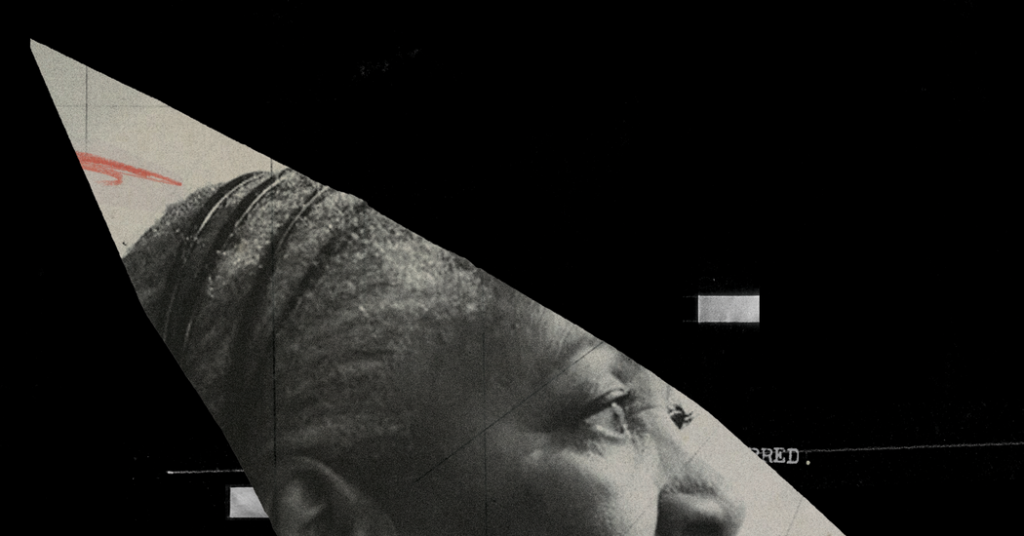
Source photograph for illustration: Damon Winter/The New York Times
The post Toni Morrison Was a Master of the Unthinkable appeared first on New York Times.