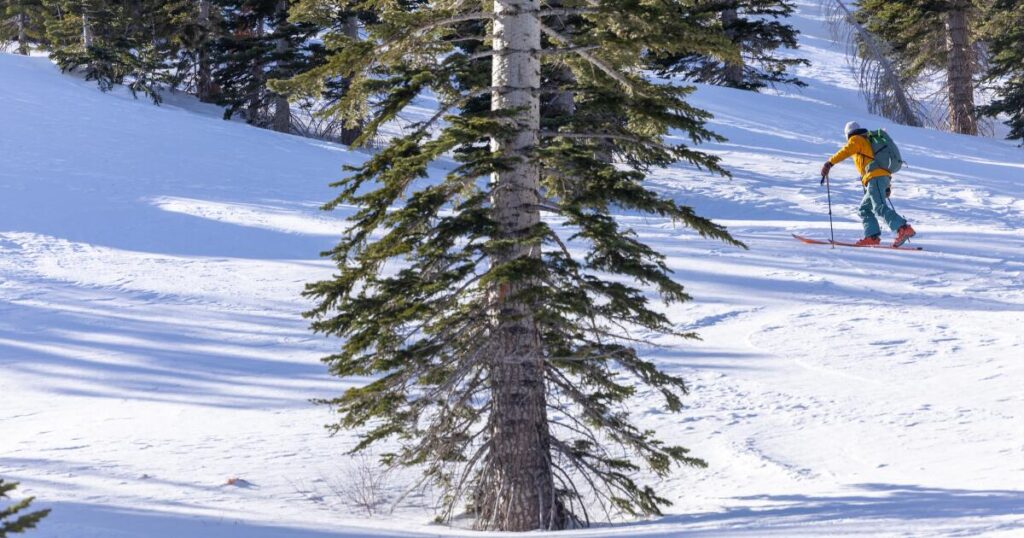
For anyone who has stood freezing in an endless lift line at a ski resort, or flinched as some out-of-control “rad Brad” whooshes by like a Red Bull-and-vodka-fueled missile, the allure of backcountry skiing needs no explanation.
Out there, far from the madding crowd, it can be just you and your friends, gliding through acres of untracked powder, surrounded by silent, untamed wilderness.
Undoubtedly, that was part of the draw for the 15 people — four professional guides and their 11 clients — who went for a Presidents Day weekend adventure in the remote slopes north of Lake Tahoe, only to become victims of the deadliest avalanche in modern California history.
After two days in the backcountry, they were struggling home through a blizzard on Tuesday morning when an avalanche that authorities said was the size of a football field swooped down and killed eight of them. Another is still missing and presumed dead.
As soon as the skiers were reported missing, and before the enormousness of their loss was confirmed, rescuers, other professional ski guides and endless social media commenters started asking why they had ventured out when they knew a huge storm was on the way.
There are indications it was not the first time the guide service, Blackbird Mountain Guides, chose to take clients out in a storm.
An undated five-star review on their website for the trip to the Frog Lake Huts — where the avalanche victims stayed — reads: “Despite the tough weather and significant avalanche conditions, they kept the tour safe, fun and exhilarating. I now believe storm skiing may be the best way to go!”
The company has not responded to an email requesting comment.
Dave Miller, owner of International Alpine Guides in June Lake, which also guides backcountry skiing trips to the Frog Lake Huts, said storm skiing isn’t as shocking as it might sound to a layperson.
It’s something “backcountry skiers do all the time, just like resort skiers do,” he said. “There are safe ways to do it, even in high [avalanche] danger.”
That safety depends on a lot of factors, but a key one is avoiding very steep slopes when avalanche danger is elevated, particularly when they’re loaded with many feet of fresh, unstable snow.
Skiers typically carry safety equipment such as avalanche beacons to help find each other if they get buried in snow, and probes to dig each other out. The survivors of this week’s avalanche used an emergency beacon and the SOS feature on an iPhone to contact rescuers.
Last winter, while guiding at a remote, fly-in backcountry lodge in Canada, Miller said he and his clients were surrounded by avalanche terrain in all directions. Instead of risking it, they spent a stormy day skiing a relatively gentle slope, between some trees, right next to the lodge.
“It was great fun and not in, or near, any avalanche terrain,” he said.
People who are unfamiliar with the sport might think that anywhere in the mountains is too risky to travel when it snows. But, Miller said, “it’s not like the entire backcountry is dangerous avalanche terrain. Most of it isn’t.”
In the Castle Peak region north of Tahoe, where this week’s tragedy unfolded, the journey from the trailhead to the Frog Lake huts comes with known risks.
“All routes involve avalanche terrain, requiring appropriate education and safety equipment,” according to the website for the huts, which are owned by the Truckee Donner Land Trust.
While a full accounting of what happened on Tuesday has not materialized, details offered at a news conference Wednesday indicate that the group was passing beneath a steep, avalanche-prone slope when tragedy struck.
Rusty Greene, operations captain for the Nevada County Sheriff’s Office, which coordinated the rescue of survivors, said he was told that someone in the group apparently saw snow barreling down from above and yelled, “Avalanche!”
While the scale of this week’s avalanche has shocked millions and generated headlines around the world, the fate of its victims is all too familiar to practitioners of the extremely niche sport of backcountry skiing.
Last year, after decades of skiing at resorts, this reporter took a maiden voyage into the Eastern Sierra backcountry with Howie Schwartz, a veteran guide based in Bishop.
To get started, we glued “skins” to the bottoms of our skis, synthetic material that allowed them to glide forward through the snow but stopped them from sliding backward, making uphill travel possible.
The uphill was exhausting, even for a distance runner. The temperature was well below freezing, but we left most of our layers in our backpacks, because we didn’t want to get soaked in sweat only to freeze on the way down.
Then came a review of the safety gear, which included avalanche beacons — devices about the size of an old Blackberry that can send and receive electronic signals. We strapped them to our chests so if one of us got buried, the other would, theoretically, be able to find the beacon.
We also had probes: long, thin sticks that unfold like tent poles and are designed to punch holes in avalanche debris and make contact with a buried partner. You hope you don’t poke someone in the eye, but if you’re using one, it’s a life-or-death emergency, so it’s no time to be squeamish. And we had collapsible shovels to help us dig if we were lucky enough to find our friend.
The exercise was far more sobering than reassuring. It was clear that every step in the process would take time, and someone buried in snow is likely to suffocate within minutes. Putting on the beacon didn’t make me feel as if I’d be safe if tragedy struck, but it made me confident someone would eventually find my body.
Despite the joy of making effortless, bouncy turns through untracked powder, and floating hundreds of feet through the trees in perfect silence, that’s where the dream of backcountry skiing meets grim reality.
As of this time last year, at least 245 people in the U.S. had been killed by avalanches in the preceding decade, according to data compiled by the Colorado Avalanche Information Center and the U.S. Forest Service. Some victims were hikers and snowmobilers, but more than half were skiers.
Backcountry skiing offers “a very harsh learning environment,” said Steve Mace, director of the Eastern Sierra Avalanche Center, which publishes daily updates on the weather and avalanche risk in California’s high country.
Skiers get lots of unreliable “positive feedback,” he said in an interview last year. You might have traveled a given backcountry route many times, in all kinds of weather, and think you’ve figured things out, he said.
“But there are a million reasons why an avalanche might not release” on any given day, Mace said. “It may not be that you made good choices; it may be that you just got lucky.”
Reached on Thursday to discuss this week’s tragedy near Tahoe, Mace said it wasn’t unreasonable for that group to go out during this storm. He went out in it himself to collect data and firsthand information for his forecasts.
“I don’t think that they were going out there uninformed, and I don’t think that they were being reckless,” Mace said. “But I think there is sometimes a fine line between pursuing your passion and mitigating risk.”
Last year, after our adventure, Schwartz said it can be hard to find the right advice to give new backcountry skiers. He doesn’t want to underplay the dangers, but he also doesn’t want to discourage people from something that could bring them joy.
“What you see more often than not,” Schwartz said, “is that people know what they’re doing is dangerous. They know there’s a mortal risk. But they do it anyway.”
Times staff writer Andrea Flores contributed to this report.
The post The perils and pleasures of backcountry skiing: why some take the risk appeared first on Los Angeles Times.