America’s Constitution proudly proclaims that all people born on American soil and under the American flag are Americans — equal birthright citizens — regardless of their parentage. Constitutionally, it does not matter if you are born Black or white, male or female, in wedlock or out. It does not matter what religion, if any, your parents profess, what country or continent they descend from, whether their ancestors were ever enslaved or whether they themselves are American citizens or even lawful permanent residents.
But on the first day of his second term, President Trump declared his intent to defy this grand guarantee by refusing to recognize the citizenship of a wide swath of American-born babies going forward. With small exceptions, Mr. Trump’s Executive Order 14160 proclaims that an American-born baby will not be treated as a birthright American citizen unless at least one of the baby’s parents is a citizen or lawful permanent resident (colloquially, a green-card holder).
Every judge to consider the matter thus far has emphatically rejected Mr. Trump’s edict, which has not been allowed to take effect. On April 1, Supreme Court justices will take center stage, hearing oral arguments in Trump v. Barbara, a legal challenge to the executive order. A final written ruling from the court will most likely emerge in June.
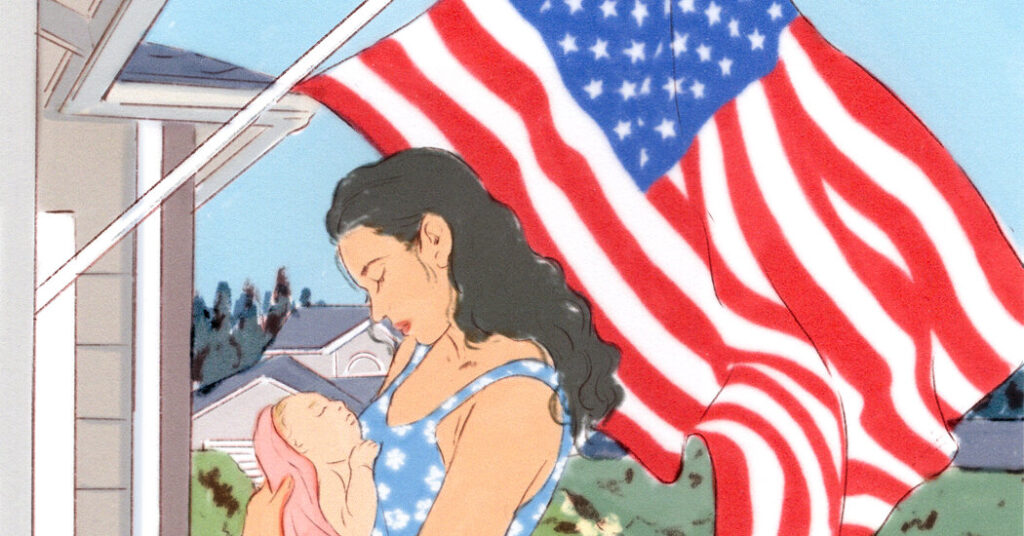
The opening sentence of the 14th Amendment, ratified in 1868, means exactly what it says: “All persons born or naturalized in the United States, and subject to the jurisdiction thereof, are citizens of the United States.” The key initial preposition, “in,” is geographic. The text says nothing whatsoever about the family to whom a baby is born. The refining jurisdictional clause essentially means that a baby must be born under the flag.
This was the precise phrase that the architects of this constitutional amendment in the mid-1860s — Abraham Lincoln’s Republican allies — repeated dozens of times. The word “under” was (and still is) synonymous with “subject to,” and “the flag” was (and still is) a helpfully concrete stand-in for the more abstract word “jurisdiction.” The amendment thus codified a simple test that 1860s Republicans reiterated ad infinitum: On the day a baby is born, does American soil lie below, and does an American flag fly above?
Like the preposition “in,” the preposition “under” was geographic and place-based, not hereditary and blood-based. Certain territorial enclaves located inside the general geographic perimeter/footprint of the United States fell under a different flag — most notably, quasi-sovereign American Indian lands, foreign embassies and land occupied and administered under international law by foreign armies. These enclaves lay outside the full guarantee of constitutional birthright citizenship.
Crucially, nowhere does the text use the words “parent,” “parents” or “domicile.” Had it done so, the amendment’s framers and ratifiers would have needed to wrangle over countless complexities, large and small, raised by these words. For example: Would both parents matter or just one? If one, which one? Who exactly are a baby’s parents? What if a mother is married to one man but another man is the biological progenitor? What about foundlings?
Chief Justice Roger Taney saw things differently in the infamous Dred Scott case in 1857. Taney proclaimed that no Black American descended from slaves or from “the slave races” could ever be a citizen.
By late 1862, Lincoln’s administration openly began pushing back against blood-based and hereditary-caste-like citizenship rules. Sidestepping Dred Scott, Lincoln’s attorney general Edward Bates in November 1862 issued a landmark opinion asserting that American citizenship was based on soil and not blood. Birthright citizenship, Bates said in an official response to an inquiry from Treasury Secretary (and future Chief Justice) Salmon P. Chase, generally depended on where a person was born. “Every person born in the country,” wrote Bates, “is, at the moment of birth, prima facie a citizen … without any reference to race or color, or any other accidental circumstance.”
In an earlier memo to Secretary of State William Seward, Bates was absolutely emphatic on the precise question at the heart of today’s Trump v. Barbara case: “Children born in the United States of alien parents, who have never been naturalized, are native-born citizens of the United States.” In official correspondence in 1864, Seward echoed Bates: “The children of foreigners born here are citizens of the United States.” Chase, too, enthusiastically echoed Bates’s opinion: “All free persons born in the United States or naturalized of whatever color, are citizens of the United States.”
After Lincoln’s death, his allies in Congress aimed to vindicate his and his cabinet’s vision in a clearly written constitutional amendment with bulletproof rules guaranteeing Black birthright citizenship: soil-based rules, clean and clear rules that focused on where a person was born and not fuzzy rules focusing on parentage or parental allegiance or parental domicile. Republicans never aimed to allow ex-Confederate states to deny the vote to various Black men because these men had been born to slave mothers or slave fathers who in turn had been born in Africa.
Countless American freedmen were indeed born to formerly enslaved parents who themselves were not citizens when their babies were born. Many of these parents were not only African-born and never-naturalized aliens; they were also African-born and never-naturalized illegal/undocumented aliens, having been smuggled into America after 1807 in violation of American law prohibiting international slave importation. Republicans aimed to make citizens of the children of all such aliens — no ifs, ands or buts.
Beginning with a landmark 1898 decision, United States v. Wong Kim Ark, the Supreme Court has faithfully followed the clear letter and spirit of the birthright citizenship clause. So has Congress in an iconic statutory provision first enacted in 1940 and re-enacted in 1952.
America’s government may properly impose a wide range of harsh sanctions on foreign parents who violate America’s immigration laws. But unless and until our Constitution is amended, our government is simply not allowed to punish innocent babies guaranteed full and equal citizenship by the Constitution itself.
Akhil Reed Amar is a professor of constitutional law at Yale and the author of “Born Equal: Remaking America’s Constitution, 1840-1920.”
The Times is committed to publishing a diversity of letters to the editor. We’d like to hear what you think about this or any of our articles. Here are some tips. And here’s our email: [email protected].
Follow the New York Times Opinion section on Facebook, Instagram, TikTok, Bluesky, WhatsApp and Threads.
The post Soil, Not Blood, Determines U.S. Citizenship appeared first on New York Times.