When Kevin Puts’s song cycle “Emily — No Prisoner Be” had its New York premiere at Carnegie Hall on Thursday night, the composer wrote in his program notes, “I could see from the start this wasn’t going to be your grandmother’s Emily Dickinson song cycle.”
Was that a potshot at Aaron Copland and his classic “Twelve Poems of Emily Dickinson?” Maybe. But then, as Puts noted self-deprecatingly, there have been thousands of musical settings of her work, and he is simply adding to a long list.
To his credit, Puts, who won the Pulitzer Prize for Music in 2012, imagines Dickinson anew. His song cycle for mezzo-soprano and string trio pulsates with restlessness that only occasionally breaks into reverie. This is not the somber shrinking violet that a high schooler might envision holed up in her 19th-century New England bedroom scrawling away stoically and secreting her poems in a drawer. In Puts’s telling, the famously reclusive poet withdrew from society to thrive, not wither.
At Carnegie, the ensemble Time for Three and the opera star Joyce DiDonato brought this idea to lacerating life. The intensity of their shared focus buoyed the material when it sometimes veered into a certain sameness.
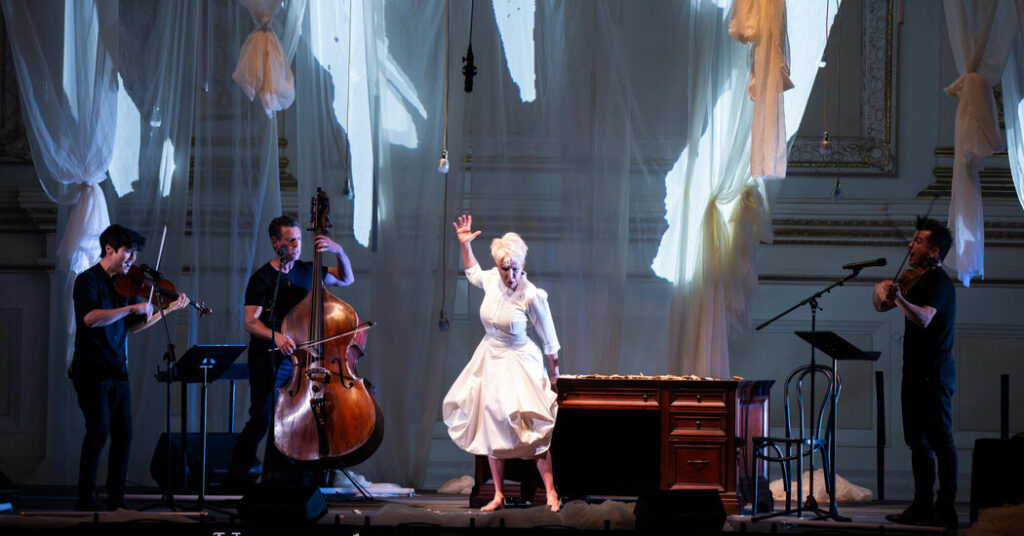
The show began and ended with Emily, dressed in her favored white, working at her desk. What came between, though, was a dramatization of the life of her mind in its churning energy. In Andrew Staples’s highly effective staging, her plain bedroom transformed into a dreamlike space of loosely gathered white drapes, and William Reynolds’s lighting illuminated her moment-to-moment feelings, from warm pinks to blinding yellows.
DiDonato’s Emily was a fiercely intelligent, physically brazen woman. Her voice roared and bloomed with conviction across the work’s two-and-a-half-octave range, from throaty lows to shuddering highs, from a meaty bellow to a thread of gossamer. (All of the artists were miked.)
Puts strung together roughly two dozen poems, both cryptic nuggets and beloved lyrics, into a loose narrative arc. Dickinson’s famous preoccupations were all there: death, social isolation, individuality, letter writing. In Puts’s sequencing, memories of childhood bled into staunch, intellectualized self-reliance and a vaguely blossoming amorousness. Emily’s liberation from societal norms formed the finale: She embraced the freedom afforded by her confined life.
The adventurous string ensemble Time for Three, comprising the violinists Nicolas Kendall and Charles Yang and the bassist Ranaan Meyer, is the engine of Emily’s creativity. They tapped out their own percussion, played their violins like guitars and sang three-part harmony as they bowed. Yang, in particular, sang convincingly in an alto’s register even with his violin tucked under his chin. Their extended techniques expressed the volatile, irrepressible will to artistic creation.
Puts didn’t try to make the trio sound like a full, lush string section. He emphasized coordinated horizontal movement, with the instruments playing sculpted ostinatos or chasing one another in fugal style. Solo effects like harmonics alternated with sprightly pizzicato accompaniments. Instrumental warmth had the subtle glow of embers. Time for Three did it all with suavity and fevered focus.
Puts found clever ways into even the most famous poems. In “Because I could not stop for Death,” a highlight of the evening, the shifting time signature conveyed the narrator’s unease as Death took her for a carriage ride. DiDonato sang the entirety of “‘Hope’ is the thing” on an “ooo” vowel, since hope “sings the tune without the words.”
At times, the tone turned overheated. Whirring agitation overtook Puts’s usual lyrical splendor, and Emily came across as a lecturer pointing her finger for emphasis. A song like “I dwell in Possibility” stayed on the right side of the line between self-actualization and tedious instruction; “The Props Assist the House” did not.
In this time of omnivorous musical tastes, Puts didn’t shy away from pop. The lovely duet “Her Face,” with its high-lying tenor part, could be a distant cousin of Rihanna and Mikky Ekko’s 2013 hit “Stay.” On the recent studio recording of “Emily — No Prisoner Be,” the rousing title track that gives the cycle its name provided a gospel-tinged finale, but at Carnegie, it had a folksier, countrified twang.
The concert was part of Carnegie Hall’s “United in Sound: America at 250” festival. As an encore, DiDonato led the audience in a singalong of “No Prisoner Be,” a three-line poem about finding liberty within yourself despite what’s going on around you. When an audience member improvised a harmony, DiDonato cheered her on: “You better sing.”
Emily — No Prisoner Be
Performed on Thursday at Carnegie Hall, Manhattan.
The post Review: A Pulitzer Winner Imagines Emily Dickinson Anew appeared first on New York Times.