Practice makes … better, if not perfect.
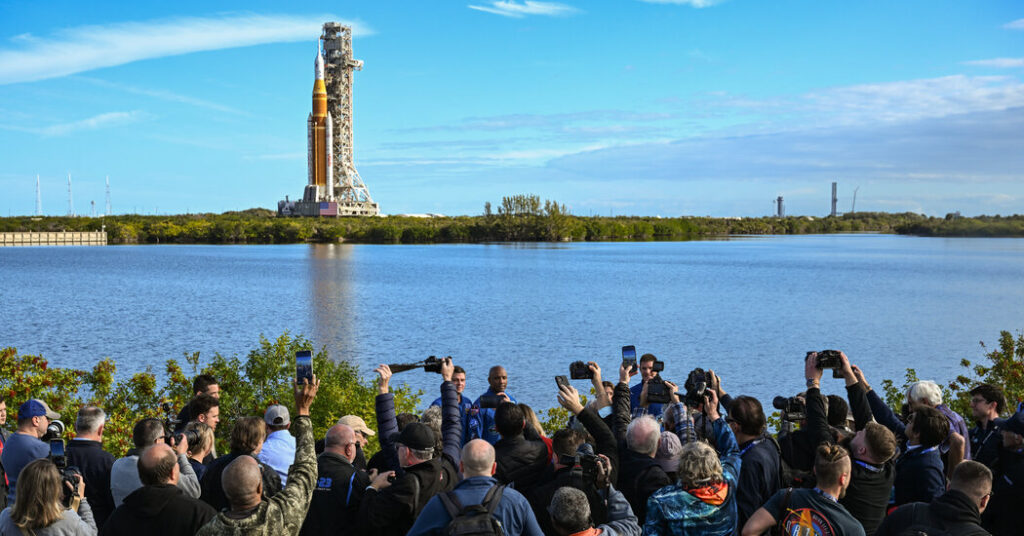
On Thursday night, NASA successfully completed a countdown rehearsal for the Artemis II moon mission, experiencing only a few small glitches along the way.
That was a marked improvement from the agency’s first try a couple of weeks ago, which was cut short because of leaks of hydrogen, the fuel used by the rocket.
“Proud of the @NASA team as this was a big step toward America’s return to the lunar environment,” Jared Isaacman, the NASA administrator, wrote on X on Friday morning. “We are going.”
NASA is holding a news conference about the testing on Friday at 11 a.m. Eastern time. Unless a review of data reveals a subtle showstopper, the almost flawless rehearsal should pave the way for a launch attempt as soon as March 6 for Artemis II.
That launch will send four astronauts on a 10-day journey that will swing around the moon and return to Earth. The astronauts will not land on the moon, but they will be the first to leave low-Earth orbit since the end of NASA’s Apollo program more than 50 years ago.
The two-day countdown test at NASA’s Kennedy Space Center in Florida included filling up the tanks of the giant Space Launch System rocket with millions of pounds of liquid hydrogen and liquid oxygen.
The S.L.S. design is, in large part, a remix of decades-old technologies from NASA’s space shuttles. The rocket on the launchpad includes leftover engines and other parts from the retired shuttles.
Like the shuttles, S.L.S. has been bedeviled by hydrogen leaks at the launchpad.
Because hydrogen is the lightest element, it is efficient, providing the most energy per pound of any fuel. But hydrogen molecules, which consist of pairs of hydrogen atoms, are also small and notoriously difficult to contain.
During the first attempt, sizable hydrogen leaks occurred at the interface between the rocket and the launchpad. The tanks were eventually filled, but hours behind schedule.
But in the final part of the countdown, the hydrogen leak reappeared, and the rehearsal was ended with about five minutes left in the countdown.
On Thursday, NASA did not report any hydrogen leaks. Minor issues included a problem with ground communications in the launch control center and a “voltage anomaly” in one of systems that briefly paused the countdown with 90 seconds left.
The countdown resumed and ticked down to 33 seconds, then stopped as planned. The countdown clock was then reset to 10 minutes as systems were reconnected.
That allowed NASA to practice how to reset a launch attempt to fix a last-minute problem instead of scrubbing the attempt.
After hydrogen and oxygen were replenished in the rocket’s propellant tanks, the countdown resumed, again ending as planned — this time with 29 seconds left.
It was a busy night in Florida. As the Artemis II rocket sat on the pad, a SpaceX Falcon 9 rocket launched from a nearby launchpad at the Cape Canaveral Space Force Station, carrying a load of Starlink satellites to orbit.
Kenneth Chang, a science reporter at The Times, covers NASA and the solar system, and research closer to Earth.
The post NASA Conducts Successful Launchpad Test of the Massive Artemis Rocket appeared first on New York Times.