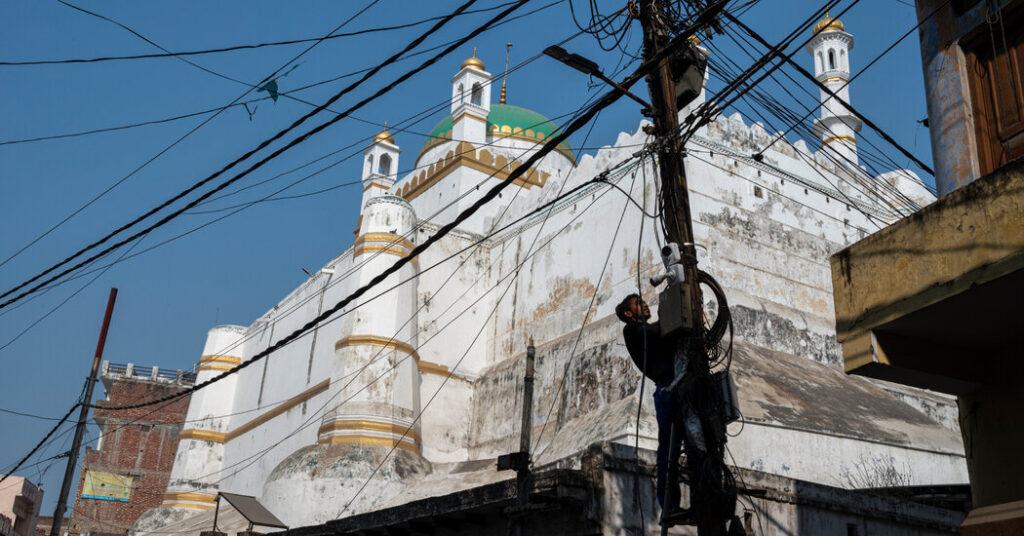
The defining scene, before the city’s transformation, was that of a lawyer, dressed in his barrister’s black robe and casual slippers, walking out of the narrow alley of a mosque shielded by security guards and supporters who chanted hail to the Hindu deity Ram.
All around, it was deadly chaos.
An angry crowd of Muslims had gathered in late 2024 to defend the mosque, one of the oldest still standing in India, which they feared was under threat from a court ruling prompted by the lawyer. The police, led by a former Olympic wrester with a penchant for shirtless muscle-flexing on Instagram, charged at them with clubs as the tensions grew, and many in the crowd hurled stones. The officers shot tear gas and opened fire. Residents said at least five people were killed.
For Muslims in India’s north, the mosque, Shahi Jama Masjid, and the city that grew around it are a prominent bastion of their identity.
But for the Hindu right, the 16th-century mosque is an eyesore — a symbol of an abhorred past of foreign invasions that brought Islam to India’s north and altered the region’s ancient demography. Hindu nationalists sought to dismantle the mosque through the courts by claiming it was built on a sacred Hindu site, using archaeological claims to help further the rise of Hindu nationalism.
The swiftness with which the city, Sambhal, was subsequently brought to submission in the year that followed speaks to the unstoppable momentum of the Hindu Right as India’s dominant political force, leveraging the local government, the police and the judiciary.
After the clashes, officials shut down the internet, closed Sambhal to outsiders and crushed dissent. The authorities, relying largely on phone location data, rounded up dozens who were found to have been in the area of the clashes. The police registered criminal complaints against 2,750 “unnamed” people in relation to the violence — indicating that they could add anyone’s name as a suspect later, which some Muslims saw as a threat. The families of those killed and injured said they were pressured not to file complaints against the police. A lawyer representing the mosque who blamed the police for the deaths was accused of inciting violence and sent to jail.
“The system, this hatred they are sowing, took my son,” said Nafisa, who goes by only one name. Her son Ayaan, 17, was killed in the violence.
Violence along religious lines is not new in India. But what played out in Sambhal — documented in interviews and court documents — crystallized a new reality where the arms of the state that once tried to play the role of referee now increasingly serve as the muscle of the forces recasting India’s secular republic as a Hindu-first nation.
“India’s drift toward Hindu majoritarianism has received the support of large swaths of the population as Indian society moves from transactional communalism to institutionalized bigotry,” two leading experts of India, Devesh Kapur and Arvind Subramanian, wrote in a new book, “One Sixth of Humanity.”
Three-quarters of Sambhal city’s estimated population of about 300,000 is Muslim. But they say they have been forced to largely confine expressions of faith to private spaces, and they have been frightened into silence as the city took on a more overt Hindu identity.
“Our people’s peace was replaced with harassment,” Zia ur Rahman Barq, an opposition lawmaker representing Sambhal, said. “Their work, the education of their children, is affected.”
On the ground, the most visible face of this new reality of Hindu dominance was the police chief, Anuj Chaudhary, who said his officers were simply enforcing the law. (The police have denied any role in the killings and any harassment.) He aspired to Bollywood stardom after an injury ended his wrestling career, but settled for another type of celebrity — a tough-guy cop with social media reels set to thumping music.
But setting the tone from the top is Yogi Adityanath, the leader of the surrounding state, Uttar Pradesh, India’s most populous with 240 million people. Ruling in a monk’s saffron-robe, he defines the law, the boundaries of the new reality where full display of Hindu religiosity is the norm. Meanwhile vigilantes — often unchecked by the police — frequently suppress other public religious expression.
Mr. Adityanath, whose office did not respond to requests for comment, has used Sambhal to further his strongman reputation, a plank on which he will fight for re-election next year, according to a senior state official who asked not to be named because he was not authorized to speak. Mr. Adityanath’s image, which includes championing big-ticket development, has made him popular around the country and a possible successor to Narendra Modi as the country’s prime minister.
Mosque Battle
By his own account, Vishnu Shankar Jain, was simply carrying out the court order he had obtained to examine the history of the site of Shahi Jama Masjid.
But he was also following in the footsteps of his father as a legal warrior of the Hindu cause. His father had been a key member of the legal team in a dispute over another 16th-century mosque, Babri, in Ayodhya, also in Uttar Pradesh, that was razed in 1992 and set off deadly violence. That movement began unraveling the fragile understanding that had held India together since its founding as a republic: that it is a tolerant, forward-looking modern nation not focused on settling past scores.
Mr. Jain, 39, calls himself a “destination” lawyer available to anyone who wants to pursue a dispute on behalf of Hindus.
“This is about reclaiming our cultural heritage,” he said in an interview.
Within hours of Mr. Jain getting the court’s approval on Nov. 19, 2024, a survey officer was appointed. The many government entities involved reached the scene to begin work long past official working hours, looking for clues that the site may have once been a temple. Their unusual speed, in a typically snail-paced bureaucracy, aroused suspicions among Muslims that the authorities were seizing and demolishing the mosque.
“What was the need for such haste?” said Mr. Barq, the lawmaker. “Surveys don’t happen at night, but during office hours.”
The first survey passed peacefully. But after the team, accompanied by a large security force, arrived again early on Nov. 24 for a second survey, an angry crowd of Muslims assembled outside the mosque. When water from a tank in the mosque started gushing down a slope, the crowd grew restless, said the mosque’s lawyer, Zafar Ali. Rumors spread that the team had started excavating the site.
The crowd rushed forward, some of them throwing stones. The police charged back, firing bullets that killed and injured some of them, their families said in interviews and court documents.
Among those killed was Mohammad Roman Khan, 45, who sold garments from a bicycle. He had two bullet wounds — one in the chest, one in the back of the head — his son, Mohamad Adnan Khan, said.
The family did not file a complaint.
“If the killer is the same police, what can we do?” the son said.
Four families of the dead registered police complaints but were harassed by the police to change their statements, their lawyers said. Days before some were scheduled to give evidence in July to an inquiry committee, they were picked up from their homes by the police, one lawyer said.
When a local baker complained to the police that he had been hit by bullets and had seen “with his own eyes that it was police who fired at him,” he was booked over the violence, said Qamar Hussain, his lawyer.
“If you look for witnesses, they end up as accused in jail,” Mr. Hussain said.
The police described the violence as a conspiracy by a local group “to establish their might” by orchestrating large-scale riots. Other officials portrayed the violence as a gang war between two Muslim factions.
Mr. Barq, the local parliamentarian, was named by the police as an instigator of the violence. His home was raided by hundreds of security forces, TV cameras in tow, over what he said were trumped up accusations of “electricity theft.” (Mr. Barq’s name loosely translates as electricity.)
“Those killed are our people,” Mr. Barq said, “and we are accused of the killings.”
A Police Hero
As Hindu influence over the city grew, Mr. Chaudhary, the area police chief, saw his celebrity soar. He was the guest of honor at functions, and he often posted visuals on Instagram of him carrying out religious rituals in his police uniform. (In contrast, when a Muslim police officer in the state made a reference to Prophet Muhammad while addressing a school, he was transferred after right-wing groups protested against what they called indoctrination.) When Holi, the Hindu festival of colors, coincided with Islamic Friday Prayers in the tense months after the violence, Mr. Chaudhary told Muslims to stay home if they did not like it.
An imposing police station has been built next to the mosque, fitted with dozens of surveillance cameras. The main wall is painted with battlefield scenes from Mahabharata, an ancient epic central to Hinduism. At the station’s opening in spring — with a full religious ceremony on the birthday of the Hindu deity Ram — attendees posed with Mr. Chaudhary for selfies.
Mr. Chaudhary has since been elevated in rank and put in charge of another town. When a judicial magistrate last month ordered a police inquiry against Mr. Chaudhary and other officers into complaints that they were behind the shootings, the police in Sambhal refused the order. Days later, the magistrate was transferred from his post.
In an interview, Mr. Chaudhary said he had been simply doing the work of “maintaining law and order.” As he talked, he referred to the Muslims in Sambhal as “the other side.”
“They have not seen this kind of policing,” he said. “It used to be appeasement — the mollycoddling kind of policing, where the officers touched someone’s chin and pleaded them not to do something.”
The city’s new reality has since been entrenched.
When the Hindu festival of Kanwar Yatra took place in July, police officers kept watch near the mosque as young men paraded through Muslim neighborhoods, blaring music from speakers on the backs of trucks.
Kantikrant Tiwary, a local Hindu leader, was overseeing a food stand organized by a local temple. In the past, he said, such processions would quietly pass through Muslim-majority neighborhoods and with heavy police protection.
“Now we can pass like this,” he said, pointing to a D.J. playing loud rave music outside.
Mujib Mashal is the South Asia bureau chief for The Times, helping to lead coverage of India and the diverse region around it, including Bangladesh, Sri Lanka, Nepal and Bhutan.
The post India’s Hindu Right Seems Unstoppable. This City Shows How. appeared first on New York Times.