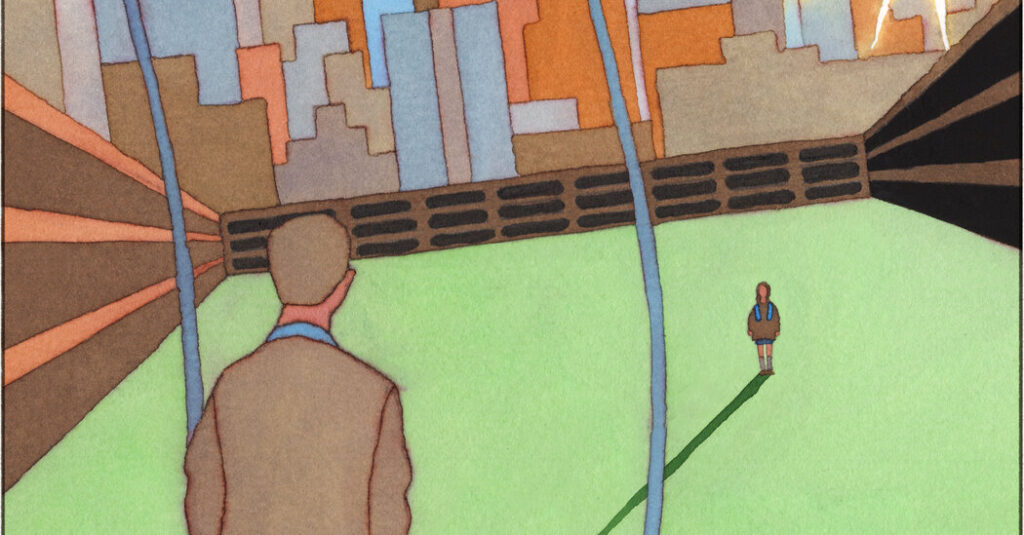
THE OPTIMISTS, by Brian Platzer
There is a cherished and well-populated genre of fiction about influential teachers, be they fondly remembered (Arthur Chipping in “Goodbye, Mr. Chips”) or not so fondly (Miss Jean Brodie). But there are few novels about influential students. Tom Perrotta’s deliciously wicked novel “Election” will forever be the paragon of this much smaller group, but certainly there ought to be more: It’s always a pleasure to watch that once-in-a-career student catch the eye of a veteran teacher.
John Keating, the narrator of Brian Platzer’s third novel, “The Optimists,” is such a teacher, and his former pupil, Clara Hightower, is such a student. Clara is the point around which Keating has organized his life, despite the fact that there is little contact between them once she has left his classroom at St. George’s, the Manhattan private school where he teaches eighth-grade English.
Keating first encounters Clara as a memorable 5-year-old at a birthday party, and when, in due course, she becomes his student, he quickly recognizes her as the standout of his long tenure at St. George’s: “I’d waited 20 years for her, and I already understood there’d never be another one.”
Now, Keating wants nothing less than to understand his own life by understanding hers. “I’ve chosen to tell Clara’s story,” he tells us, “because I don’t know how I’d explain my own.” It’s a lot to ask of a relationship that essentially ends when one party graduates from middle school.
After a devastating stroke, Keating is painstakingly constructing an account of his life in the form of a “novel” about his former student. There’s a lot he doesn’t know about Clara, but his template is Somerset Maugham’s “The Razor’s Edge,” a novel that, in Maugham’s words, “consists of my memories of a man with whom I was thrown into close contact only at long intervals, and I have little knowledge of what happened to him in between.”
But why should an eighth-grade teacher remain in thrall to even an exceptional student who doesn’t keep in close touch? Why should he fixate on a relationship between her and another 14-year-old? Why should he hold a grudge on their behalf for years?
If you’re worried that “The Optimists” is moving toward the territory of Joyce Carol Oates’s recent novel “Fox,” about a prep-school teacher who preys on his prepubescent female students, fear not: There is no prurience here, only its intellectual counterpart.
Yes, Clara is plainly brilliant. She’s also a poor child in a rich child’s school, the daughter of a mother with “down times” and an agoraphobic father, both of whom barely appear in the narrative. But do these attributes sufficiently explain a degree of “specialness” apparent to everyone, even the grandly named headmaster, Richard Kingsley Madison IV, who declares her the school’s and his personal “legacy,” destined to donate large fortunes to St. George’s and draw future parents and their children? “Clara is the closest I’ve come to greatness,” Keating says.
The question that propels “The Optimists” is: Just what is so remarkable about Clara, anyway? And the fact that it never gets answered is one of the novel’s shortfalls. Keating, whose stroke has left him paralyzed, is putting the pieces together using “an ingenious system of sensors and software that allows me to communicate … an exhausting process, but then again, I have nothing else to do.” He examines his own memories along with those of other admiring witnesses from college and from Silicon Valley, where she is hailed as a visionary of data until her crisis of conscience about the world she has helped to create, after which she disappears into underground activism.
Keating’s neurological impairments and the effort required to record his thoughts mean that the narrative is often choppy, out of order, repetitive and even contradictory (“There is no such thing as an origin story. … My point is that villains have origin stories as much as heroes do, and often the same story can serve as an explanation of either good or evil”). None of that is especially helpful to the reader.
Our difficulty, under the constraints Platzer has set for his narrator, is understandable; less understandable is Keating’s frequent meta-commentary about the book he’s writing (“Only at that point would this story’s many inexorable recognitions and reversals begin in earnest”), his reassurances to his future audience (“I don’t want to give the reader the impression that I am intentionally hiding some specific trauma that occurred when Clara was younger, a trauma I plan to reveal at a key moment in this novel”), digressions into knock-knock jokes with discourse on why they are funny (or not), or frustration over finding a path through the material (“Novels need plot. We need one thing to happen because another thing did. That way, details matter”).
The irony is that there’s another novel hiding behind the story Keating is telling about his former student, one much closer to home and very worthy of Platzer’s obvious skill as a writer. Keating may not, himself, be a luminous Clara, but he’s thoughtful, erudite and humble, and his late-in-life experience is far from ordinary. When he tells us, “No one who hasn’t been stuck inside a nonfunctional body can imagine what it’s like. How awful it is when no one visits, and how awful it is when someone does,” we can only wish Platzer had directed his protagonist’s focus inward instead of tailing the ever-obscure Clara to pick up the Maughamian crumbs of her specialness.
In the end, she is no more interesting a person than the narrator who’s spent his life in her thrall, and I’m left with the sense that Keating has spent his limited time and extraordinary effort in telling the wrong story. Platzer, himself a teacher in a New York private school he calls “the model for all that’s good about … St. George’s,” writes in his acknowledgments that Mr. Keating was created in the mold of his own middle-school teacher, a man he remembers more as a Mr. Chipping than a Miss Jean Brodie. “In his classroom, you felt it: the quiet conviction that teaching, in its highest form, could change everything.” If this author ever writes a novel about that, I would love to read it.
THE OPTIMISTS | By Brian Platzer | Little, Brown | 291 pp. | $29
The post In This Novel, It’s the Student Who Shapes the Teacher’s Life appeared first on New York Times.