I’m a dance critic, one who trained as a figure skater in my early teens. I am not a judge. But I do have enough insight to know that competition is the beast that makes figure skating and the discipline of ice dance such a messy and confusing mix of art and sport. Often, it seems like the idea of a performance is the last thing on a skater’s tense and troubled mind. It’s nerve-racking to watch them fight the ice instead of moving with it, but the ability to bring warmth to a hard, frozen surface is where artistry lives.
Alysa Liu, a rare artist on ice, skates to perform. Now 20, she came back to competitive skating on her own terms after retiring at 16 and has done so with a renewed focus on joy. This is a woman who moves with abandon; who laughs in amusement, as much to herself as to the crowd; and who floats with such looseness and buoyancy that she can seem nonchalant. This is an illusion. She cares. But her motivation is different from other skaters who are fueled solely by competition. Her drive is rooted in the art of performance, and the first person she needs to please is herself.
Even if she hadn’t won the gold medal in figure skating at the 2026 Winter Olympics — and she did, amazingly, with no nerves whatsoever on Thursday — Liu was always going to be its shining star for the way her skating is driven by love.
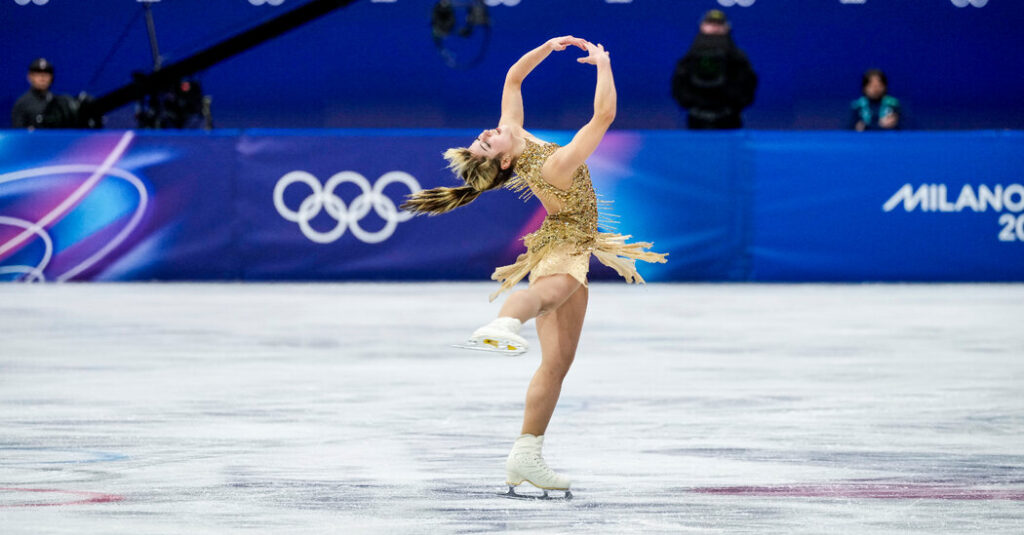
She moves like water on a frozen surface, staying flexible to its grooves and bumps while keeping her body in a continual, flexible state of flow. This was the sensation throughout her free skate at the Milan-Cortina Games: Just as the opening notes of Donna Summer’s “MacArthur Park Suite” played, Liu stood, one hand resting on its opposite shoulder before looking up and smiling — not in a showbiz way, but in anticipation of the fun she was about to have. I’ve never seen anything like it.
Fluidity is her trademark, allowing for a certain softness to buffer her strength, not just in jumps that propelled her spinning body into the air but in the way she moved in and out of them, landing with open arms and expressive, alive hands. Following serpentine patterns, she painted the ice with deep, gliding edges that raveled and unraveled as her ponytail, a striped work of art, bounced in the air.
As her jumping passes turned more buttery, mirroring the music’s pulse, Liu loosened up even more, at one point playfully flicking a hand forward before soaring into a double axel. She danced through a footwork sequence, swaying her head, her hips and her arms as she found her way inside of the propulsive disco beat.
There were slides, one with a knee forward as her back arched like Diana, goddess of the hunt, and another in which she spun on both knees, grabbing the sides of her hair and rolling her head like she was losing her mind in a mosh pit. So fun, so fun.
Liu topped off her free skate with a layback spin — lovely — before grabbing her blade behind her back for a Biellmann finish. It’s not an unusual way to end a program, but for Liu it was an exclamation point showing how much better skating can be when it’s a tool for self-expression and not an excuse for a quad jump.
The emotional toll of the Olympics was real. Skaters in this impressively competitive group imploded in big and small ways. But Liu pointed out that there can be another way to be a skater, where the pressure cooker of a competition falls away. In her free skate, Amber Glenn, recovering from a disastrous short program, had a moment when she revealed this for herself as she sailed across the ice in a magnificent spiral.
Liu wasn’t the only one to trust the art of performance over competition. The outcome of the ice dance championship last week drew the wrong kind of attention, once again, to a field grappling with existential questions about the aesthetics of athletics. The French team of Laurence Fournier Beaudry and Guillaume Cizeron won the gold over the Americans, Madison Chock and Evan Bates, with a free dance program marred by errors even a novice could see.
But the controversy also overshadowed the only performance that mattered: Piper Gilles and Paul Poirier’s exquisitely detailed and transfixing free dance.
Representing Canada, they came in third after their ice dance set to the indie-folk duo Govardo’s rendition of “Vincent” and inspired by Vincent Van Gogh’s “The Starry Night.” For roughly four vivid minutes, the nature of competition wasn’t as relevant as the potency and sweep of Gilles and Poirier’s skating.
In “Vincent,” the pair didn’t skate with manufactured slickness, the forced and grating brand of theatricality that can permeate the sport. Their skating was more aligned with Jerome Robbins than Maurice Béjart. They were skaters as people. Their athleticism made everything they did possible, but it wasn’t front and center. Like Liu, they found a way to skate — to live — in the moment.
The choreographer Martha Graham once spoke about how learning is achieved through practice. “It is the performance of a dedicated precise set of acts,” she said, “physical or intellectual, from which comes shape of achievement, a sense of one’s being, a satisfaction of spirit.”
What’s most important in a free dance is just that: freedom. With Gilles and Poirier, and especially Liu, you could sense how practice became, as Graham said, “a means of inviting the perfection desired.”
Liu was a vision of spontaneous perfection, so deep in her body that as she connected steps and jumps with seamless ebullience, her skating became a release, as much a feeling as a physical act. You couldn’t see her thinking. This was an artist unbound. She didn’t just find her flow, she danced her way through it, sharing herself — and her art — with the world.
Gia Kourlas is the dance critic for The Times. She writes reviews, essays and feature articles and works on a range of stories.
The post In Her Big Olympic Moment, Alysa Liu Celebrated Her Freedom appeared first on New York Times.