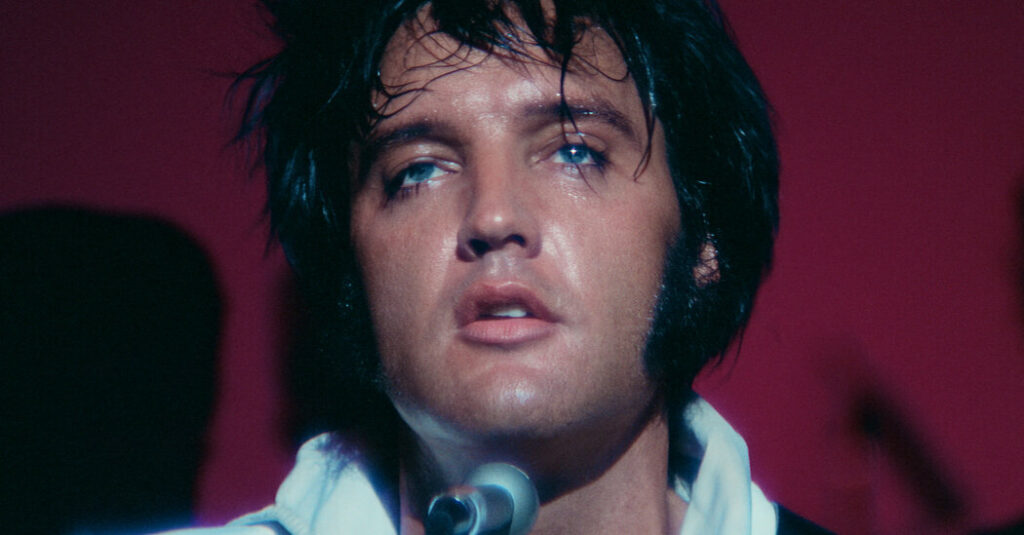
Baz Luhrmann first heard about the footage while researching what would become his 2022 Elvis Presley biopic, “Elvis.” There was this treasure trove of unused, unseen film, he was told, shot by MGM for the 1970 concert movie “Elvis: That’s the Way It Is” and its 1972 follow-up, “Elvis on Tour.” Luhrmann’s interest was piqued; he wondered if he could save himself the effort of building an elaborate set by using existing footage of the Vegas showroom where Presley returned to live performing.
Instead, he began a multiyear journey of rescue and restoration that has resulted in the new documentary “EPiC: Elvis Presley in Concert,” which opens in IMAX theaters across the country on Friday.
That journey began, improbably enough, in an underground salt mine in Kansas. “People think it’s a turn of phrase,” Luhrmann said, in a video interview from his office in Australia. “It’s not.” Such facilities are where studios like Warner Bros., which now owns the footage, keep their archival materials — at a price.
“It costs you $100,000 just to send someone down looking,” he explained, so he paid the tab out of his own pocket and got researchers into the vault. “They find not just one or two reels,” he said. “They find 69 boxes of footage.” Much of it was 35-millimeter film, shot during several Vegas performances for “That’s the Way It Is”; the rest was 16-millimeter footage, shot backstage for both films and onstage for “Elvis on Tour.”
“But it’s all mislabeled,” Luhrmann said. “Some’s been stolen, dust corroding, just a mess.” And there was one other problem, said Jonathan Redmond, editor and executive producer of “EPiC” and Luhrmann’s longtime collaborator. “It was just 59 hours’ worth of picture. There was no sound, because film and sound are recorded separately and archived separately,” he said in a video interview from Los Angeles. “So we were looking at all this footage, some kind of amazing stuff, but we didn’t know what he was singing.”
Even in that rough and baffling state, the filmmakers were captivated by what they saw. “We’ve got to do something special with this,” Redmond told Luhrmann. “We can’t just put it back in the salt mines.”
Luhrmann agreed: “We’ve got to do something special, like a companion piece.”
But first, they had to make the film it was accompanying. While Luhrmann and Redmond shot and cut “Elvis,” Warner Bros. oversaw the scanning of the raw footage in 4K, and an assistant editor, Jim Greco, set about syncing it up to any and all available sound recordings. In the meantime, Angie Marchese, vice president of archives and exhibits for Presley’s Graceland museum, provided the filmmakers with several reels of 8-millimeter and Super-8 home movie footage, much of it previously unseen as well.
“But then what really happened, the breakthrough, was that then we found this interview,” Luhrmann said. Early one morning, after a late night of gospel singing, Presley had consented to an audio-only interview with the “Elvis on Tour” filmmakers, in which he was atypically unguarded and candid about his life and career to that point.
“Having read all the books and done so much research on Elvis, we knew his story, so he wasn’t necessarily telling us something we didn’t already know,” Redmond said. “But hearing him tell it in his own voice was so much more powerful, in a way. And that really kind of unlocked the key to the project.”
Specifically, it helped Luhrmann answer the question he’d been asking since they started contemplating the picture: “What do we make?” They didn’t just want to do another concert movie, or refurbish one of the earlier films with new footage (which had already been done, for “That’s the Way It Is,” in 2001). Nor did they want to make yet another biographical documentary, like “This Is Elvis” from 1981.
“They’re good documentaries,” Luhrmann said. “But it’s always people talking about Elvis — not him.” Instead, Luhrmann and Redmond devised a mixture of concert film, bio-doc and something a bit more … surreal. “We’re going to make, like, a dreamscape,” Luhrmann said, “where Elvis comes to you in your dream and sings and tells your story like never before. That was the idea.”
The all-encompassing nature of their approach meant tracking down even more footage, interviews and concert film — in high enough quality for the IMAX release that they were now working toward. “Basically, we wanted film backing for all the archive material,” Redmond explained. “So even the stuff in the ’50s, we were able to go back to the various vendors and source film for it and scan that.”
That dedication to original film and sound elements sometimes meant going beyond traditional sources. “We wired together some audio that’s out there, that’s bootlegged,” Luhrmann said with a laugh. “We had to meet people in car parks and buy it, bless their socks. The trading of illegal Elvis stuff — there’s Colombian drug lords, and then there’s the guys that trade bootlegs, and dude, I think I’d rather work with the Colombian drug lords.”
The director was less bothered by the occasional bits of missing instrumentation, which he had rescored and rerecorded, an aesthetic choice that jibed with their overall concept.
“This is the opposite of ‘Get Back,’” he said, referring to Peter Jackson’s Beatles archival docuseries, “in the sense that what makes ‘Get Back’ so great is that it’s fly-on-the-wall. What I wanted to say was, No, this is an imagined concert, where all these things happen at once.” But the filmmakers enthusiastically engaged Jackson and his WingNut Films for the job of image restoration as they’d undertaken for projects like “Get Back” and the 2018 World War I documentary, “They Shall Not Grow Old.”
“He’s the gold standard of film restoration,” Redmond said. “So quite early on, we decided, as good as our footage is, let’s shine it up as much as possible.”
Rest assured, however, that that’s all they did. “I want to underline, there’s not a single frame of A.I. in this,” Luhrmann said, firmly. “And there are no visual effects. I like to say the only visual effect in this is the visual effect Elvis has on his audiences.”
With their multiyear, dual-film exploration of Elvis Presley finally complete (and a few brief images from the recovered footage making the cut, though they did end up rebuilding that Vegas showroom), Luhrmann and Redmond hope they’ve added something important to the copious cultural conversations surrounding the King. For them, it always boiled down to the question who was Elvis Presley, really? “We had this phrase: in the cracks, you see the light,” Redmond said, “which really strongly applies to a character like Elvis, who was so used to cameras and being on camera.”
“Elvis says in this movie, it’s very hard to live up to an image,” Luhrmann noted. “He said, a human being is one thing and an image is another.” And so for the director, understanding Elvis Presley meant grappling with, and empathizing with, both the human being and the image. “I hope that the two films show the mask,” he said, “because we all love to see Elvis being the iconic Elvis, but also take the mask off. That’s what I set out to do.”
The post Elvis in IMAX: How Newly Found Footage Became an Immersive Documentary appeared first on New York Times.