It was a recent late night in the VIP Club, the hedonistic heart of Cortina d’Ampezzo, Italy’s most ski-and-be-seen winter destination. An Olympic security manager watched from the bar as scions of wealthy families, men in expensive sweaters and women in backless leotards sang along with the piano player to Lionel Richie’s “All Night Long (All Night).” Others kicked back with champagne and admired the view of the Olympic sliding track, winding like a glow worm through the Cortina night.
The Winter Olympics, much of which are based in Cortina, have shined a light on the natural beauty of its surrounding landscape, a valley bathed in sunshine and wrapped by the craggy Dolomite mountains. But Cortina’s beautiful people hope the Games can also revive Cortina’s long-held reputation for glamour, which has waned in recent generations.
“We have the opportunity to show the world how Cortina is beautiful in a different way,” said Manuel D’Avanzo, the owner of the VIP Club, which he called “a holy grail” for wealthy, night-life loving Italians. It is a place, he said, with heritage and history — and now a sponsorship deal with Rolls-Royce. At least one sliding-sport athlete admitted to slipping out with teammates to party at the club during the Games, though he was granted anonymity when he pleaded that without it, he would be thrown off the team. (“Our coach will kill us,” he said.) Mr. D’Avanzo agreed that it was more prudent for athletes to come after they won their competitions, “not before.”
Cortina, once a small village of shepherds and farmers, has long served as a winter playground of the Italian upper class. Carriages ferried aristocrats to their Cortina villas in the 19th century. In the 1920s, Ernest Hemingway boozed here, calling the area “the swellest” place on earth. The 1956 Olympics, which the town hosted, “internationalized Cortina,” according to its current mayor, Gianluca Lorenzi. In the 1960s, Hollywood nobility flocked here along with “all of the Dolce Vita,” he said, referring to the stars of the golden age of Italian cinema. They kept coming through the 1980s, when libidinous Christmas comedies named after Panettone cakes were set here and immortalized the town in the broader Italian imagination.
Cortina lost its luster in recent decades, and the Olympics helped bring new investment, hotels and luxury. “So we can say the jet set also welcomed us hosting the Olympics,” Mr. Lorenzi said.
Since the Olympics started, the fashionable crowd in fox and mink coats have been outnumbered by fans wearing bright wigs, puffer jackets branded with national flags, and the odd dinosaur outfit. But the Games have shown that the pursuits of athletic excellence and decadent indulgence can coexist.
During the opening ceremonies, as national delegations began parading in alphabetical order down the town’s main drag at 8:42 p.m., the leading figures in Cortina had gathered around televisions farther down the street, at the Hôtel de la Poste. They managed to sit still until about the letter M.
“At 9:30, we start the music again,” the DJ announced to a cheer. “Or even earlier.”
“If I wanted to watch TV, I would have stayed home,” one woman said as the music started back up and she and other middle-aged patrons began to dance vigorously at the screens.
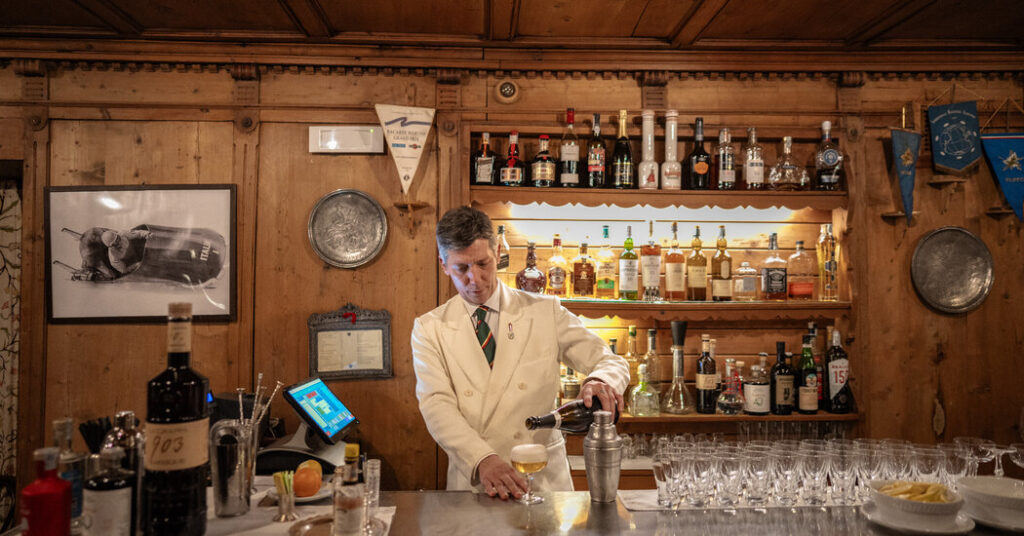
Gherardo Manaigo, the sixth-generation owner of Hôtel de la Poste, went around shaking hands. He had grown up with stories of the wonderful Olympic atmosphere. “Now it’s our time,” he said as Filippo Borghi, La Poste’s famous bartender, made signature cocktails.
Throughout the Games, helicopters have brought the superrich to a helipad near the 1956 Olympic ski-jump venue. In the years after those games, fatal crashes led to the closure of a small airport and to the end of plane travel to Cortina.
“We don’t want the airport,” Mr. Lorenzi said, speaking for the nay side of the debate over a possible airport, though he did see a near future in which the jet set could be replaced by the drone set. Aviation officials, he said, had told him that “the first drone” carrying up to 18 people to the mountains would arrive by 2030.
In the meantime, jet setters have to schlep along winding roads, but some said they appreciated the drive, that it sealed them off from the demands of the real world. In the days before the Games began, a group of elegantly tailored Italians who lived and worked in Miami, New York and London gathered to celebrate the anniversary of a previous bash they had held on sailboats in Bodrum, Turkey. The idea, said Federico Pellegrini, 35, a Miami-based fashion executive, was for all the invitees to bring a friend so that they could “assess if they are eligible for the good vibes,” he said.
Mr. Pellegrini’s friends, mostly Cortina veterans dressed in exquisite fabrics, fur coats and hats, talked about how taking it easy was actually quite difficult.
“An intense job. You get up at 7:30 to ski,” said Pier Alberto Patergnani, 32, an Italian who works for an artificial-intelligence company in London. Then, he said there was lunch, après-ski, “town,” happy hour, dinner and finally clubbing. The Olympics had injected more life into Cortina, he said, and his friends from the boating trip could feel it. They wore short fur coats over short shorts and spoke excitedly about catching a glimpse of an Italian athlete training on the slopes.
Mr. Patergnani’s group often ended up at the VIP Club, where Francesco Bernardin, the 55-year-old piano player, explained the tastes of Qataris, Americans and Russians “who love Abba.” Tamara Khermayer, a longtime VIP patron, took a break from singing her heart out to sip a gin fizz at a bar built from an 18th-century pharmacy counter. She said that Cortina, unlike St. Moritz and other fancy locales, had a more intimate feeling. “It’s an expensive home,” she said, “but it’s still home.”
During the Games, the VIP Club has had unlikely competition from the Corona Zero Green Room, a lounge with nonalcoholic beer in the Olympic Village, where the athletes are staying a short bus ride from town.
Despite their apparent sobriety, the athletes “are flirting a bit,” said Nena Dekker, a bartender at the green room. Competitors from Liechtenstein had handed her “paper with their number on it,” she said.
The top athletes, though, seemed to have other things on their minds.
Hitting Cortina’s party scene was not on the agenda, the Italian skier Federica Brignone said shortly after winning the gold medal in the super-G downhill race.
“I haven’t eaten from 6:45 in the morning and my legs need treatment, so no,” Ms. Brignone said. Instead, she would spend time with her family: “I will celebrate after the Olympics.”
Jason Horowitz is the Madrid bureau chief for The Times, covering Spain, Portugal and the way people live throughout Europe.
The post By Day, Cortina Is an Olympic Hub. By Night, It’s a Party. appeared first on New York Times.