Companies across the country welcomed the Supreme Court’s ruling on Friday with jubilation and a collective exhale after months of anxious waiting. Suddenly, it seemed, they were freed from the burden of punishing import taxes.
Victor Owen Schwartz, a small wine importer in New York City and one of the plaintiffs in the Supreme Court case, said it was “impossible to describe the feeling of elation, that we were right and the court agrees with us.”
Trade groups including the National Retail Federation expressed relief. Owners of small businesses, which were particularly vulnerable to the tariffs, flooded social media, and one another’s inboxes, with messages of delight.
“The toy industry is just celebrating massively right now,” said Sari Wiaz, the founder of Baby Paper in Northbrook, Ill., which sells crinkly-sounding paper for babies that it has produced in the same Chinese factory for 15 years. “We feel vindicated.”
But the revelry was quickly tempered by the possibility of a renewed trade war with a different slate of tariffs, creating fresh uncertainty for companies. In a defiant news conference, President Trump vowed to impose a new, across-the-board 10 percent tariff on U.S. trading partners, part of a series of steps to preserve his trade policy.
For months last year, businesses tried to game out scenarios in Mr. Trump’s volatile trade war. Many raced to stockpile inventory before the punishing tariffs took effect. Some paused shipments indefinitely in the hope that the United States would strike more favorable trade deals with other countries.
Businesses made more adjustments to account for the higher costs, including laying off workers and raising prices when it appeared increasingly likely that the tariffs were not going away.
The Supreme Court’s 6-to-3 ruling — which invalidated the tariffs that Mr. Trump had enacted under the International Emergency Economic Powers Act, known as IEEPA — scrambled calculations and shattered a fragile sense of stability that had come with adapting to the status quo.
“It’s once again imposing some uncertainty on us, because the question is what is the reaction of the administration going to be?” said Gert Reichetseder, president and chief executive of Wacker Neuson America, a Wisconsin manufacturer of excavators, front-end loaders and other construction equipment. “We need to get clarity A.S.A.P.”
Mr. Reichetseder’s company — the American division of a German-based multinational corporation — assembles many of its products in the United States, but most of the parts come from overseas. It spent last year trying to navigate shifting tariff rules and negotiating with suppliers and customers over who would shoulder the costs.
“We managed it pretty well, but it was a rough ride for us,” Mr. Reichetseder said, adding that his company planned to seek refunds on tariffs it paid.
In his news conference, Mr. Trump argued that the Supreme Court’s ruling would help to reduce the uncertainty that had swirled around his trade policy since he began imposing levies on trading partners. “Great certainty has been brought back to the economy of the United States,” he said.
But economists said the unknowns — including what other tariffs Mr. Trump would try to impose — are now sharply higher. That could have broad implications for the wider economy, they warned.
“The question is not whether tariffs continue, but how long the transition takes to the new rules and who or what gets caught in the gap,” said James Knightley, the chief international economist at ING. He cautioned that the Supreme Court’s decision risked deterring companies from spending capital and hiring.
“For me, the net effect on growth is negative,” Mr. Knightley said.
More immediately, many companies are turning to the practical matter of getting back their money. After the ruling, importers in the United States began contacting their customs brokers — businesses that calculate and collect duties — to try to find out more.
“Within minutes of the ruling, we had emails flooding in from our customers asking, ‘What does this mean?’” said Adam Lewis, a co-founder and the president of Clearit, a customs broker.
Mr. Lewis said many of his customers were smaller businesses that imported goods from China and had been paying significant sums under the struck-down tariffs. The financial relief from no longer having to pay the tariffs will be significant, he said.
We Pay the Tariffs, a coalition of over 800 small businesses, called for the administration to issue refunds swiftly. “A legal victory is meaningless without actual relief for the businesses that paid these tariffs,” the group said in a statement.
Rick Woldenberg, the chief executive of Learning Resources, an educational toy company in Vernon Hills, Ill., and another plaintiff in the Supreme Court case, said the tariffs were an unlawful tax that the government was not entitled to take.
“It’s our money — give it back,” he said.
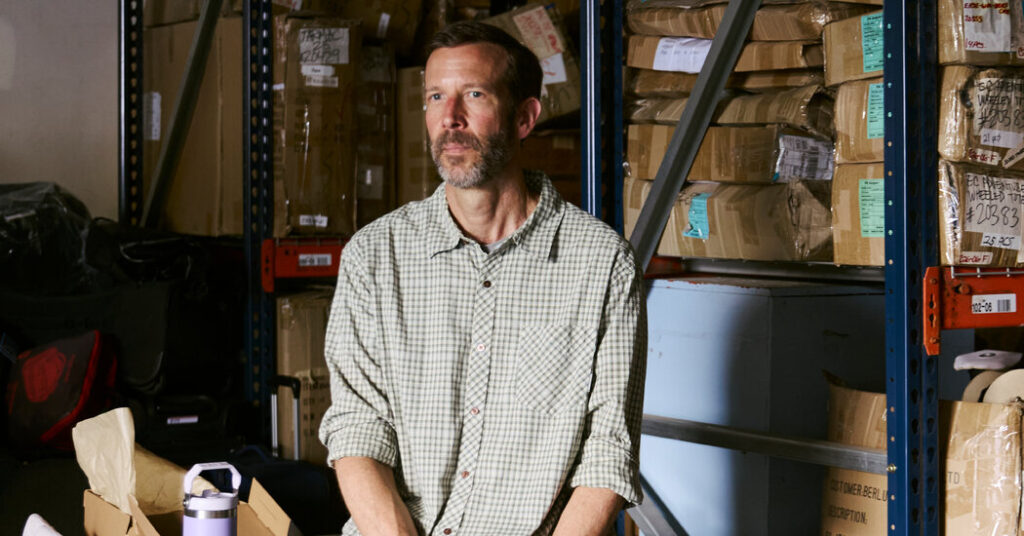
Whether, and how quickly, refunds can be obtained is of paramount importance to companies such as Eagle Creek, a luggage manufacturer in Steamboat Springs, Colo.
Travis Campbell, the Eagle Creek’s owner and chief executive, said his company hoped to recoup over half a million dollars in tariffs — a meaningful sum for a relatively small business.
“If we could snap our fingers and have that back tomorrow, it would transform our ability to operate this year,” he said.
Even if companies are able to recover the money they paid in tariffs over the last year, many are likely to bear lasting scars. Some of the changes they made to account for higher import duties, including cutting their work forces, could take time to reverse — if they can be reversed at all.
Sarah O’Leary, chief executive of Willow Innovations, a start-up that sells breast pumps, said her company had laid off employees and curtailed its spending on research and development in the last year to help offset the additional import duties. The company’s medical devices are manufactured in countries throughout Asia, she said, and tariffs had added about 10 to 15 percent in incremental costs to her business in Mountain View, Calif.
After learning of the Supreme Court’s decision invalidating many of Mr. Trump’s tariffs, Ms. O’Leary said, she was cautiously optimistic yet frustrated.
“To have them overturned is a relief,” she said, “but it also leaves me with this overwhelming feeling of what a waste.”
Reporting was contributed by Ben Casselman, Lydia DePillis, Kevin Draper, Peter Eavis, Jordyn Holman, Colby Smith and Farah Stockman.
Sydney Ember is a Times business reporter, covering the U.S. economy and the labor market.
The post Businesses Celebrate Tariff Relief, and Brace for New Uncertainty appeared first on New York Times.