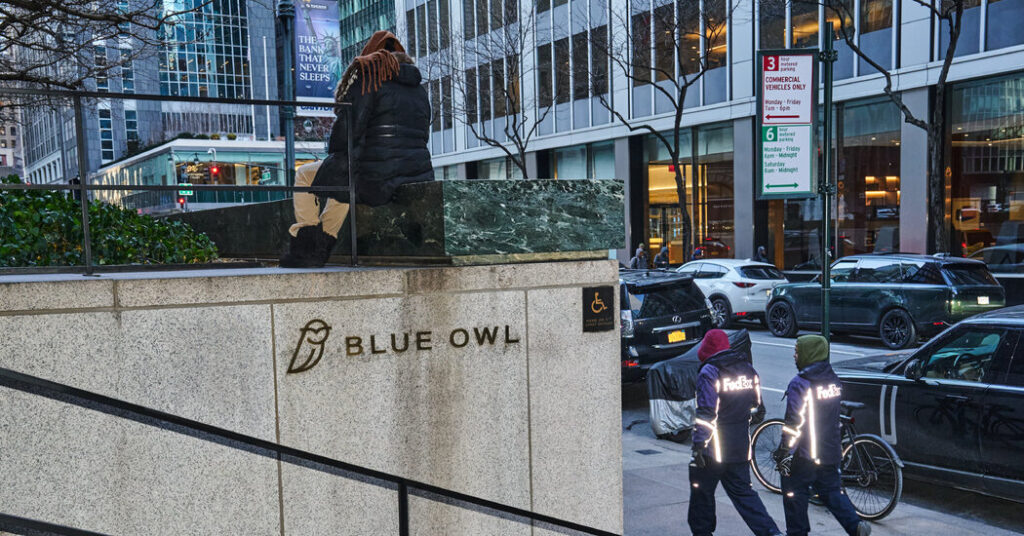
Shares of Blue Owl Capital, the giant private lender, plunged on Thursday after the company announced that it was changing how investors can get their money out from one of its funds, raising fresh concerns about potential problems lurking in the private credit industry.
Blue Owl said investors would not be able to ask for a set amount of money back every quarter. Going forward, the firm will decide how much it will pay out quarterly.
On a conference call with investors, Blue Owl executives sought to portray the changes favorably, but the announcement had the opposite effect as some investors worried the moves could lead to obstacles to future redemptions.
The company’s stock ended down 6 percent on Thursday, after falling as much 10 percent earlier in the day. Other companies with exposure to private credit, including Ares, Apollo and Blackstone, fell more than 5 percent.
Mohamed El-Erian, the Wall Street veteran and former chief executive of PIMCO, wrote on social media that Blue Owl’s change in redemption terms reminded him of the beginnings of the financial crisis when banks sought to contain the damage from the souring mortgage loans on their books.
“Is this a “canary in the coal mine” moment, similar to August 2007?’’ Mr. El-Erian wrote in a post.
In just a few years, private credit has extended trillions of dollars in loans to business, and Blue Owl, which was founded in 2016, has amassed nearly $300 billion in investor money. But the industry exists outside of the traditional, highly regulated banking system and investors can see only a limited amount of information about private credit borrowers and the terms of their loans.
The sell-off Thursday comes after Blue Owl’s stock had already fallen nearly 50 percent in the past year, with investors becoming increasingly concerned about the quality of its loans and whether the company can keep growing.
While there have been only a handful of private credit defaults in recent months, investors have, in recent weeks, zeroed in on potential trouble spots, such as private credit exposure to software companies at a time when software is being pressured by artificial intelligence. By many estimates, at least 20 percent of the loans extended by private credit funds have gone to software companies.
Blue Owl also said on Thursday that it had sold $1.4 billion in loans from three of its funds known as business development companies. The company said it would use a portion of the proceeds — $600 million — to give money back to its investors in one of its private credit funds. Blue Owl said it was able to sell the loans at nearly 100 cents on the dollar.
Many industry analysts said they were relieved that Blue Owl was able to avoid a loss.
In an interview, Blue Owl’s co-president Craig Packer said the loan sale was “an unequivocal extremely positive thing for our investors,” adding that “I’m getting congratulations from everyone in our industry.”
Mr. Packer also said that investors were misinterpreting the new redemptions rules. On the investor call Thursday, he said the firm was “simply changing the method by which we’re providing redemptions,” and said the firm would be handing investors’ money back in one of its funds quicker than they had planned.
In a statement, Blue Owl said that rather than returning 5 percent to investors every quarter, it will now pay 30 percent of their money “immediately.” Going forward, Blue Owl said, “our intention is to continue to return capital on an accelerated basis,” but would first need to discuss the matter with its board.
One buyer of the loans appeared to be Kuvare, an insurance and annuity provider that Blue Owl purchased in 2024, according to Peter Troisi, a Barclays analyst.
In a research note, Mr. Troisi said that while technically the loan sale was an “arms-length transaction,” he expressed concerns that if private credit firms were effectively on both sides of a transaction, “it would make it more difficult to track the risk.”
In the interview, Mr. Packer declined to say whether Kuvare was one of the four loan buyers and said the others included state pension plans.
“This was a really thorough process involving four really high-quality institutional investors in a very tight time frame,” he said.
Maureen Farrell writes about Wall Street for The Times, focusing on private equity, hedge funds and billionaires and how they influence the world of investing.
The post Blue Owl Sets Off New Private Credit Fears appeared first on New York Times.