Applicants hoping to win a federal museum or library grant this year were told to consider how their projects align with Trump administration priorities, including an emphasis on offering “uplifting and positive narratives of our shared American experience.”
The guidance appeared in a cover letter introducing new funding opportunities offered through the Institute of Museum and Library Services, an independent agency that distributes grants to libraries and museums. The notice cited several of President Donald Trump’s executive orders, such as March 2025’s “Restoring Truth and Sanity to American History,” which called for purging the Smithsonian of “improper ideology” and federal historic sites of “divisive narratives,” and which has formed the basis for a Trump-led content reviewat the Smithsonian, as well as the recent removal of an exhibit on slavery at Philadelphia’s Independence National Historical Park.
The directive to hew to Trump’s preferences unnerved some grant writers, reviewers and former recipients accustomed to nonpartisanship from the agency, stirring debate over what it would mean to accept their funding.
“If you even apply for this, are you going to get pushback from either your museum community or your fellow museum professionals because you’re kind of caving to the administration?” Lori Byrd, a former museum professional who has served as an IMLS grant reviewer on and off since 2015, said of the bind it presents applicants.
Ashley Rogers, executive director of Whitney Plantation, said her organization will not be applying for IMLS grants “anytime soon,” pointing to existential concerns sparked by the new guidelines.
“Our mission is to educate the public about the history and legacies of slavery. We’re a nonprofit. This is the only thing we do,” she said. “I don’t know how to make that align with the current funding opportunities at IMLS and more fundamentally than that, if I did, would I be betraying my mission?”
Also highlighted in the cover letter are a Trump executive order on “Making Federal Architecture Beautiful Again,” which deemsclassical or traditional architecture the preferred style for federal buildings, plus orders on combating antisemitism, “Eradicating Anti-Christian Bias,” and encouraging AI education. The agency says it hopes applicants will submit projects that showcase “what makes our country the greatest in the world.”
Aside from the cover letter, IMLS has used the same template and much of the same language that accompanied 2025 grant notices, but with a glaring alteration: The agency appears to have removed every instance of the words “inclusive,” “equity” and “diverse” or “diversity.”
In all 13 grant notices, for example, a section that in 2025 said one of the agency’s objectives is to “promote inclusive engagement across diverse audiences” has been edited to say it aims to “promote broad public engagement.” In the IMLS’s 2025 notice for the Laura Bush 21st Century Librarian Program, the words “diverse” and “diversity” appear 23 times. In this year’s notice, such terms do not appear at all.
Despite these changes, calls for proposals for grants specifically aimed at supporting Black, Latino, Native American and Hawaiian culture and history have still been posted on the IMLS website. Historically, IMLS’s grants have run the gamut, providing critical funding to institutional mainstays like the Cleveland Museum of Art and the Brooklyn Public Library as well as smaller organizations such as house museums, community college libraries and historic associations.
Trump’s vision for the nation’s cultural institutions has been criticized for sanitizing the darker parts of U.S. history and offering a limited perspective on the nation’s past. The president in August wrote on social media that the Smithsonian is too focused on “how bad Slavery was,” and his administration has called for telling an overwhelmingly positive version of American history as the country’s 250th birthday approaches.
Over the past year, the administration has tried to first defund and then to remake U.S. federal arts agencies. Last fall, the Trump administration abruptly fired the vast majority of the National Council on the Humanities, which advises the National Endowment for the Humanities, “hoping to place members on the board who align more closely with his vision.” A January 2025 executive order required federal agencies to award grants on the condition that recipients do not “operate any programs promoting ‘diversity, equity, and inclusion.’”
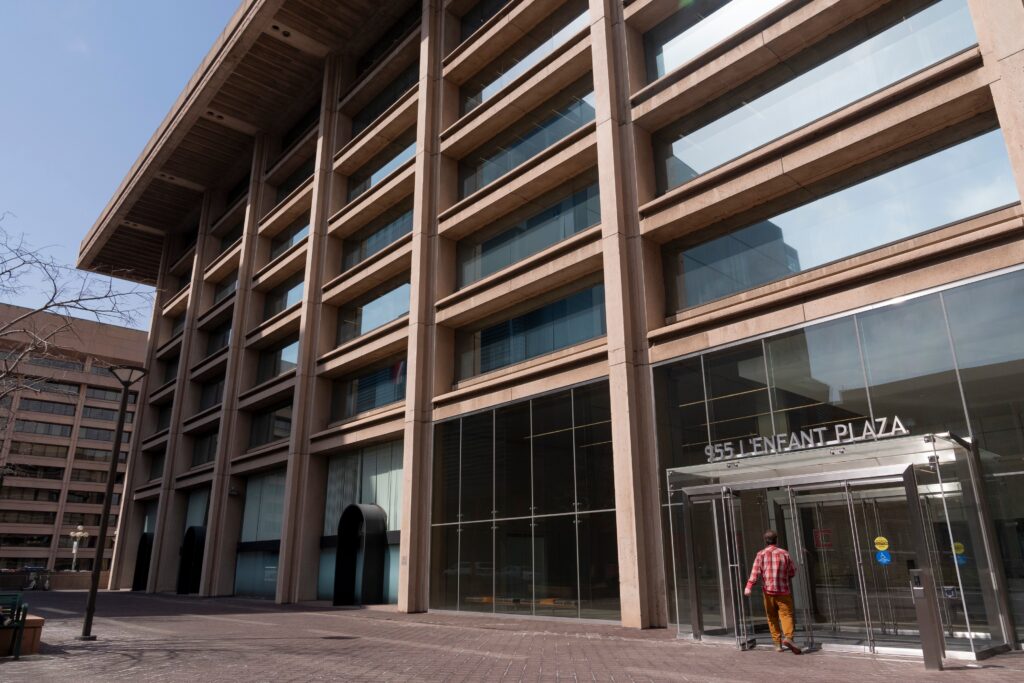
An independent grant-making agency, the IMLS was created in 1996. In 2024 it described itself as the primary sourceof federal support for the nation’s libraries and museums. Its acting director, Keith E. Sonderling, a lawyer who is also deputy secretary of labor, was appointed by Trump last year and said at the time that he would steer the agency in “lockstep” with the Trump administration and “restore focus on patriotism.”
That IMLS is even offering grants this year came as a surprise to some. Last March, Trump signed an executive order seeking to essentially eliminate the IMLS, but a week later appointed Sonderling. Dozens of IMLS employees were placed on administrative leave, and museums and libraries saw their grants terminated. (A court ruled in November that the latter move was unlawful, and IMLS restored funding.)
The IMLS grant cycle, which usually has fall deadlines, is months behind schedule, and the new guidelines have added anxiety in a process that has been shrouded in uncertainty. Multiple people who have served as grant reviewers in previous years said they have not yet been contacted to participate in the process, sparking concerns about how the applications might be assessed and by whom.
Byrd told The Washington Post that in past years diversity was an essential part of strong proposals. When evaluating pitches for IMLS’s “Museum Empowered” grant, for example, “diversity and inclusion” was listed as a category for “project justification.” Applicants would provide specific demographic information detailing the communities served by the project. “And if you didn’t really lay all of that out, it was rare that you would get the funding,” Byrd said.
James Howard, executive director of the Black Inventors Hall of Fame, which received IMLS funding last year, said he’s still planning to apply for two IMLS grants this year, one to support capacity building and the other to fund an exhibit on Charles Richard Patterson, who operated the first Black-owned automobile company in the United States. He’s not worried about the optics.
“The IMLS has been a principled government-run organization for many, many years,” he said. “All this does is just create additional layers of nuance.”
If that means avoiding certain terms, “I don’t think to consider new phraseology is necessarily a bad thing,” he said, “because the principles behind it are still supported by my organization and by my core beliefs.”
Others are more wary of the changes.
Last year, museum consultant Andrea Jones was being paid to lead several workshops on museum social impact metrics through an IMLS grant when funds were pulled. The new guidelines make her concerned future projects could be arbitrarily dismissed, perhaps by IMLS staff who deem them “not patriotic enough.”
This year, Jones said, she’d be reticent to participate in any projects funded by NEH or IMLS. “Not only is the risk to my livelihood too great,” she said “ … but I care about doing credible, nuanced work — not being part of a propaganda machine.”
Rogers, the Whitney Plantation director, said it’s a loss that institutions like hers might not receive new federal funding, especially during America’s 250th. “It feels like organizations like ours are boxed out from telling a complete and true and honest American story.”
The post Applicants seeking federal museum grants directed to adhere to Trump vision appeared first on Washington Post.