Frank Bruni: Greetings, Bret. Before we round up the usual suspects, can we strike a more inspirational note? A somewhat less political one? Are you tuning in at all to these Olympic Games?
Bret Stephens: The Olympics? Athletic contests? Do you know me?
Frank: I do, quite well, and am glad for that, but my point in bringing up the Olympics is that it often has the power to draw in precisely the likes of you. All those inspirational back stories, all that yearning, all the tears — of triumph, of devastation. I’m sorry, Bret, but it’s the human experience distilled. And, no, I’m not on my third glass of wine.
Bret: Well, I did watch the Bad Bunny halftime show at the Super Bowl, so there’s that.
Frank: And?
Bret: I’d like to be spared political lectures from singers complaining about American depredations at the most quintessentially American event of the year. What about you?
Frank: I neither liked nor disliked Mr. Bunny’s show itself; not my cup of chamomile. But I was hugely bothered by the preshow, during-show and post-show reaction — by the way in which everyone on the political spectrum played precisely to type. President Trump and the MAGA faithful were horrified — horrified, Bret! — by this perversion of Americana. On the political left, the show was The Best and Most Important Creative Statement Ever. Neither of those takes is true. Both reflect our broken discourse today.
Bret: The defining feature of American cultural life in this century is that everything has become political, an endless cycle of provocation and counterprovocation. I think Trump is chiefly to blame, but our politics would be helped if his critics wouldn’t constantly rise to his bait.
Meanwhile, Zohran Mamdani, New York City’s new mayor, is threatening an almost 10 percent property tax increase if Kathy Hochul, the governor, doesn’t raise income taxes on wealthy New Yorkers. Your thoughts?
Frank: Oh, dear. When you introduce Mamdani, I know you’re about to get really worked up.
Bret: Every time I think about Mamdani, I actually consider moving to Florida.
Frank: Please don’t. You burn too easily. (See, I do know you.) As for Mamdani, he’s in a bind that was entirely predictable, because he made gaudy promises that were beyond a mayor’s power to keep. His frustration bespeaks an utterly legitimate and virtuous concern about income inequality and about the help that many New Yorkers need. But if he raises property taxes like that, he’s going to see an exodus from New York City that makes matters worse. And because, again, I know you, I know you agree with me on that last point, yes?
Bret: I’ve always been fond of the Margaret Thatcher line that the problem with socialism is that eventually you run out of other people’s money. If Mamdani wants the city, which already has some of the steepest tax rates in the country, to thrive, he should want wealth to flow in, not fly out, so he can pay for some of his expensive schemes. And, of course, the people who are likeliest to flee aren’t the uber-wealthy but the upper-middle classes: editors and doctors and professors and lawyers and small-business owners who make just enough to get walloped by the highest tax rates but not nearly enough to be able to comfortably afford them.
Speaking of which, a similar battle is unfolding in California: Bernie Sanders is pushing for a 5 percent tax on California billionaires; Gavin Newsom, the governor, is opposed. How do you think that will play in Newsom’s all-but-certain presidential bid?
Frank: A fascinating question. On one hand, Newsom’s position moves him toward the center. On the other, a left-right framework may not be the correct one when we’re talking about taxes on plutocrats who can upgrade their yachts with considerably less thought than I give to buying free-range, organic chicken thighs over less pampered poultry. At a moment of such powerful populist currents, I think Newsom may be calling this one wrong, at least politically. Though he’s taking the wise stance if he’s thinking about major campaign contributions!
Bret: The only chicken anyone needs in life is the spicy chicken sandwich at Chick-fil-A.
As for Newsom, I’m not exactly his biggest fan. But he’s doing the right thing. California already has a reputation as the state from which hundreds of thousands of people have fled in recent years to escape high taxes, overregulation, chronic NIMBYism, unaffordable housing and dysfunctional cities. The last thing it needs now is to drive out its remaining wealthiest citizens to places like Austin or Palm Beach. There’s a fable about not killing the goose that lays the golden eggs, and the leftward edges of the Democratic Party need to reread it.
Frank: I agree with you to a point, but your Midas-adjacent goose ——
Bret: “Midas-adjacent.” Gonna have to borrow that one. Go on.
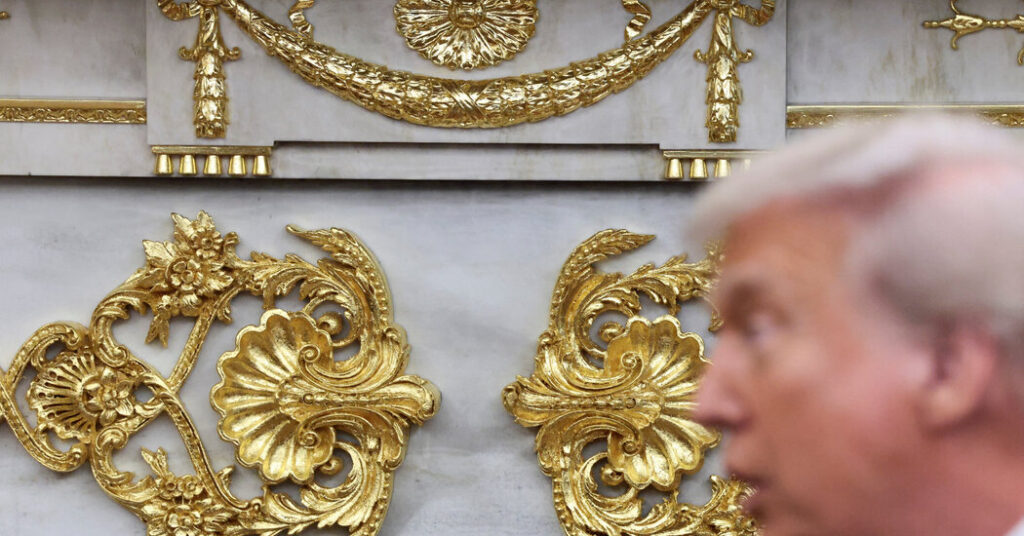
Frank: —— also sounds at least somewhat adjacent to trickle-down economics. Honestly, Bret, I find it increasingly hard to talk about billionaires and how to treat them most prudently when we’re living in such a Second Gilded Age of galling excess and greed. And, yes, that is my bridge to President Trump — who’d dip himself in gold if he were confident that it wouldn’t seal his mouth shut and prevent him from yammering — and to the corrupt administration over which he reigns.
Bret: One reason I’m not a liberal Democrat is that the idea of great wealth in itself doesn’t bother me: I’m delighted for people to get fabulously rich off businesses that make other people’s lives better. The problem with Trump is the use of governance and political power for the sake of self-enrichment. That, plus the bad taste.
Frank: Bret, forgive my interruption, but I hereby and henceforth forbid you from ever — ever! — repeating “the problem,” singular, “with Trump.” There are so very, very many problems with Trump.
Bret: Conceded. Above all, the complete lack of humanity, empathy and grace. Which makes this a good opportunity to mention Jesse Jackson, who died this week.
I spent most of my adult life thinking ill of Jackson, probably because of his infamous “Hymietown” remark in the 1984 presidential race (which also inspired one of Eddie Murphy’s greatest “S.N.L.” skits). Then, about seven years ago, I met him for breakfast in New York. The man I spent an hour with was gracious, reflective, engaged, knowledgeable and more than a touch sad, probably because he was aware of his Parkinson’s diagnosis. It reminded me that people are never the caricature that others make of them, and that there can be a lot to like and learn from people with whom we often disagree.
Frank: We talked earlier about how everything is instantly politicized in these deeply troubled times. Another hallmark of our era is how it reduces and flattens everyone into a presumed archetype, an assigned role. We deny people their complexity — we disregard how beautifully messy most of them are. To that end, the veteran political journalist Joe Klein, in his fetchingly named Sanity Clause newsletter had an interesting, nuanced take on Jackson as someone who could be gratuitously combative and staggeringly charismatic, who mingled cynicism and idealism, and who made important, necessary strides no matter how you look at him. Speaking of complexity and nuance, ahem, I understand you’ve been to the movies recently?
Bret: So, from the profound to the profoundly shallow: I had a private screening of “Melania,” the documentary. I mean “private” in the sense that I was the only person in the theater. It’s hard to see the film as anything other than a political bribe from Amazon — I mean Jeff Bezos — to the Trump family.
Frank: Of course it’s a bribe, and the one-two punch of the release of “Melania” and Bezos’ gutting of The Washington Post underscored what a starring role he’ll play in the eventual history book “Profiles in Cowardice,” about the ultrawealthy capitulators and collaborators of the Trump period. As for your seeing “Melania,” I guess I really don’t know you, Bret. I didn’t take you for a full-fledged masochist.
Bret: I wanted to see how bad it could be. It exceeded my expectations. For much of the documentary I kept wondering whether our first lady is an A.I. bot. But she did appear human when she started bopping to the tune of Michael Jackson’s “Billie Jean.”
Your mention of The Washington Post just made me sad. A great newspaper, eviscerated, and some of the finest reporters in the country, sacked. I don’t buy the argument that Bezos should have treated the newspaper as a charity. But the lesson of The New York Times’s success is that it always invested in the journalism. That … and Wordle.
Frank: As you know, Bret, I teach media classes at Duke, and I talk extensively about what family ownership meant for newspapers and how that often made the bottom line less important than tradition, pride, honor. Bezos doesn’t have the same investment in The Post that the Grahams did or that the Sulzbergers do in The Times. Often, Bret, little hedges against pure capitalism and the profit motive are a good thing.
Bret: True. And I suspect that one problem that billionaire newspaper proprietors typically encounter is that their media properties become a tiny fraction of their assets but a major percentage of their headaches. Which reminds me of a Robert Duvall story I just came across, thanks to our former colleague Clyde Haberman, who wrote the actor’s obituary for The Times. Duvall played a newspaper editor in the 1994 film “The Paper,” in which his character has this to say about columnists:
I hate columnists! Why do I have all these columnists? I got political columnists, guest columnists, celebrity columnists. The only thing I don’t have is a dead columnist. That’s the kind I could really use!
That one put a smile on my face. Returning to our original theme, Frank, what’s making you happy?
Frank: This is going to sound dippy, but I’m a dip or sap or some other three-letter word ending in P. I make no apologies for that. But after so many brutally cold weeks, even here in North Carolina, there has been some verging-on-spring weather over the past few days. There has been a swell of birdsong. A few plants are budding in my backyard, and my dog, Regan, can lounge on the front stoop and watch the world go by for as long as she likes because it’s neither too cold nor too hot out there. I guess I’m saying that an imminent or slow-rolling change in seasons is reminding me of simple pleasures and ready solace. Even Pam Bondi can’t ruin that.
The Times is committed to publishing a diversity of letters to the editor. We’d like to hear what you think about this or any of our articles. Here are some tips. And here’s our email: [email protected].
Follow the New York Times Opinion section on Facebook, Instagram, TikTok, Bluesky, WhatsApp and Threads.
The post Who Would Win Gold in the Coward Olympics? appeared first on New York Times.