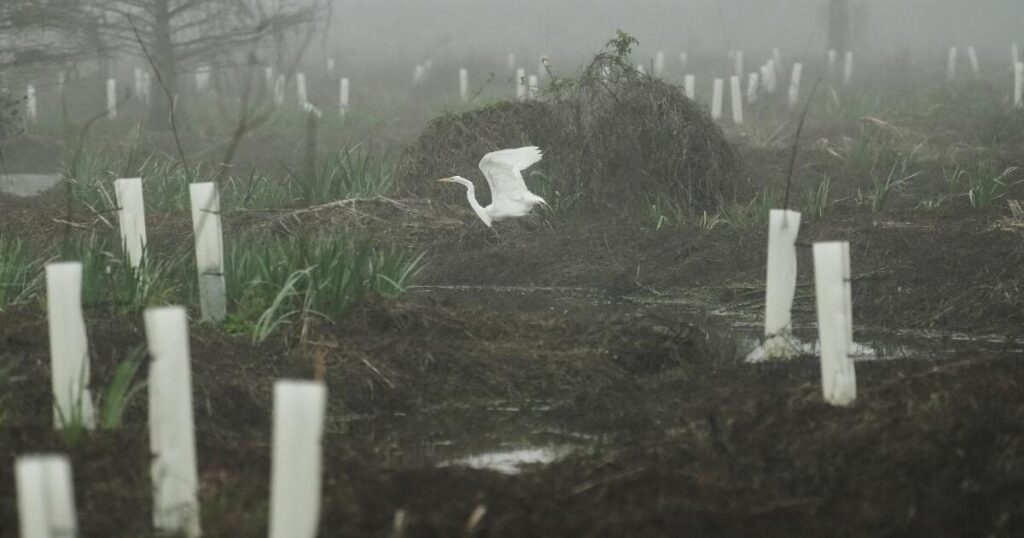
MERAUX, La. — Across the calm waters behind a pumping station near Lake Borgne, hundreds of saplings stand out in the mist, wrapped in white plastic cylinders.
To get there and to other sites like it, organizers have ferried dozens of volunteers week after week in airboats. They have a trailer equipped with supplies. Rubber boots in all different sizes. Bins full of snacks for the end of a hard day’s work.
One day, they hope to see 30,000 fully grown trees like bald cypress and water tupelo at this and other sites that restore the natural barrier of wetlands into the protective forest it once was. The goal is for the roots of these native trees to hold the earth around New Orleans in place as it slips farther below sea level, create habitat for wildlife and help shield the city from storms.
Much of that natural barrier was lost after Hurricane Katrina, which killed over 1,000 people and caused over $100 billion in damage in 2005. But many have been working since then to restore the land, and near the end of a long effort run by local environmental groups, organizers are reflecting on the roots they’ve helped put down — a more solid ecosystem, so different from the degraded marsh they started with.
“We’re one part of a larger movement to resist this sort of ‘doomerism’ mindset, and to show that recovery is possible,” said Christina Lehew, executive director of Common Ground Relief, one of the organizations working on the tree planting. “When we use our imaginations to envision the past and the vast amount of wetlands landscapes that we have lost, we know that likely we’ll never return to that pristine image of the past. But we can gain something back.”
Why organizations have joined forces to plant trees in wetlands
In other locations around New Orleans, cypress trees planted years ago tower over dense thickets rich with other native plants. They tell the story of what could have been, and what restorers are trying to bring back.
Before the logging industry, before the oil and gas industry, before anyone built levees to contain the Mississippi River, the Delta naturally ebbed and flowed and flooded as the river deposited sediment on the Gulf Coast. The plants that thrived in that ecosystem formed protective estuaries.
But then the Great Mississippi Flood of 1927 burst through levees in dozens of places. Hundreds of people died and the water caused catastrophic damage across several states. After that, the government initiated a new era of levee building. By the mid-1960s, the U.S. Army Corps of Engineers had also constructed a shipping channel called the Mississippi River — Gulf Outlet Canal (MRGO), which ultimately became a path for Katrina’s storm surge into the city of New Orleans.
Those engineering decisions worsened Katrina’s destruction. They allowed saltwater into freshwater ecosystems around the city, poisoning many of the trees. And so the city was exposed to future hurricanes, and lost the living guardians whose roots held the land in place.
In 2009, the MRGO was shut down to cut off further saltwater intrusion, and environmental groups started reforesting. Eventually, about five years ago, several organizations came together as a collective to apply for federal and state funding for a bigger project. Spreading two large grants across different volunteer bases, planting in different areas and using different techniques, they’re getting closer to that 30,000-tree goal. One of the largest groups, the Coalition to Restore Coastal Louisiana, has planted about 10,000 of its 15,000-tree quota, said Andrew Ferris, senior coordinator for their native plants program. They’ll finish by next year, he said.
“In our wildest dreams we never thought we’d be able to plant some of the areas that we are now planting,” said Blaise Pezold, who started planting trees around 2009 and is now coastal and environmental program director for the Meraux Foundation, one of the partner organizations. “It was thought to be too low, too salty, Katrina messed it up too much, and we would have to focus on areas that were easier to get into.”
The closing of the MRGO and the drop in salinity levels changed all that. “The Central Wetlands Reforestation Collective has kind of allowed us to be very adventurous in the sites we choose,” Pezold added.
A way of processing grief, and rebuilding for the future
For many of the organizers in Louisiana who have been helping with restoration and recovery efforts, the project has been a way to cope with living in the wake of a natural disaster.
Katrina hit the day after Ashe Burke’s 8th birthday. “It still affects everybody that went through it, and … it changed us all. I mean, we had our lives ripped out from underneath us in a day,” said Burke, the wetlands restoration specialist for Common Ground Relief, where Lehew also works. “It still does hurt in some ways, you know? But we gotta keep going on and the sun rises in the morning.”
That’s also something important to teach the next generation, said Rollin Black, who works with the Center for Sustainable Engagement and Development, one of the tree-planting partner organizations. He also has family in New Orleans, and he said restoring the environment has been a way to act on the problems he saw. Seeing kids participate helps.
“That brings a little bit of joy to my heart that they’re actually inspired by what we’re doing. So maybe they could come back or maybe they have some reason to live in New Orleans,” he said.
Walling writes for the Associated Press.
The post What can toughen Louisiana coast against worsening storms? Four years and 30,000 trees appeared first on Los Angeles Times.