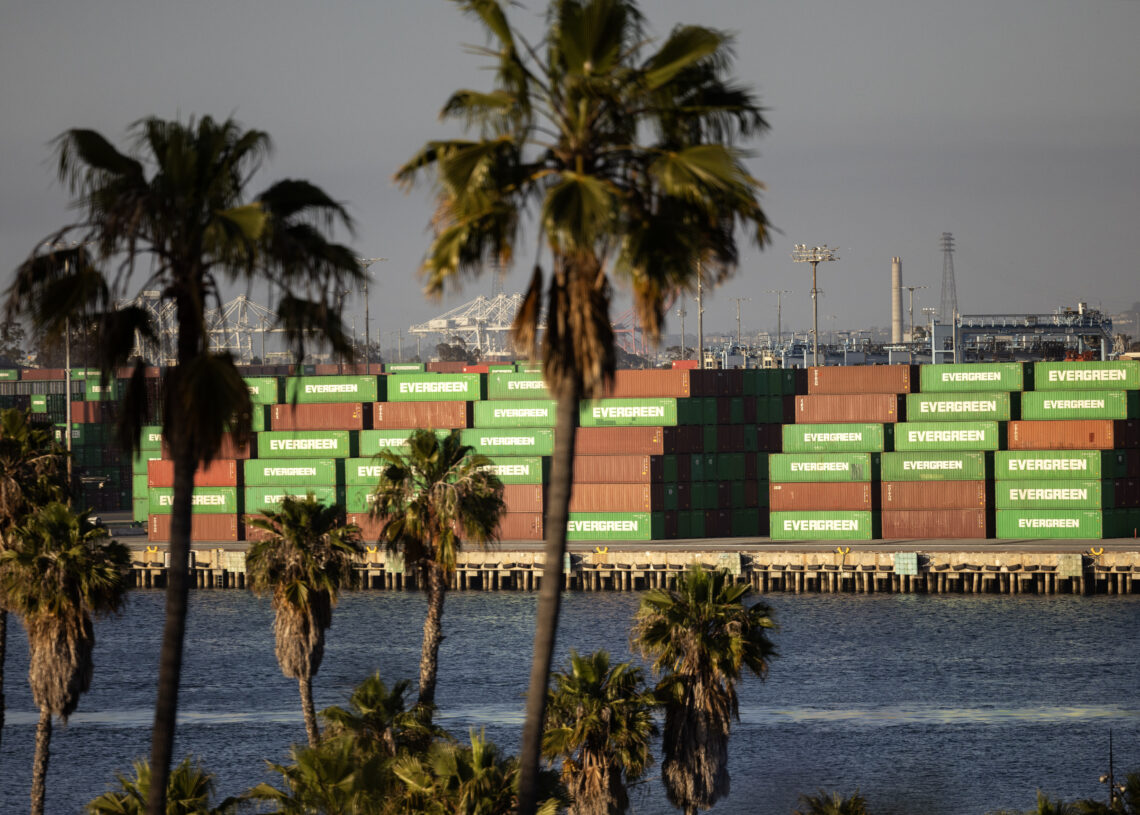
The U.S. merchandise trade deficit hit a record $1.2 trillion last year, despite President Donald Trump’s promise to eliminate it by imposing the highest tariffs in eight decades on foreign-made products.
Thursday’s Commerce Department report represents the first full-year assessment of the president’s ambitious reordering of global trade. The persistence of the deficit in the face of steep new taxes on imports from China, the European Union and scores of other nations reflects the limits of Trump’s preferred policy tool, economists said.
The president has described the trade deficit in goods, which the U.S. has run every year since 1975, as a “national emergency” resulting from unfair trade practices on the part of foreign nations.
A broader measure of the nation’s trade balance — including services such as travel, education and financial management — showed a full-year deficit of $901.5 billion, down slightly from the previous year, the Commerce Department said Thursday.
Exports of goods and services rose 6.2 percent to a record $3.4 trillion. Imports rose nearly 5 percent to a record $4.3 trillion.
The goods and services deficit for the month of December widened more than Wall Street analysts had expected, reaching $70.3 billion, up from $53 billion in November.
The trade deficit — reflecting the gap between the cost of goods Americans buy from abroad and the value of U.S. goods sold overseas — is driven largely by domestic economic policies, in the view of mainstream economists. The sizable U.S. budget deficit, a sign of a nation living beyond its means, inevitably draws in large amounts of foreign goods, despite tariffs, they note.
“Tariffs are not the dial to turn if you want to change the overall balance of trade,” said Erica York, vice president of federal tax policy with the nonpartisan Tax Foundation.
Although the president has failed thus far in his bid to shrink — let alone eliminate — the trade deficit, he has set in motion a fundamental reordering of global trade flows.
U.S. imports of Chinese goods fell by nearly 30 percent last year, marking a sharp break from decades of economic integration between the world’s two largest economies.
China, which accounted for more than 13 percent of all U.S. merchandise imports in 2024, provided just 9 percent last year, according to economist Chad Bown of the Peterson Institute for International Economics.
“The tariffs definitely mattered. But they mattered more for shifting imports away from China,” Bown said.
As corporations tried to escape Trump’s steep tariffs on Chinese goods, they found new suppliers of products such as laptops and video game consoles in places like Vietnam.
Taiwanese companies also assumed a larger role in U.S. supply lines as demand increased for technology needed to assemble new data centers amid a boom in artificial intelligence investments.
Monthly snapshots of the nation’s trade performance gyrated wildly last year as importers struggled to respond to the president’s shifts in tariff policy.
At the beginning of 2025, businesses increased imports of foreign goods in hopes of front-running the new tariffs, which caused the trade deficit to balloon. Those shipments ebbed as the tariffs took effect. But in the final months of 2025, gold exports surged as foreign central banks stepped up purchases to hedge against geopolitical uncertainty, distorting trade data.
On Wednesday, Trump claimed in a Truth Social post that the “TRADE DEFICIT HAS BEEN REDUCED BY 78%,” an apparent reference to the difference in monthly shortfalls reported in January and October.
The president also predicted that the trade balance “WILL GO INTO POSITIVE TERRITORY DURING THIS YEAR, FOR THE FIRST TIME IN MANY DECADES” — an assessment that few economists share.
Asked to explain the president’s comments, a White House spokesman referred to a separate 17 percent decline in the deficit over the final eight months of 2025 compared with the same period in 2024.
Starting the clock in April, when the president announced his global tariff campaign, omits the year’s largest monthly deficits, which were recorded during the period of accelerated imports designed to beat the new levies.
In a further disappointment for the administration, manufacturing employment over the same period fell by 72,000 jobs. And economic studies continue to find that American consumers and businesses are bearing the tariffs’ costs, despite Trump’s repeated insistence that foreigners are paying the tab.
The administration’s ire over the discordant findings reached new levels this week, when Kevin Hassett, director of the White House National Economic Council, said several Federal Reserve system economists should be “disciplined” for concluding that Americans bear “nearly 90 percent” of the tariffs.
Though the analysis published by the Federal Reserve Bank of New York drew Hassett’s ire, it was no outlier. Earlier research by the nonpartisan Congressional Budget Office and by the former chief economist of the International Monetary Fund reached similar conclusions.
The White House insists that the president’s “America First” policies will pay off this year. Trump has announced a flurry of preliminary trade deals that are deemed likely to open foreign markets to U.S. exports and attract increased foreign investment.
“Americans can rest assured that the days of American workers and industries getting ripped off are behind us,” said Kush Desai, a White House spokesman.
The outlook for trade is clouded by uncertainty over Trump’s tariff plans. The Supreme Court court rule as soon as Friday on a legal challenge to the president’s authority to impose the bulk of the new import taxes.
If the court invalidates some or all of the levies that Trump imposed last year, administration officials have vowed to replace them using other legal avenues. But the details remain unclear.
The president also has ordered several Commerce Department investigations that could lead to additional industry-specific tariffs on goods such as robotics, personal protective equipment and wind turbines.
The post U.S. runs record trade deficit in goods, despite Trump’s tariffs policy appeared first on Washington Post.