The rapid buildup of U.S. forces in the Middle East has progressed to the point that President Trump has the option to take military action against Iran as soon as this weekend, administration and Pentagon officials said, leaving the White House with high stakes choices about pursuing diplomacy or war.
Mr. Trump has given no indication that he has made a decision about how to proceed. But the drive to assemble a military force capable of striking Iran’s nuclear program, its ballistic missiles and accompanying launch sites has continued this week despite indirect talks between the two nations on Tuesday, with Iran seeking two weeks to come back with fleshed out proposals for a diplomatic resolution.
Mr. Trump has repeatedly demanded that Iran give up its nuclear program, including agreeing not to enrich any more uranium. Prime Minister Benjamin Netanyahu of Israel, whose country would potentially take part in an attack, has been pushing for action to weaken Iran’s ability to launch missiles at Israel.
Israeli forces, which have been on heightened alert for weeks, have been making more preparations for a possible war, and a meeting of Israel’s security cabinet was moved to Sunday from Thursday, according to two Israeli defense officials.
Many administration officials have expressed skepticism about the prospects of reaching a diplomatic deal with Tehran. The indirect talks on Tuesday in Geneva ended with what Iran’s foreign minister said was agreement on a “set of guiding principles.” U.S. officials said the two sides made progress but added that big gaps remain.
Mr. Trump has repeatedly threatened that Iran must meet his terms or face severe consequences. But another attack, eight months after a 12-day war in which Israel and the United States assaulted military and nuclear sites across Iran, would potentially carry substantial risks, including that Iran would respond with a ferocious barrage of missile strikes on Israel and on U.S. forces in the region.
For a president who ran for office promising to keep the United States out of wars, Mr. Trump is now considering what would be at least the seventh American military attack in another country in the past year, and his second on Iran. Last June, after striking three Iranian nuclear sites, Mr. Trump declared that Iran’s nuclear program had been “obliterated.” But now he is considering sending U.S. military back to continue the job.
But unlike the U.S.-Israeli assault last June, Mr. Trump’s objectives now are less clear.
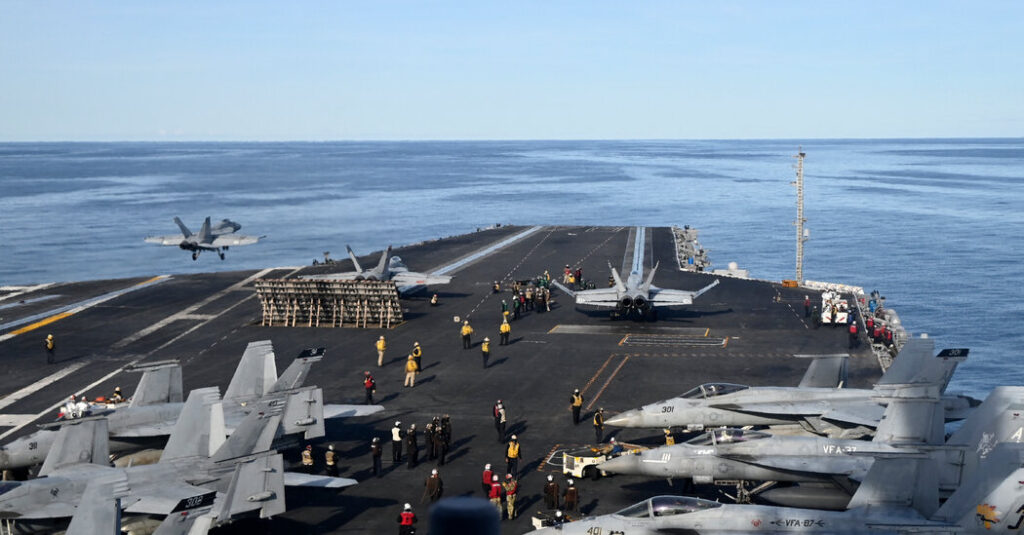
The U.S. military buildup includes dozens of refueling tankers, rushed to the region by United States Central Command, more than 50 additional fighter jets, and two aircraft carrier strike groups, complete with their accompanying destroyers, cruisers and submarines, U.S. officials said.
The aircraft carrier U.S.S. Gerald R. Ford, fresh from the Caribbean where it was part of the naval fleet pressuring the Venezuelan government of President Nicolás Maduro, was approaching Gibraltar on Wednesday as it made its way to join the aircraft carrier U.S.S. Abraham Lincoln in the region.
“The president has always been very clear, though, with respect to Iran or any country around the world, diplomacy is always his first option, and Iran would be very wise to make a deal with President Trump and with this administration,” Karoline Leavitt, the White House press secretary, said on Wednesday.
“He’s always thinking about what’s in the best interest of the United States of America, of our military, of the American people, and that’s how he makes decisions with respect to military action,” she added.
In Israel, the two defense officials said that significant preparations were underway for the possibility of a joint strike with the United States, even though no decision has been made about whether to carry out such an attack. They said the planning envisions delivering a severe blow over a number of days with the goal of forcing Iran into concessions at the negotiating table that it has so far been unwilling to make.
The U.S. buildup suggests an array of possible Iranian targets, including short and medium range missiles, missile storage depots, nuclear sites and other military targets, such as headquarters of Iran’s Islamic Revolutionary Guard Corps.
The ultimate decision on scope of targets is largely up to Mr. Trump, U.S. officials said.
Administration and military officials said the United States has bolstered its defensive assets since the president initially threatened to strike Iran in January.
At the time, Mr. Trump had requested options to respond to the Iranian government’s bloody crackdown on protests. But more recently, he has threatened to attack if Iran failed to reach a deal to limit its nuclear program and said that a “massive Armada” was heading toward the country.
Despite Mr. Trump’s tough stance, the Pentagon last month was in a poor position to back him up. The 30,000 to 40,000 U.S. troops scattered around the Middle East, including at eight permanent bases, were low on air defenses to protect them from expected retaliation.
The additional fighter jets necessary to conduct the kind of operation Mr. Trump spoke of were idling at American bases in Europe, and as far away as the United States. Much of the military hardware in the Middle East accumulated over 20 years of war had since departed the region.
But over the past month, the U.S. military has moved the necessary air defenses — including Patriot missile defense and Terminal High Altitude Area Defense (THAAD) systems — into the region. Both systems can intercept Iranian ballistic missiles.
One military official said the U.S. military could now defend its troops, allies and assets from any Iranian retaliation for American strikes on its nuclear and military targets, at least for a short campaign. But, the official said, the question remained as to whether the American military is ready to sustain a longer and wider war.
The American buildup also includes dozens of additional F-35, F-22 and F-16 fighter jets that have been flowing from the United States to Europe and onward to the Middle East in recent days, according to flight tracking data and U.S. officials.
Dozens of refueling planes, vital for a prolonged air campaign, have also been moved forward, those officials say.
The second aircraft carrier, the Gerald Ford, and its three destroyer escorts could be in the Mediterranean by the weekend or early next week, military officials said. The Ford is likely to be deployed initially near the coast of Israel to defend Tel Aviv and other Israeli cities and towns, officials said.
A military official said on Wednesday that the carriers have their own defense systems, including accompanying destroyers that can shoot down missiles aimed at them. It is difficult to hit an aircraft carrier with a ballistic missile, he said, if the carrier is moving rapidly.
American B-2 bombers, which were used last year when Mr. Trump struck Iran, and other U.S.-based long-range bombers are on a higher alert status, officials said.
Senior national security officials have told the president that any operation that aims to change the Iranian leadership is not guaranteed to be a success, the officials said.
Mr. Trump’s decision to put off his threatened Iran strikes last month — which two administration officials said came about after military officials cautioned him that the Pentagon wasn’t ready — may have allowed Iran to better prepare for an attack.
“Diplomacy may give the U.S. more time to get its military ready, but it also gives Iran more time to plan its retaliation,” said Vali Nasr, an Iran expert at Johns Hopkins University. “Ultimately,” he added, “the president has to weigh the cost of attacking Iran. Ironically his approach has made those costs more likely.”
Tyler Pager contributed reporting.
Helene Cooper is a Pentagon correspondent for The Times. She was previously an editor, diplomatic correspondent and White House correspondent.
The post U.S. Military Moves Into Place for Possible Strikes in Iran appeared first on New York Times.