To the Editor:
Re “A Superman, Jedi and Pope: Trump’s Relentless Bid to Mythologize Himself,” by Peter Baker (news analysis, front page, Feb. 16):
Although many, if not most, presidents “have enjoyed being the center of attention,” as you note, President Trump’s demand for exaltation is undeniably unique in American history. His requirement for compliments, flattery, adoration and awards is so continual and extreme that it is of cartoonish proportions, with all the garishness that characterizes the most exaggerated satire.
Mr. Trump’s comment that “you’ve got to put your name on stuff or no one remembers you” is extraordinarily revealing. It indicates the depth of his fear that no one will even remember him, much less honor him, once he is gone.
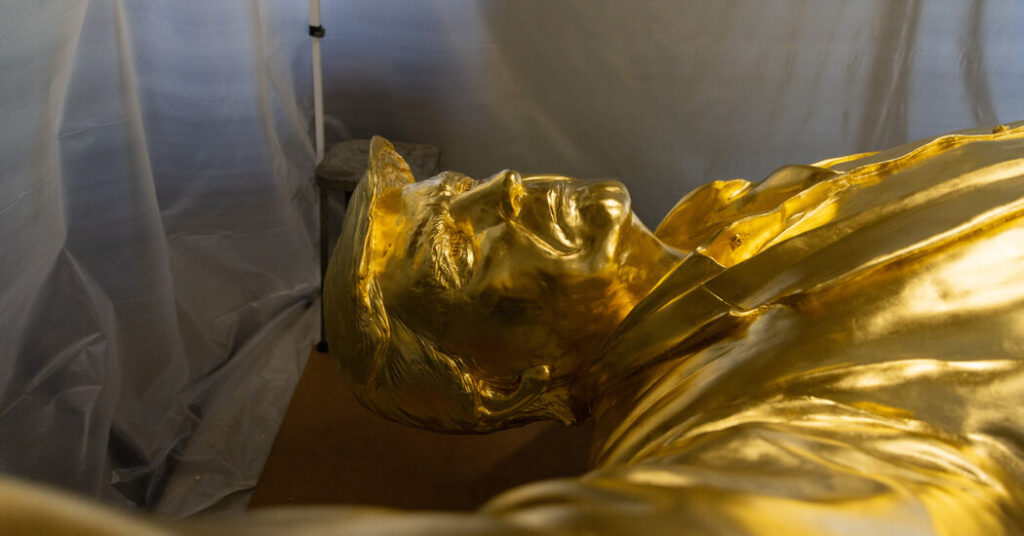
As a result, he demands that others provide a steady supply of praise, trophies and honors. He designs monuments to himself and is even willing to usurp the honors bestowed on others, as in accepting María Corina Machado’s Nobel Peace Prize medal or renaming the Kennedy Center.
Mr. Trump seems unaware that he is in absolutely no danger of being forgotten. The tragedy is that he will be long remembered for nonstop and intentional destructiveness to our democracy, our global alliances and our standing in the world.
Lisa Langhammer West Roxbury, Mass.
To the Editor:
As Donald Trump’s gold-plated cultocracy rises from the smoldering wreckage of what used to be our respected democracy, the question is this:
How did our constitutional system of checks and balances allow it to happen so quickly and easily?
Bob Salzman New York
To the Editor:
Your compelling analysis of President Trump’s self-aggrandizement focuses too much on Mr. Trump’s role in fashioning his “cultlike following” and not enough on who his followers are and why they’re so devoted to him.
We Americans simply must come to grips with the fact that a potentially decisive percentage of Americans has determined that evidence of a candidate’s personal integrity and other qualities generally associated with good character (for example, honesty, generosity, patience, humility) does not matter when electing a leader.
That this is the case is, I believe, the real story. We can’t be trusted — shouldn’t be, in fact. When people here and abroad talk about no longer trusting America, I don’t think they’re talking only about this particular president. Rather, I think they’re talking about American voters generally.
Have we decided that character doesn’t count? I believe that to a very troubling degree, it appears we have.
What is the extent of the rot? Please address that question in a future analysis.
David Hingston San Francisco
To the Editor:
The ancient Chinese philosopher Lao Tzu said, “He who knows that enough is enough will always have enough.” In this country, for our president, there is no such thing as having enough.
Donald Trump isn’t satisfied with being a billionaire. It’s not enough; he wants more. He’s not satisfied with the power bestowed upon him as the president; he wants more. He’s not satisfied with the massive geographical land mass of the United States; he wants more.
A person who constantly craves “more” can never have enough. Mr. Trump may be the most powerful person in the world, but I dare say he’s far from being the most content and happy.
Ken Derow Swarthmore, Pa.
To the Editor:
A proposal: July 4, 2029, is declared a national day of liberation from a 21st-century king. The highlight is the removal of the name Trump from every building and monument that belongs to the American people.
Alexis Gerard Finger Bala Cynwyd, Pa.
What Schools That Took ‘Dirty Money’ From Epstein Owe
To the Editor:
Re “Epstein’s Ties With Academics Show the Seedy Side of Fund-Raising” (news article, Feb. 17):
The release of the most recent Jeffrey Epstein files reveals that Mr. Epstein and his cronies used large donations to elite universities as a form of reputation laundering. It seems only fitting that the involved institutions tally up how much money they and faculty members received from Mr. Epstein’s unsavory network and create a fund for the survivors.
Reparation would constitute only a tiny hit to their enormous endowments, but would be a symbolically meaningful recognition of the survivors’ suffering. Dirty money does not clean the reputation of the donors; it instead sullies the reputation of the recipients.
An act of contrition for their past moral blindness will help universities establish higher future standards for themselves and for their donors.
Donna Manning Carmel, Calif.
The post Trump’s ‘Cartoonish’ Monuments to Himself appeared first on New York Times.