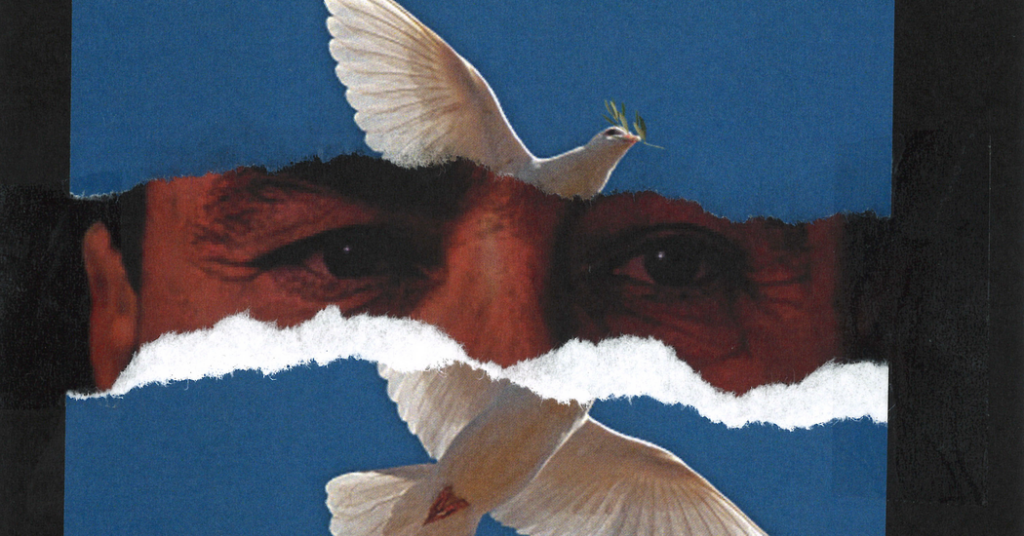
To anyone who spent time in the old U.S.S.R., President Trump’s newly hatched “Board of Peace,” which holds its first meeting on Thursday at the newly rechristened Donald J. Trump Institute of Peace, evokes worrying echoes.
Nobody loved peace as much as the Soviet people, or at least it seemed that way in the cascade of official proclamations. It was professed on billboards and May Day slogans and in “peace cruises” down the Volga at which starry-eyed foreigners were invited to sing “We Shall Overcome” with brightly dressed schoolchildren or met with peace-loving “ordinary” (read: carefully primed) Soviet citizens to discuss American militarism.
“Mir i druzhba” — “peace and friendship” — was often the first toast in any formal meeting between Soviet officials and foreigners, with the subtext that we, the foreigners, were the warmongers. A colleague of mine dubbed these toastmasters the “peace and friendship hard-liners,” and the underground humor mill suggested that many Soviets agreed. “Mir” also means “world” in Russia, which made for a neat anti-slogan: “We want mir! The whole mir!”
The Kremlin did not have a “Board” or an “Institute” dedicated to peace, like Mr. Trump now does, but it did have a “World Peace Council,” a “Soviet Peace Fund” and a “Soviet Peace Committee,” headquartered in Moscow on Prospekt Mira, the Avenue of Peace. The groups were a major weapon in Soviet foreign policy, organizing regular international peace conferences and providing generous secret funding for many international antiwar movements that were, in fact, glorifying the Soviet Union.
Like any concerted effort to fool people, it worked some of the time. I met Russians who seemed to really believe that America was itching for war. On one news-gathering trip deep into Russia, I was asked so often why “you Americans” want war — either naïvely or provocatively — that I finally snapped at one questioner. We can’t help it, I said; we just love war so much.
It’s not clear whether Mr. Trump is aware of how much the Soviets loved peace, too, though he has offered a seat on his Board of Peace to Vladimir Putin, the successor to the Bolshevik bosses, whose invasion of Ukraine has so far led to almost two million people being killed, wounded or missing.
Mr. Trump’s own idea of peace is also a bit muddled. He misses no opportunity to demand a Nobel Peace Prize for the eight wars he claims to have ended: between Israel and Iran; Israel and Hamas; Pakistan and India; Rwanda and the Democratic Republic of Congo; Thailand and Cambodia; Armenia and Azerbaijan; Egypt and Ethiopia; and Serbia and Kosovo. (Russia-Ukraine is pending.)
To be clear, most of the deals were temporary fixes to old disputes, not all of them really wars. At the same time, the Trump administration has attacked boats in the Caribbean and eastern Pacific, invaded Venezuela to capture its leader, bombed Iran and Houthi-controlled areas in Yemen and sent aircraft carriers to threaten Iran’s mullahs.
In any case, Mr. Trump’s Board of Peace does differ from the Soviet peace fronts in some key ways. The board was initially created to oversee the Gaza peace process, which is what leaders of about 20 countries that have joined so far are gathering to discuss on Thursday. Mr. Trump says board members have already pledged $5 billion to support rebuilding and humanitarian efforts in Gaza.
That mission, however, was somehow omitted from its charter, and U.S. allies, many of which have declined to join, fear that Mr. Trump envisions it as a fully Trump-controlled, by-invitation-only and pay-to-play alternative ($1 billion for a permanent seat) to the U.N. Security Council. “The Board of Peace will prove to be the most consequential International Body in History, and it is my honor to serve as its Chairman,” Mr. Trump declared in a social-media post.
The Soviet Peace Fund, by contrast, was designed to resemble a grass-roots movement, purportedly funded by an annual “donation” of one day’s pay from every Soviet citizen. It was meant to burnish Moscow’s role in international organizations, not supplant them.
Its goal, central to Soviet propaganda, was the reversal of reality that Orwell’s readers called “doublespeak”: to depict a totalitarian system as the apogee of democracy. “War is peace” was only one plank of this strategy. Brutal repression, a vast network of political police, a cult of personality and widespread corruption were masked as perfect equality, respect for human rights, and justice. One of my favorite Sovietisms was the official description of any alteration to the system as “further perfectioning.”
The Soviet Union may have pioneered doublespeak, but it has since become something of a fixture among aspiring authoritarian regimes. Going down the list of Soviet totalitarian tactics, as so much of the world slides in that direction, is a depressing exercise.
Maintaining the myth of a perfect system in the face of overwhelming evidence to the contrary is not easy, and authoritarians are forever obliged to assail skeptics and dissenters. Stalin went all in with the Terror and the Gulag, but even when the Kremlin pivoted away from his astounding excesses, it continued, almost to the end, to maintain a vast apparatus of repression to enforce absolute fealty to its ideology and increasingly senile leaders.
No Soviet grand jury, if there were one, would have dared throw out charges against Senator Mark Kelly after the top leader had declared him guilty of “SEDITIOUS BEHAVIOR,” to quote from a Trump post.
The leader of a perfect system is, after all, infallible by definition. For the leader to admit a mistake in the Soviet Union was inconceivable; there were scapegoats for that. Mr. Trump, who has never explicitly admitted a mistake, is different: “I will apologize sometime in the hopefully distant future if I’m ever wrong,” he once said.
A cult of personality, however, can become quite difficult to maintain as the leader-for-life deteriorates. Leonid Brezhnev was nearly incoherent toward the end of his 18 years in power. The more befuddled he became, the more tributes were heaped on him. A whole city was named after him — not just some theater, airport, railroad station, football stadium or institute — and he received every possible award, including a Lenin Literature Prize for his pathetic manufactured memoirs. When a senior comrade warned him that people were making fun of him, Brezhnev replied, “It means they like me.”
Mr. Trump must still contend with a critical independent media — “fake news,” in Trumpspeak — but he has plenty of fawning news outlets prepared to churn out superlatives about him when he’s not doing it himself on social media. He has also taken the lead in perpetuating his name at every turn, explaining, as he did on a visit to George Washington’s estate at Mount Vernon, “You’ve got to put your name on stuff or no one remembers you.”
Of course, any resemblance between Soviet practices and leaders and anything happening in the United States is largely coincidental. I know that. But the price of having worked in the old Soviet Union is to see authoritarianism lurking behind every gilded door, self-serving monument or paean to peace. There is a sordid and banal similarity across time and societies in how men greedy for power build elaborate lies around their true intentions.
In any case, the history of the Soviet Union also teaches that an authoritarian system cannot forever sustain its lies. Stalingrad is Volgograd now, Leningrad is St. Petersburg again, and Brezhnev the city is back to being Naberezhnye Chelny. That would all be more comforting had Russia used its brief moment of freedom to shape a better system of government instead of lapsing back into authoritarianism.
Mr. Putin, a former K.G.B. agent, knows the old playbook. He insists that NATO is somehow to blame for his invasion of Ukraine, and he has dragged out peace talks with Washington while continuing to pound Ukraine. He has also delayed responding to Mr. Trump’s invitation to join the Board of Peace, though he has suggested he is willing to plunk down the $1 billion lifetime membership fee if the United States releases the Russian assets it froze after the invasion of Ukraine. He knows how to play the peace game.
The Times is committed to publishing a diversity of letters to the editor. We’d like to hear what you think about this or any of our articles. Here are some tips. And here’s our email: [email protected].
Follow the New York Times Opinion section on Facebook, Instagram, TikTok, Bluesky, WhatsApp and Threads.
The post Trump Plays the Peace Game appeared first on New York Times.