Earlier this month, President Trump found the latest pressure point to extend his leverage over Canada: a new bridge connecting the country to the United States that is expected to open this year.
Mr. Trump threatened to block the opening, just hours after the billionaire owner of a competing U.S.-Canada bridge met with Howard Lutnick, Mr. Trump’s commerce secretary. It wasn’t that the president was particularly passionate about the new bridge. What excited him, officials familiar with his thinking said, was the opportunity to use the bridge to force Canada to make trade concessions.
“I will not allow this bridge to open until the United States is fully compensated for everything we have given them, and also, importantly, Canada treats the United States with the Fairness and Respect that we deserve,” Mr. Trump said on social media on Feb. 9.
The threat was a preview of the high-pressure tactics the president is expected to deploy when his administration renegotiates a trade deal with Canada and Mexico. The United States-Mexico-Canada Agreement, which Mr. Trump signed into law during his first term, is set to be reviewed by the summer.
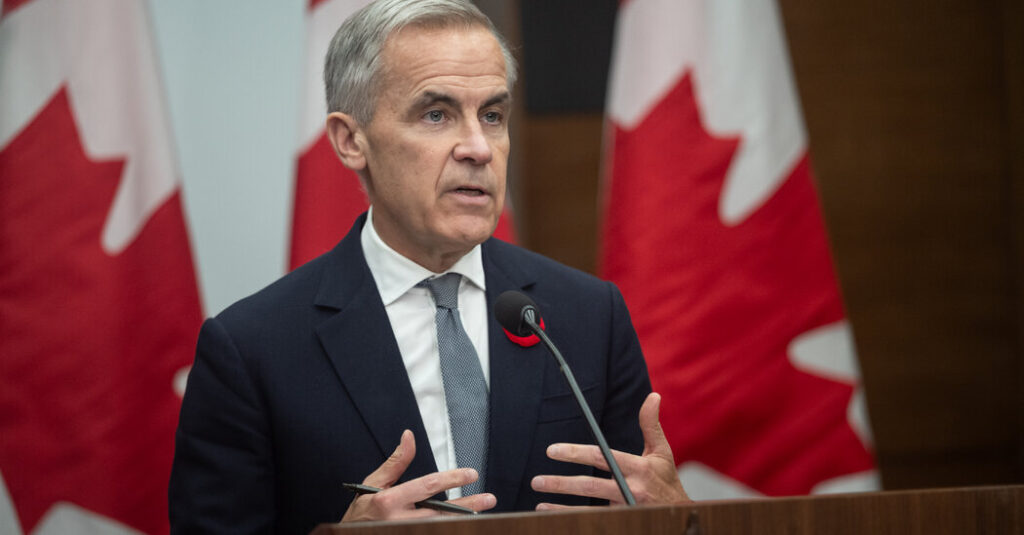
U.S. officials have been raising pressure on Canada to get it to concede to their demands over trade and other issues. Mr. Trump’s threat to block the Detroit-to-Windsor bridge was the latest in a series of flash points that Mr. Trump has capitalized on to needle Prime Minister Mark Carney of Canada. In October, Mr. Trump suspended trade talks over an advertisement featuring a historical address by President Ronald Reagan decrying tariffs, which was paid for by the Province of Ontario and aired in the United States. Mr. Carney apologized.
The Trump administration has a list of things it wants Mr. Carney to concede, including longstanding grievances about protected industries in Canada, including the dairy sector. Another pressing issue for the U.S. administration is the fact that liquor distributors controlled by Ontario and other provincial governments in Canada pulled U.S. liquor off their shelves last year, in retaliation against Mr. Trump’s tariffs on Canada.
Trump administration officials have also been irked by Mr. Carney’s global charm offensive as he seeks to bolster Canada’s trade relationships with other countries, including China. Responding to a modest tariff deal that Mr. Carney struck during a visit to Beijing last month, Mr. Trump threatened to impose 100 percent tariffs on Canadian goods, and claimed that China would “take over” Canada and even ban hockey.
He also responded bitterly to Mr. Carney’s speech in Davos, Switzerland, where he said that the era of a U.S.-led global order was over and that middle powers like Canada should band together to defend their interests.
“Canada lives because of the United States,” Mr. Trump said the day after Mr. Carney’s Davos speech. “Remember that, Mark, the next time you make your statements.”
The spats haven’t resulted in new tariffs, but they form the acrimonious backdrop against which the two countries enter trade talks in earnest this year. The text of the U.S.M.C.A. says the review must be completed by July 2026.
Mr. Trump and his advisers have indicated that the three-country pact could be scrapped altogether. Instead, the United States could end up with bilateral deals with Canada and Mexico, the advisers have suggested. The White House did not respond to a request for comment.
That could be catastrophic for companies that have structured their business around the trade agreement. Trillions of dollars of trade happens under the pact, and leaving it could cause pain for American farmers and automakers and dent U.S. economic growth. Some trade experts and executives believe the idea of abandoning the North American trade deal is probably a pressure tactic from a president who has walked back from some of his biggest economic threats.
But Mr. Trump has been dismissive when asked about the future of the agreement. “There’s no real advantage to it — it’s irrelevant,” he said in January. “Canada wants it. They need it.”
The Trump administration has imposed tariffs on Canada and Mexico despite the U.S.M.C.A. In Canada, those are hitting important pockets of the economy hard: Lumber, autos, steel and aluminum are particularly hurting.
But the current arrangement does leave most of the U.S.-Canada trade tariff-free, as it does with Mexico. The president created major exemptions to his tariffs last year for goods that follow the rules of U.S.M.C.A. That has led to a rush of companies trading under the pact’s terms, and significantly brought down the average U.S. tariff rate.
In an interview with The New York Times in January, Jamieson Greer, the U.S. trade representative, said that the administration wanted to keep things in the agreement that were working, but that there was no “natural reason” that U.S.M.C.A. needed to be one pact. The United States would discuss energy production, corn sales and labor issues with Mexico, while the main issues with Canada included dairy, electricity transmission and digital regulation, he said.
“We’re not wedded to any particular agreement or format of an agreement simply because it’s there,” Mr. Greer said. He said the administration’s priority was to bring manufacturing jobs to the United States, encourage wage growth and shrink the U.S. trade deficit.
“The president’s been quite clear,” Mr. Greer said in a second interview this month. “He’s half inclined to leave. So we’ll see how that goes.”
Mr. Greer helped negotiate and pass U.S.M.C.A. through Congress during Mr. Trump’s first term, as chief of staff to Robert E. Lighthizer, who was then the trade representative. But he is not afraid of changing the agreement, people close to him say.
Mr. Greer last summer began urging a more disruptive approach to U.S.M.C.A. negotiations, saying its current form wasn’t working for the United States, one person who spoke with him said. One outcome of that approach could involve the president’s withdrawing from the agreement and replacing it with two separate deals, the person said.
U.S. officials are unhappy with Canada’s continued protections for its dairy industry, among other issues. To keep talks on track last year, Mr. Carney dropped Canada’s planned digital services tax, which the United States had criticized, but the concession did not seem to advance talks.
The U.S. administration has also criticized Mexico for welcoming investment from Chinese factories, which can then export their products to the United States under the preferential terms of the trade deal.
The Canadian government is bracing for a rupture and weighing the financial and political costs of changing domestic policies that protect socially and economically sensitive industries, in exchange for a trade deal with the United States.
Two Canadian officials involved in the U.S. trade discussions, who spoke anonymously to frankly convey their impressions of the state of the talks, said expectations in Ottawa for a full renewal of the U.S.M.C.A. were very low. Mr. Carney’s team, they said, even questions whether it could trust any fresh trade agreements with Mr. Trump.
The Canadian government, they said, is preparing for long, bumpy and dramatic talks with a hostile U.S. administration, and even for a breakup of the U.S.M.C.A. Mr. Trump repeatedly said last year that he wanted Canada to become part of the United States — calling it the 51st state — and that he was prepared to use “economic force” to get the country to heed his wishes.
Mr. Carney was elected last spring on a pledge to stand up to Mr. Trump. He said at the time that the president wanted to “break us so that America can own us.”
Despite some positive interactions between Mr. Trump and Mr. Carney, Canadian officials said they believed that Mr. Trump wanted to weaken Canada economically to force it to give up some protectionist policies it preserved in previous trade talks.
By contrast, U.S. officials began meeting with the Mexican government about the trade deal in January, and Mexicans say they are optimistic.
The divide-and-conquer tactic is not new for the Trump administration. In Mr. Trump’s first term, when U.S. officials were negotiating the U.S.M.C.A., they also pushed ahead with negotiations with Mexico, while threatening to jettison Canada.
It was Mr. Greer who had kicked off the strategy. He traveled to Mexico in early 2018 to have conversations with the Mexicans without Canada’s awareness, he said in the interview.
The United States went ahead and proposed a bilateral deal with Mexico and told Canada to get on board or be left out. One minute before the deadline to reach an agreement, Canada squeezed one concession out of Mr. Greer’s team and made one concession of its own, and a deal was made.
Ana Swanson covers trade and international economics for The Times and is based in Washington. She has been a journalist for more than a decade.
The post Trump Mulls a North American Trade Pact Without Canada appeared first on New York Times.