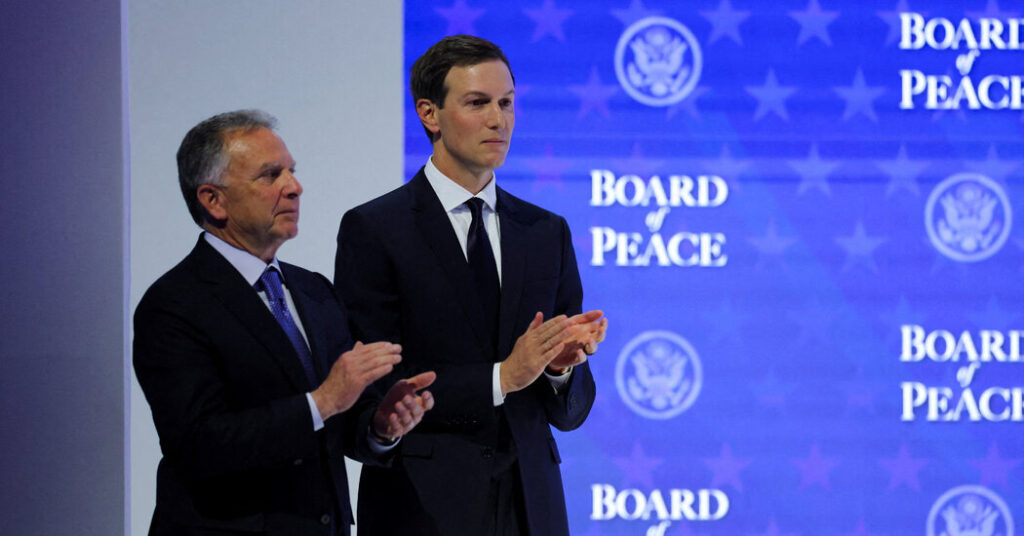
President Trump’s special envoys, Steve Witkoff and Jared Kushner, are racing between Europe and Washington to try to resolve three of the world’s most intractable conflicts.
This week alone, Mr. Witkoff, a businessman and close friend of Mr. Trump, and Mr. Kushner, Mr. Trump’s son-in-law, were in Geneva to conduct talks on the Iranian nuclear program, even as an American armada builds up near Tehran. They then turned to two days of talks on Russia’s war against Ukraine.
Then they fly to Washington for the first meeting on Thursday of Mr. Trump’s “Board of Peace,” set up to try to resolve the war in Gaza and the larger issue of an Israeli-Palestinian settlement.
Marco Rubio, who is both secretary of state and national security adviser — the first person since Henry Kissinger to hold both roles — seems reduced to a bystander.
The energy of the envoys, neither of whom is a diplomat, is remarkable, given the long histories and complications of all three conflicts. But real progress has been scant.
Here is a sense of where the three negotiations stand:
Iran: Talks Go On Amid Signals of War
Another round of talks between Iran and the American envoys, mediated by the Omanis, took place on Tuesday. At the end, Iran’s foreign minister, Abbas Araghchi, sounded positive but vague, saying there had been agreement on a “set of guiding principles” and an exchange of draft texts at some point after consultation with both capitals.
One U.S. official, speaking on the condition of anonymity to discuss private negotiations, said the two sides had made progress. The official said the Iranians would provide more detailed proposals in the next two weeks to address some of the unspecified gaps.
But on what exactly remains unclear, especially with the United States building up its forces at a scale that seems to go beyond mere message-sending. With a second aircraft carrier on its way, the Americans seem to be preparing by the end of the month for a large-scale attack on Iran while working to forestall the larger regional conflict that Iran promises if it is attacked. But Mr. Trump has the option of striking as soon as this weekend.
Iran, too, is preparing for war.
The messaging from Washington has been inconsistent. Mr. Trump talks about a nuclear deal, which seems at least possible, and another day about regime change. That seems harder.
Diplomats suggest that a nuclear deal could involve Iran agreeing to suspend any enrichment of uranium for up to 10 years, while handing over its current supply of highly enriched uranium close to bomb grade. A nuclear deal could also involve Iran limiting any future enrichment to 3.67 percent, which can only be used for civilian purposes, with strong oversight and inspections from the International Atomic Energy Agency.
While Iran denies ever wanting to build a nuclear bomb, it insists on the right to enrich under the Nuclear Nonproliferation Treaty.
But administration officials say a deal must go beyond Iran’s nuclear program to limit its ballistic missile program and its support for its armed proxies in the region. And so far Iran has rejected any limits on its missile program in the name of self-defense, or on its help for its allies. It considers those demands to be asking for capitulation from a government already badly weakened by major protests at home, which were put down with extreme violence.
Complicating the talks further is the deep mistrust of the United States and Mr. Trump by Ayatollah Ali Khamenei, the supreme leader of Iran. Not only did Mr. Trump rip up the 2015 nuclear deal in his first term, but he joined Israel in bombing Iran in June, even as U.S.-Iran negotiations were continuing.
Tehran fears the same duplicity now and says it will strike back hard if attacked. That would most likely include large-scale missile and drone strikes against American ships and bases in the region and against Israel, and an attempt to close the Strait of Hormuz to all shipping. Iran has submarines with torpedoes and high-speed patrol boats armed with antiship cruise missiles.
It could also attack U.S. allies and their energy infrastructure, like Saudi Arabia and Gulf countries, that would altogether drive up oil prices. Those countries have been urging Mr. Trump to negotiate and avoid a regional war with uncertain consequences.
Talks are proceeding, but the signals of war are growing louder.
Ukraine: Little Agreement Between the Sides
Later Tuesday and again on Wednesday, Mr. Witkoff and Mr. Kushner held talks with delegations from Ukraine and Russia, trying to seek an end to the war that began four years ago with Russia’s full-scale invasion of Ukraine.
Mr. Trump wants to end the killing and have a diplomatic victory before the American midterm elections in November, but a final peace deal still seems far away. The two main obstacles remain the issue of territory and of future security assurances for Ukraine after a settlement.
Washington has been pushing Ukraine to hand over the rest of the Donbas region to Russia, even the large part that has not been occupied by Moscow. President Volodymyr Zelensky, supported by European leaders, has so far refused.
Behind the scenes, Ukrainian, Russian and American negotiators have floated the idea of a demilitarized zone in that area of the Donbas, people close to the talks say, but there is little sign of a compromise that both Mr. Zelensky and President Vladimir V. Putin of Russia would accept.
Ukraine has pressed for an international peacekeeping force to be deployed to the region, which Russia is likely to reject; the Kremlin has suggested it could accept a demilitarized zone if it were patrolled by Russian police or its national guard, probably a nonstarter for Ukraine.
Any such deal would also require a sophisticated monitoring program against incursions by Russian forces in mufti or police uniforms, with security assurances from European nations and backstopped by the United States.
The details remain vague, and so far Russia, at least in public, has rejected the idea of any foreign troops in any part of Ukraine.
After the second round of talks on Wednesday, which broke off after only two hours, Mr. Zelensky said some progress had been made on the monitoring of a future cease-fire, including potential U.S. involvement. But “the negotiations were not easy,” he said, and there was no breakthrough on the most contentious issues, including the Donbas and control of the Zaporizhzhia nuclear power plant, the largest in Europe.
Russia has been losing up to 30,000 soldiers a month, according to Mark Rutte, the NATO secretary general, and its economy is faltering with high inflation. Russian territorial gains are slow and bloody, while Russia continues to hit Ukraine’s energy infrastructure with missiles and drones. But there is no indication that either Russia or Ukraine is ready to end the war.
What remains unclear, as ever, is Mr. Trump’s mood. He has swung from blaming Mr. Zelensky for the war to frustration with Mr. Putin and then back again. Mr. Zelensky complains that it is “unfair” for Mr. Trump to demand concessions from the victim and not the aggressor. European countries have vowed to continue support for Ukraine — Washington provided Kyiv no money at all last year — but do not have their own strategy to end the war. Unless, that is, Mr. Trump puts considerably more diplomatic and economic pressure on Mr. Putin, which has so far not been forthcoming.
There is always the possibility that Mr. Trump will just walk away from the problem. “Sometimes you’re better off letting them fight,” he said in June.
Gaza and the Board of Peace: Elusive Goals
On Thursday, Mr. Witkoff and Mr. Kushner are expected back in Washington for the inaugural meeting of Mr. Trump’s Board of Peace, set up to manage a plan to end the Israeli-Hamas war in Gaza. That war has resulted in the deaths of at least 70,000 Palestinians, civilians and combatants.
The board’s mandate is fuzzy, and it appears to have taken on global responsibilities beyond Gaza as well. With Mr. Trump as its chairman, its ambitions to be a more efficient alternative to the United Nations have drawn criticism. Most European countries have declined to join. But a Security Council resolution tasks it to oversee the Gaza peace plan.
On Gaza, the Americans are struggling to move ahead with the second phase of the peace agreement they forged. So far there has been a cease-fire, with the return of all hostages taken from Israel and the release of hundreds of Palestinian prisoners, but also a lot of apparent violations.
The peace plan also calls for the demilitarization of the Gaza Strip, the deployment of an International Stabilization Force, transitional governance by Palestinian technocrats under international supervision, large-scale reconstruction and a pathway toward Palestinian statehood.
So far, at least, Hamas, which controls at least half of Gaza, has refused to disarm, as also called for under the agreement. There are efforts to work out a compromise. But the Palestinians supposed to run Gaza have remained in Cairo for security reasons.
And detailed discussions of rebuilding Gaza seem far away, despite some fancy architectural proposals. Nor is the ultimate goal, a settlement to the long Israeli-Palestinian conflict and a two-state solution, anywhere visible on the rubble-strewn horizon.
Steven Erlanger is the chief diplomatic correspondent in Europe and is based in Berlin. He has reported from over 120 countries, including Thailand, France, Israel, Germany and the former Soviet Union.
The post The Three Conflicts Witkoff and Kushner Are Trying to Solve This Week appeared first on New York Times.