The best lesson I learned during my formative years in journalism came from the editor at my first daily newspaper job, Doug Turner of the late Buffalo Courier-Express.
I had told him that the councilmen at the suburban town I was covering were trying to bully me out of writing a critical story. Turner, who had spent a career covering local- and state-level politicians, replied, “Bully them back. They’ll fold. These guys have no character.”
That moment came back to me a couple of weeks ago, thanks to an online post by Josh Marshall, founder and proprietor of the estimable blog talkingpointsmemo.com. Writing a few days after massive layoffs at the Washington Post, Marshall observed of the paper’s publisher, Will Lewis, and its owner, Jeff Bezos, that their failure “to even show up, literally or figuratively, on a day of devastating cuts epitomizes the profound lack of character and accountability that is so commonplace today within the American elite.”
There was that word again: “Character.”
Marshall put his finger on the flaw that exists among our business and government leaders. It’s the absence of character.
The quality can be hard to define precisely, but we know it when we see it, to paraphrase Supreme Court Justice Potter Stewart’s personal, subjective test for obscenity in a famous 1964 case. We can also know it by its absence.
Philosophers, ministers, judges, novelists and historians have all taken a crack at defining “character.” Often they search for it in some variety of moral truth (another quality that can be hard to define).
It can encompass steadfastness in the face of adversity, selflessness, self-sacrifice, honesty and integrity in one’s dealings with others. It doesn’t demand to be displayed in public. On the contrary, sometimes it unfolds out of the public eye; self-abnegation can be a reliable marker of character.
Literary masters have grappled with defining character. Tolstoy’s great novels, “War and Peace” and “Anna Karenina,” are all about the journeys of his major figures from self-doubt and selfishness to a higher moral plane, not always successfully — he himself was so doubtful about whether he had accurately traced their trajectories that toward the end of his life he disavowed those great works as inadequate.
Faulkner found it in the patient, steadfast Dilsey of “The Sound and the Fury,” and in his greatest novel, “Absalom, Absalom!” he showed how its absence led inexorably to the ruin of Thomas Sutpen.
Character emerges in adversity. A most recent example comes from Ilia Malinin, the American figure skater whose hopes for an individual gold medal in the Olympics, which had been regarded as a preordained inevitability evaporated in a mistake-laden routine. Coming off the ice, Malinin forthrightly congratulated the winner, Mikhail Shaidorov of Kazakhstan, as if to communicate that Shaidorov won the prize from his own efforts, not from Malinin’s failure. The encounter signaled that Malinin will remain a major figure in the sport for years to come.
For us today, the term “character” allows us to avoid unprofitable debate over how to define the current administration. Is it “racist”? “Corrupt”? “Mendacious?” Applying those judgments invites partisan quibbling, because accusations of racism, corruption and lying can be colored by the eye of the beholder. But to say the administration can be defined as a lack of character—the term subsumes all those other judgments, and is much harder to question.
As Josh Marshall observed, abundant examples of the singular lack of character in our national leaders is vividly on display. Let’s take a look.
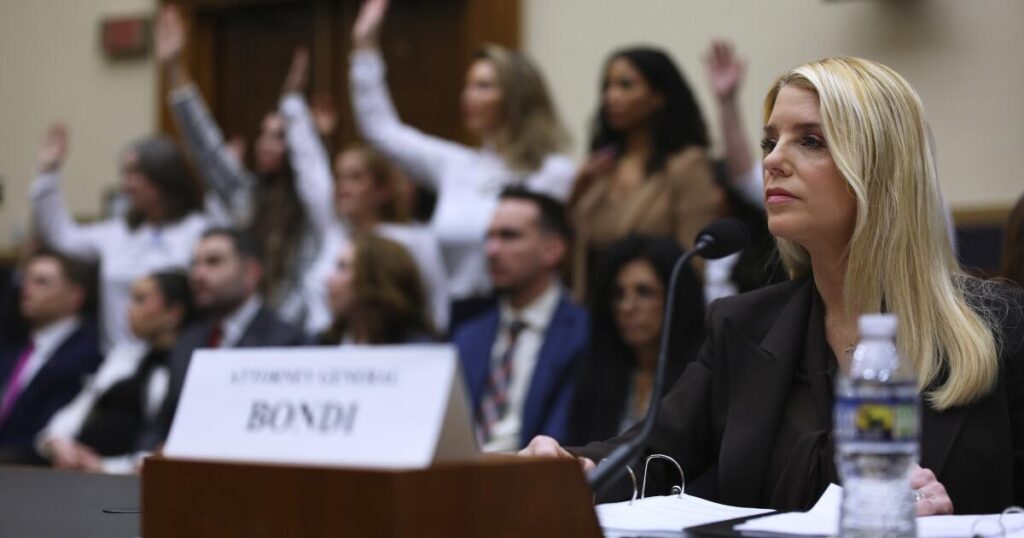
What’s a better way to describe Atty. Gen. Pam Bondi’s appearance before a House committee last week, during which she tried to evade questions about her failure to release documents related to Jeffrey Epstein’s dealings by finger-pointing at her questioners, keeping her back turned to the Epstein victims in the room behind her and citing the Dow Jones industrial average’s spike above 50,000 as a counterargument to her own inadequacies, as a singular lack of character?
When the preening Defense Secretary Pete Hegseth launched a campaign to demote the retired Air Force captain and current Arizona Sen. Mark Kelly, a combat veteran and former astronaut, because of Kelly’s reminder to active servicemen that they need not follow illegal orders (a statement Hegseth himself has made) he was displaying singular lack of character — and underscoring Kelly’s own abundance of character.
The people of Minneapolis have displayed remarkable communal character in their relentless and peaceful battle against the government’s incursion into their private life. Who has displayed a lack of character? Homeland Security Secretary Kristi Noem, her henchman Greg Bovino, and other defenders of this openly counterfeit campaign against illegal immigrants in their city.
Congress is a hive of low-character performance, full of individuals who have supplanted their responsibilities to the Constitution and the public interest with flagrant careerism.
Among those at the top of the list is Sen. Bill Cassidy (R-La.), a physician who cast the deciding vote to confirm Robert F. Kennedy Jr. as secretary of Health and Human Services, despite Kennedy’s history of anti-vaccination activity. Cassidy has never adequately responded to my question about his support for Kennedy.
Facing a tough primary challenge, Cassidy showed recently that his lack of character extends beyond matters of healthcare regulation when he praised President Trump for taking down an overtly racist social media post attacking the Obamas, writing on X, bizarrely, that Trump has “made significant inroads with his outreach in the African American community…. His post sent the wrong message despite how it may have been originally intended.”
In business, who has shown a lack of character? There’s Apple CEO Tim Cook, who gifted Trump with a crystal plaque on a gold base as part of his effort to secure an exemption for Apple from Trump’s tariffs.
Count the corporate executives who have shown their lack of character by bowing to right-wing pressure to abandon their commitments to diversity, equality and inclusion — you know, “DEI.” A notable exception: Costco, which has maintained its diversity programs in the face of partisan backlash, and improved its bottom line as a result. That’s a reminder that one can do well while doing good, a lesson in the virtues of character.
“Our efforts at diversity, equity and inclusion remind and reinforce with everyone at our Company the importance of creating opportunities for all,” Costco said in its 2024 proxy statement, pushing back against a proposed shareholder resolution insinuating that Costco’s DEI program “holds litigation, reputational and financial risks to the Company, and therefore financial risks to shareholders.” (The resolution failed at Costco’s annual meeting last year.)
Then there are the directors and executives of pharmaceutical companies who price their products for maximal profits without caring much about the impact of unaffordability on the patients whose lives depend on those products. Back in the 2010s, for instance, executives at Gilead Sciences pondered how much to charge for Sovaldi, its miracle cure for hepatitis C.
As I reported at the time, they concluded Gilead could make a profit by charging $55,000 per 12-week treatment. But they decided to charge $84,000, which would deliver higher profits from fewer patients.
They refused to offer anything but minimal discounts to big insurers and Medicaid programs, even though they acknowledged that thousands of patients might have to go without the treatments. “Let’s not fold to advocacy pressure … whatever the headlines,” one top executive counseled his colleagues.
As a historical counterweight, consider Jonas Salk, the inventor of the polio vaccine, who refused to patent it. Asked by Edward R. Murrow in 1955 who owned the rights to the polio vaccine, he replied, “The people, I would say. … There is no patent. Could you patent the sun?”
Recent history provides us with numerous cases of individuals who have shown their character at the cost of their physical and financial well-being. Among the heroes of the civil rights movement in the 1960s were many who lost their lives in the effort, such as Martin Luther King Jr. and Medgar Evers, or suffered severe physical injury, such as the late John Lewis.
I always admired former California Gov. Jerry Brown for his devotion to public service, a true avatar of character. In 2010, when he was running for his third gubernatorial term, his Republican challenger, the business magnate Meg Whitman, placed the firing of thousands of public employees to cut wasteful spending at the forefront of her platform.
Brown could have joined the chorus of critics of government “waste, fraud and abuse” — a perennially popular take for politicians — but he chose the opposite path. These people had devoted their lives to public service, Brown pointed out during a debate with Whitman. They had committed to teaching our children, cleaning up our air and water, holding dishonest businesses to account. That was an expression of character.
Brown, indeed, displayed character throughout his long political career: Fifteen years after serving two terms as governor, in 1998, he ran for mayor of Oakland, surely one of the most challenging and thankless jobs in California politics — and won. He never, ever apologized for being a “politician,” but saw politics as a noble calling.
The search for character among our politicians and business leaders could easily turn into a parlor game — draw a line down a piece of paper, with “Has Character” on one side and “No character” on the other, and compile two antipodean lists. But there’s more at stake than entertaining ourselves.
It was not always so. The 56 signers of the Declaration of Independence knew their expression of character placed them at mortal risk. That’s why the document ends with their mutual pledge of “our Lives, our Fortunes and our sacred Honor.” If we are to preserve our republic and our economy, restoring men and women of character to our leadership is an indispensable goal.
The post The missing quality that defines the flaws in our business and government leadership — character appeared first on Los Angeles Times.