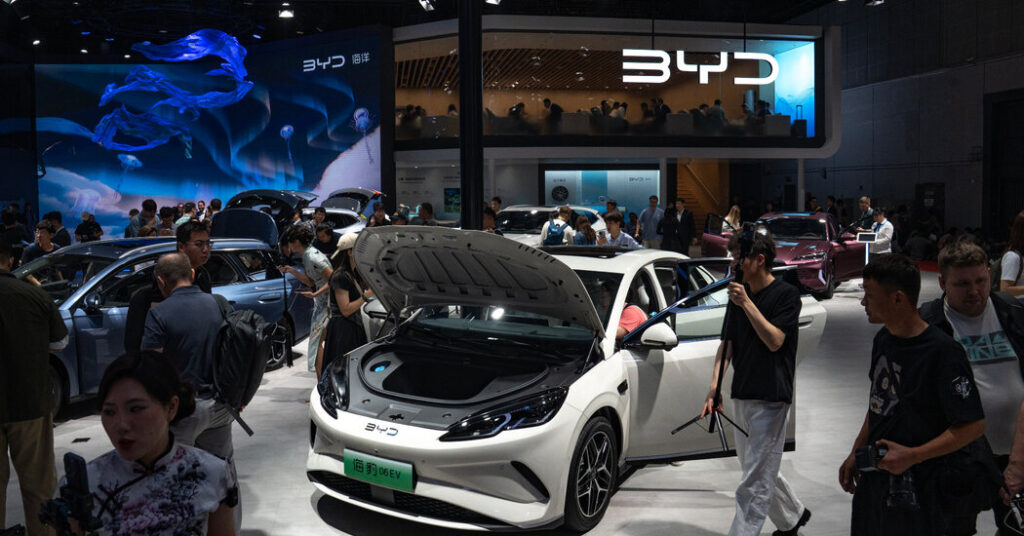
By almost every metric, the Chinese carmaker BYD looks unstoppable.
After a decade of struggling to establish itself in the automobile industry, BYD has surpassed Tesla to become the world’s largest electric vehicle manufacturer. The company’s sales are rapidly expanding in Europe and Latin America, and new and potentially lucrative markets like Canada could soon open to it.
But investors are cooling on BYD’s ascent from a little-known battery maker to the top of the automotive world’s fast-growing segment. The company’s stock has fallen roughly 40 percent from its peak last May, making it among the hardest-hit names in a broader sell-off in Chinese E.V. stocks that accelerated last week after companies reported weak sales numbers for January.
Intense competition is crushing profit margins, government subsidies are vanishing, and faster production cycles mean that no company can hold a lead for long.
BYD is emblematic of how Chinese electric vehicle companies are becoming victims of their own success. The domestic market, fueled partly by government subsidies, has grown rapidly, but Chinese companies are “maxing out the number of people for whom it makes sense” to buy one, said John Paul MacDuffie, a professor at the Wharton School of the University of Pennsylvania.
Sales are concentrated in major cities where charging infrastructure is more developed, while owning an electric vehicle simply isn’t practical in much of the rest of the country. Now, BYD and other carmakers must convert one-time buyers into repeat customers, building the kind of long-term brand relationships that more established automakers have relied on.
“BYD has grown so fast that they’re running out of new domestic customers,” Mr. MacDuffie said.
The challenges of China’s E.V. market started to surface last month. After growing 28 percent last year, BYD’s electric vehicle deliveries in January fell about 33 percent from a year earlier. Overall sales of new electric vehicles fell nearly 20 percent, according to the China Association of Automobile Manufacturers.
BYD did not respond to a request for comment. The company attributed the decline to weak domestic demand, according to a statement posted on WeChat.
The slowing growth coincides with a reduction in Chinese government subsidies. For years, Beijing waived its 10 percent tax on new car purchases. But this year, it reimposed the tax at half the original rate. The full tax is expected to return after 2027.
Another factor is the constant influx of new competition. In 2025, nearly 400 electric vehicle models were for sale in China, more than double the number in 2019, according to JATO, an automotive market research firm. More than 100 of those were released in the past two years.
Scott Kennedy, a senior adviser at the Center for Strategic and International Studies, a think tank in Washington, said the industry was entering a wartime period. The number of car companies will have to shrink from hundreds to just a handful for the industry to be sustainable in the long run, he said.
Fierce competition among carmakers has pushed prices into a downward spiral known in China as “involution,” in which companies keep cutting costs and adding features just to survive, even when it hurts everyone’s bottom line. Carmakers built huge factories and rolled out one new model after another, betting that volume would eventually make up for shrinking profits.
The country is building a new kind of automotive industry, said Tu Le, a transportation and technology analyst — one that looks less like Detroit and more like Silicon Valley.
Automotive cycles now resemble those of consumer electronics, with new models and feature changes released every year. While Ford Motor’s F-series truck has been the best-selling vehicle in America for the past 40 years, the top spot in China over the past few years has been held by either BYD, Geely or Tesla. When preferences change that fast, factories built for boom times don’t scale back as quickly, leaving excess capacity.
Mike Smitka, an automotive industry expert and emeritus professor at Washington and Lee University, estimated that 40 percent of China’s automotive production capacity was unused.
Those idle factories have further contributed to a glut of new models. Companies can commission existing factories to build their cars instead of establishing their own plants. Huawei, the Chinese telecommunications giant, sells numerous electric vehicles, but it does not produce the cars itself.
But even under strain, Chinese carmakers pose a threat to American automakers, which are doubling down on gas-powered trucks and sport utility vehicles rather than continuing to spend on electric vehicles. Ford and Stellantis each recorded multibillion-dollar losses after scaling back their electric vehicle plans this year. And even Tesla ceded its early advantage in electric vehicles to BYD last year.
So far, 100 percent tariffs have kept Chinese electric vehicles out of the United States.
But Mr. Le said it was only a matter of time. The rest of the world has already started the shift to electric, but “the U.S. just hasn’t gotten that memo yet.”
Joy Dong contributed research.
The post Stock Slide and Slow Sales: What’s Happening in China’s E.V. Market? appeared first on New York Times.