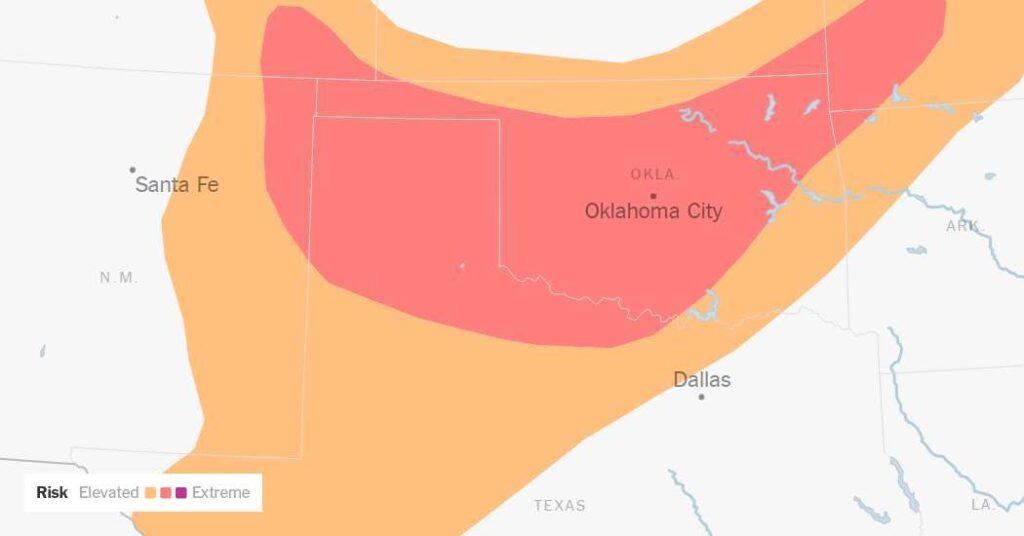
Another day of powerful winds and especially dry conditions had emergency officials in Oklahoma and across the Southern Plains bracing for new wildfires and the growth of fires that were already burning.
Both Oklahoma City and Tulsa, Okla., were under a critical risk of fire, according to forecasters. A red flag warning, the highest alert issued by the National Weather Service for conditions that can lead to extreme fire behavior, was in effect for much of Oklahoma on Thursday, according to the state’s Department of Agriculture, Food and Forestry.
By early afternoon, several new fires had broken out in Oklahoma and the Texas Panhandle. Flames chewed through desiccated, dormant vegetation as a dry weather system brought a shift in the winds that complicated firefighting efforts.
“With this low-pressure system coming through, we have strong westerly winds, and the air is very dry with relative humidities close to 15 percent,” said Derek Williams, the lead fire weather meteorologist at the Storm Prediction Center.
Oklahoma’s agriculture department cautioned that the wildfires already burning in the region had “potential to exhibit very rapid rates of spread and problematic fire behavior.”
Bryce Boyer, the department’s director of communications, said on Thursday that while the wildfires prompted evacuations in several places across the state this week, most residents had been able to return home.
“We’re dealing with the fires as they arise, as they spark throughout the state, and really what we just want the public to be aware of is everybody can play a part in this,” he said, stressing that officials were “asking the public to do their part to not do anything that might spark a fire.”
“We don’t need to spark any fires haphazardly,” he said.
Thursday’s warnings arrived days after powerful winds prompted dire warnings from forecasters and local officials that wildfires could break out and spread rapidly.
Gov. Kevin Stitt of Oklahoma declared a state of emergency in three counties on Wednesday because of the “destructive wildfires across northwest Oklahoma.” In his declaration, Governor Stitt said at least four firefighters were injured “after working tirelessly through the night.”
In nearby Texas, where wildfires burned more than 20,000 acres, officials prepared for the possibility of new fires and cautioned that the conditions could make ongoing fires harder to control.
The fires are being fueled by a combustible combination of unusually warm temperatures, low humidity, dry vegetation and strong wind gusts. These conditions have heightened the fire risk across the Southern Plains since Tuesday, when winds reached over 60 miles per hour and multiple fires broke out.
Winds were not expected to be as strong on Thursday, but Rick Smith, a meteorologist with the Weather Service office in Norman, Okla., said the dry air had become more widespread across central Oklahoma. Mr. Smith said that the air was so dry that humidity levels were not significantly increasing overnight as they usually do.
“A fire that starts in the afternoon can continue going all night and into the next day,” he said.
Many areas of Oklahoma and the Texas Panhandle have experienced temperatures that are 20 degrees above normal since Tuesday. Yesterday, Oklahoma City hit a high of 72 degrees.
Fire season usually peaks in the Southern Plains in February and March, when the vegetation is dormant, and ends by mid-spring, when thunderstorms deliver rain and wet the landscape.
“It’s something we see year after year,” Mr. Smith said. “It’s not a rare occurrence.”
The good news is that conditions in Oklahoma and the Texas Panhandle are expected to improve overnight as the weather system coming into the area brings cooler temperatures and moister air.
On Friday, the critical fire risk is expected to shift into western Texas and eastern New Mexico. By the weekend, forecasters said conditions were expected to improve, with calmer winds and cooler temperatures.
“We’ll finally get a break,” Mr. Williams said.
The fire weather is expected to return next week, though, he said.
Aimee Ortiz covers breaking news and other topics.
The post Powerful Winds and Wildfires Have the Southern Plains on Edge appeared first on New York Times.