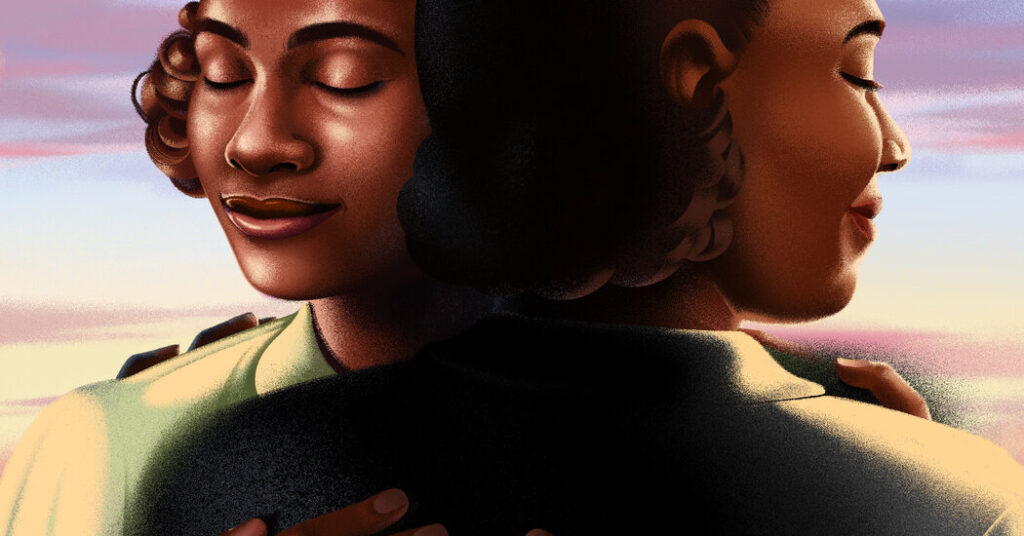
KIN, by Tayari Jones
In Tayari Jones’s 2018 novel, “An American Marriage,” one of her characters gives a treatise on the ties that bind: “I don’t believe that blood makes a family,” he says. “Kin is the circle you create, hands held tight.” This sentiment weaves through many of Jones’s stories, where relationships are hard-fought by choice, not just handed down by law or biology. In her new novel, she signals the operative theme right in the title.
“Kin” centers on two girls, Annie and Vernice (or Niecy, as Annie christens her), both robbed of their mothers while still infants. They call themselves “cradle friends,” and they might as well be sisters, so deep is their connection. They grow up together in the tiny town of Honeysuckle, La., but they are fated for different paths: Niecy, raised by her genteel, unmarried aunt Irene after her mother’s death, envisions college and a bourgeois life, while Annie’s only ambition is to find and reconcile with the mother who abandoned her, and who is apparently still alive and living in Memphis.
Men have their place in “Kin,” but women set the tone: colorful, pragmatic and above all honest. Irene has a winning penchant for telling young Niecy uncomfortable truths, like that she’s better off than Annie because Annie holds out hope of her mother’s return: “Over time, the daily discouragement will wear her down, like the heel on a loafer,” she says to Niecy. “You are the fortunate one. You know you won’t see your mama’s face ’til Gabriel blows his horn.” Annie’s grandmother spares Annie no illusions about a family reunion, describing Annie’s absent mother (and her own youngest child) as “salting the fields on her way out.”
As narrators, Niecy and Annie channel this convivial clarity, immediately drawing the reader in. And despite some heartbreaking material — the motherlessness is just the beginning — Jones maintains a light touch and a gift for effortless portraiture. Annie describes an early romantic interest, for example, as having a smile “like he opened up his mouth and God tossed in a handful of teeth, not caring what went where.” When said young man behaves in less than ideal fashion, the image of that hapless grin kicks in, as if to say, well, maybe chaos was just part of the package.
The girls come of age in the late 1950s. The civil rights movement is underway: Rosa Parks and Martin Luther King Jr. are invoked. The future holds promise, but the past lies heavy on the landscape. Niecy — who gets into Spelman — endures a racist incident on the bus to Atlanta. When Annie is heading to Memphis — an ill-fated road trip involving no money, a broken-down car and too much time at a brothel — she and her companions lodge with a woman whose mother was born a decade after the Civil War. It’s a simple reminder that not enough time has gone by, not enough generations, between the way things are and the way they used to be.
At their destinations, new challenges await. In Georgia, Niecy weighs a taboo love against a conventional marriage; in Tennessee, Annie stagnates, obsessing over her missing mother to the detriment of her own well-being and happiness. The in-betweenness of the girls’ lives matches that of their historical moment. When a Spelman classmate tries to recruit Niecy for “the struggle,” she phrases it as a call for posterity: “Vernice, don’t you want to be part of history?” Of course Niecy does, but she’s busy navigating the confines of the present, namely the college’s strict curfew. “I would have liked to one day say that I stood with him,” she allows of Dr. King, projecting herself out of the dilemmas of here and now.
Niecy and Annie spend most of the novel in vastly disparate environments, divided by geography and increasingly by class and culture, but Jones keeps them close on the page, each narrating a chapter in turn. Split structures are meaningful territory for Jones. Her debut, “Leaving Atlanta,” set in 1979 when a serial killer stalked the city’s Black children, divides into three parts, each with its own protagonist, all from the same fifth-grade class. “An American Marriage” moves among the voices of Celestial, a promising artist; her husband, Roy, incarcerated for a crime he didn’t commit; and their friend Andre, the third leg of a love triangle. As she would later write, Jones had drafted it first from Celestial’s perspective, then Roy’s, but found that the story “is neither his nor hers. It is theirs.”
So it is with Annie and Niecy, whose contrasting individual stories deepen in association with each other. And such is the bittersweet power of fiction, that it can braid two friends’ lives together, bridging their separation. When the two women reunite, the novel makes good on the promise of its title, testing the bonds and boundaries of the kin we choose.
Like “American Marriage,” “Kin” contains a few sections of correspondence, as Annie and Niecy update each other (and various other characters) on the changes in their lives. Their epistolary voices are particularly engaging and direct, perhaps because each letter is meant for one pair of eyes only. When Annie writes to Niecy to ask forgiveness for a transgression, she ends with a state-of-the-nation on her friendship status. “There is another girl with me,” she writes, “but she has seen it all and done the rest. I like her a lot, but she is not someone that I want all in my business.” Her line made me laugh; I recognized the type, and the feeling. It wasn’t until I went back to the novel’s beginning that I noticed the echo of the epigraph from Gwendolyn Brooks, a testament to love and its responsibilities: “we are each other’s/business:/we are each other’s/magnitude and bond.”
“Kin” is Jones’s fifth novel in 24 years. Her repertoire of characters feels inexhaustible, in the best way — as if she could go on for decades populating her fictional universe with women and men at once wholly unique and also bound by their author’s sensibility and purpose. When reading “Kin,” I wanted nothing more than to keep reading it. That’s the circle Jones creates, the one that connects her voice, her characters and her readers.
KIN | By Tayari Jones | Knopf | 347 pp. | $32
The post ‘Kin’ Is a Lush, Beautiful Novel About the Family We Make appeared first on New York Times.